“What makes Oishi Kogen so special?” “When is the best time to see the pampas grass?” “Is the mountain road really that narrow—can I go with kids or a pet?” If you searched with questions like these, this guide is for you.
Here is the short answer. Oishi Kogen (Oishi Highland) is a plateau rising to an elevation of 870 meters, straddling the towns of Kimino and Aridagawa in Wakayama Prefecture. It is famous for a roughly 13-hectare sea of susuki (Japanese pampas grass) spreading across its summit, and a 360-degree panorama that on clear days reaches all the way to Awaji Island and Shikoku. It is designated as a Wakayama Prefectural Natural Park.
There is more. Scattered across the highland are traces of an old reverence for mountains and great stones: Kasaishi, a boulder where the monk Kobo Daishi is said to have performed fire rituals; Hiage-iwa (“fire-raising rock”), where great fires were once lit to pray for rain; and Oishi Shrine, which enshrines a pair of “married rocks” as its sacred body. Oishi Kogen is not a place that advertises specific “blessings,” but rather a highland where a sea of silver grass, sacred megaliths, and a summit shrine come together—a place where you can feel the quiet presence of nature worship.
In this guide you will find the best season and time of day for the grass, a safer driving route for nervous drivers, the real pitfalls (congestion, winter ice), tips by visitor type (photographers, families, pets), and how to combine your trip with nearby Aragijima rice terraces and Shimizu Onsen—everything you need to decide exactly how you should enjoy Oishi Kogen.
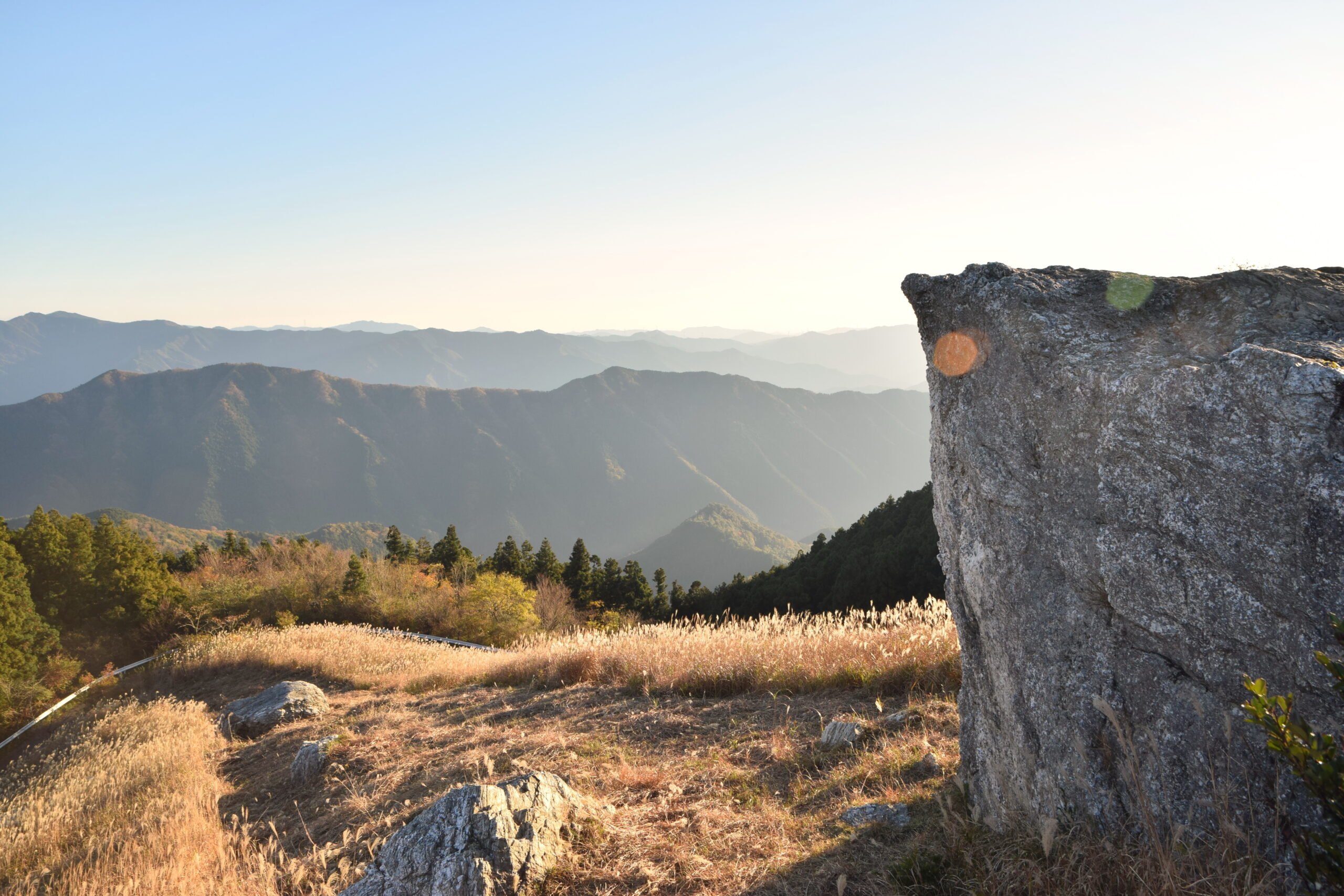
What Makes This Place Special
A 13-Hectare Sea of Silver Grass
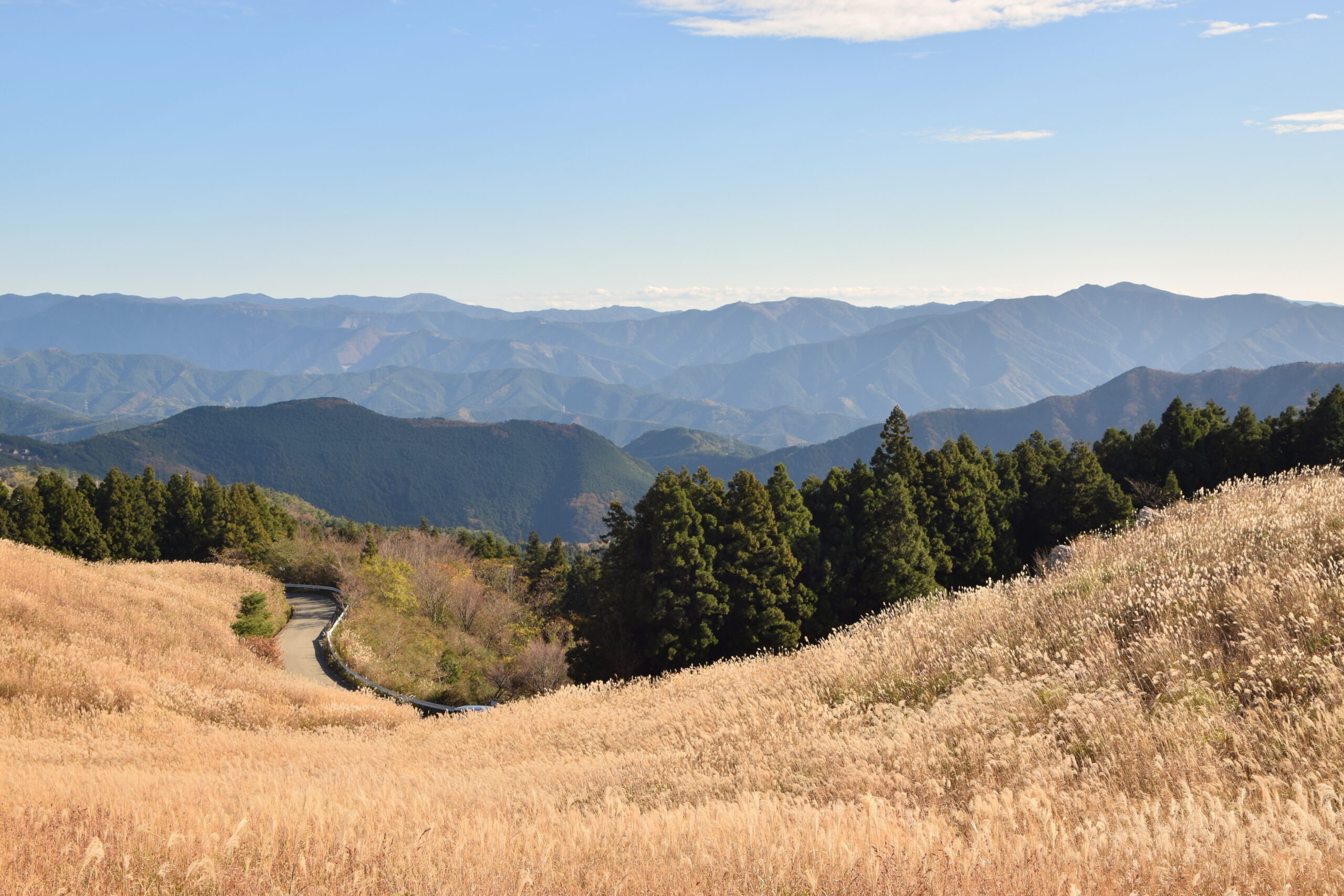
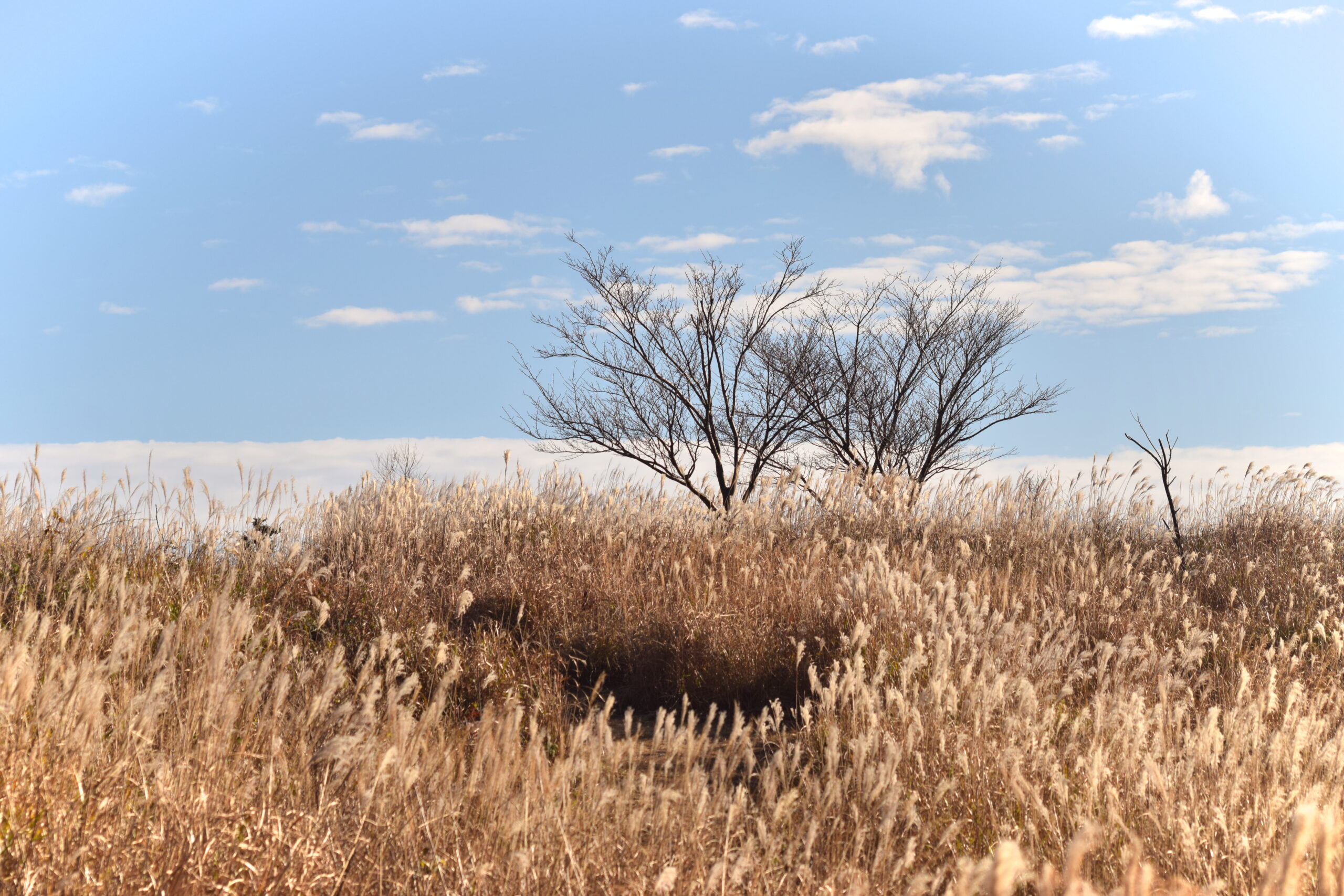
The single biggest draw of Oishi Kogen is the roughly 13-hectare expanse of susuki grass spreading around the summit of Mt. Oishigamine (870 m). This is one of the largest such grasslands in the Kansai region. Each gust of wind sends the plumes swaying in unison, and the whole field shifts between silver and gold—not merely a “view,” but an experience of sound, light, and wind all at once.
Step onto the plateau and the first thing you notice is the soft rustle of the grass. Then the clear wind at 870 meters on your cheeks. On autumn mornings and evenings, low sunlight passes through the plumes and the entire field glows gold. This grassland is not entirely natural: it has been preserved through cutting and controlled burning by local governments and NPOs. The mid-March burning of the field is a well-known sign of spring.
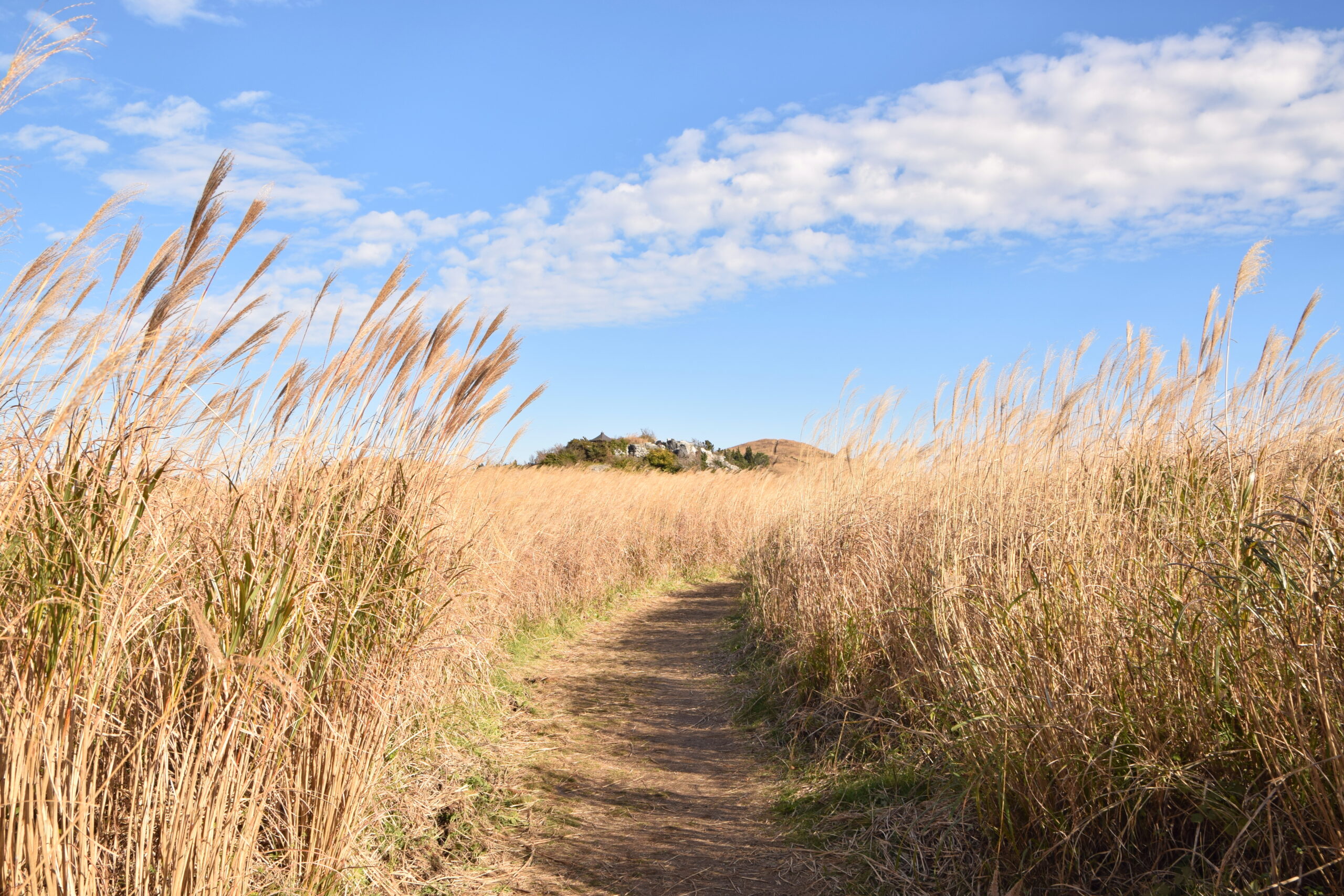
A True 360-Degree Panorama
From the summit of Mt. Oishigamine, the view opens in every direction with nothing to block it. According to the town of Kimino, on clear days you can see Mt. Rokko, Awaji Island, and even Shikoku. Below you, the deep mountains of Kishu fold into one another, the view widening from Mt. Gomadanzan toward the peaks of Oku-Koya.
Although it sits at 870 meters, you do not need to climb to reach this view—it is just a short walk from the summit parking area. Even if serious mountain hiking is not your thing, you can stand here and feel as if you are above the clouds.
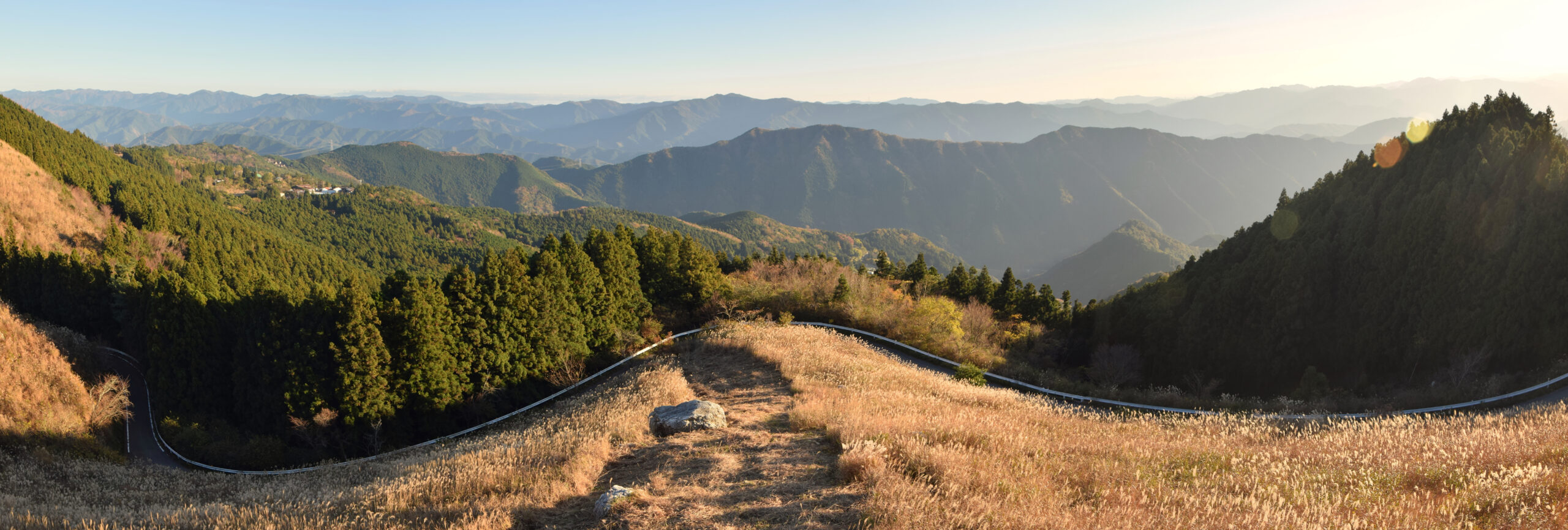
A Land of Prayer to Mountains and Stones
Oishi Kogen holds many traces of people who once worshipped nature itself.
- Kasaishi: a boulder in the central part of the highland, where Kobo Daishi is said to have performed *goma* fire rituals.
- Hiage-iwa (“fire-raising rock”): a large rock jutting out near the summit, where great fires were once lit to pray for rain. Wakayama’s official tourism site also features it as a recommended photo spot, and it has become a symbol of Oishi Kogen.
- Oishi Shrine: located a little down the eastern side of the summit, it enshrines the deities Onamuchi and Sukunahikona. The “married rocks” (meoto-iwa) behind the main hall are still revered as the shrine’s sacred body.
Note that this Oishi Shrine is an entirely different place from the famous “Stone Hall” shrine of the same kanji in Takasago, Hyogo Prefecture (read *Oushiko Jinja*). The two are easily confused in searches, so keep them straight.
Oishi Kogen itself makes no official claim to specific blessings such as wealth or matchmaking. Even so, the megaliths, the sacred rock body, and the rain-praying legend together carry the memory of people who once put their hands together before nature.
What to Expect Here—”Resetting the Mind” and “Awe of Nature”
| What you can experience | Why |
|—————-|——|
| A mental reset and sense of release | A 360° view and unobstructed highland wind |
| Relief from stress | Quiet time wrapped in the sound and light of the grass |
| Awe of nature and renewal | A land of megalith worship and rain-praying legend |
| A break from daily life | Elevation 870 m, clear air about 5°C cooler than the foot of the mountain |
Oishi Kogen suits people who want to pause and breathe deeply, to empty their minds within the scale of nature. Rather than praying for a particular benefit, the best way to receive what this highland offers is simply to gaze at the sea of grass and let the summit wind settle you.
Best Time to Visit
| Season | Highlights |
|——|—————-|
| Spring (Apr–May) | Mountain-opening ceremony around April 29. Fresh young grass and crisp breezes |
| Summer (Jun–early Sep) | Lush green grass. Cooler than the lowlands; on good nights, a sky full of stars, even the Milky Way |
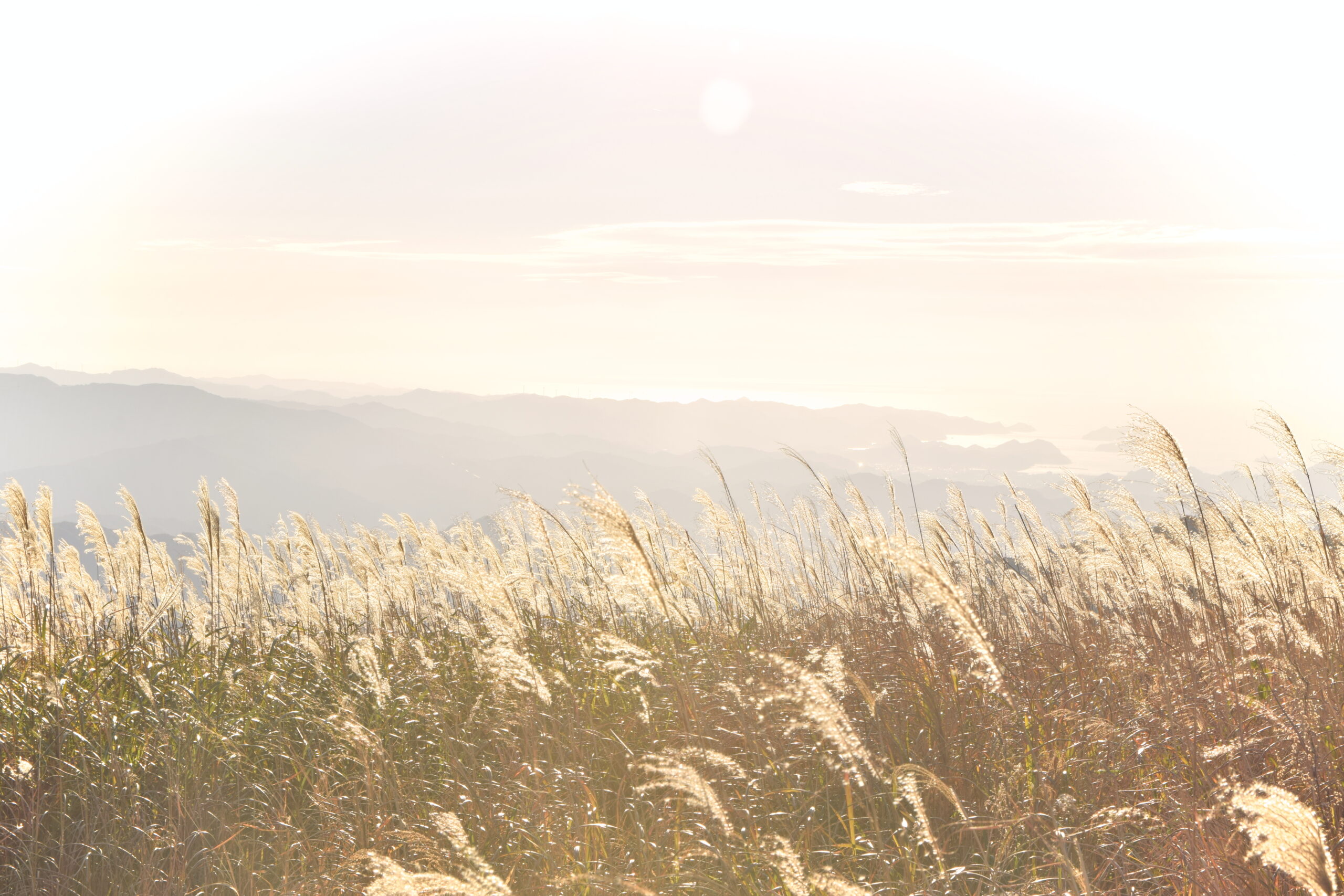
| Autumn (early Oct–mid Nov) | Peak season for the grass. Silver in October, gold in early November at sunrise and sunset |
| Winter (Dec–Feb) | The field turns to dry grass. Roads up may have snow or ice—winter tires are essential |
If you are after the susuki, aim for early October to mid-November. In October the plumes open and the field turns silver; in early November the seeds scatter and shimmer in the light. The fields glowing gold at sunrise and sunset are especially prized, so for photography, target early morning or evening. Peak timing shifts with each year’s weather, so check the latest updates from Kimino Town and the Wakayama tourism sites before you go.
If you happen to be there at dawn (for example while camping), you may also see a sea of clouds spreading below you. It is a “if you’re lucky” sight, but standing on the highland at dawn is worth it regardless.
Access—Assume the Road Is Narrow, and Choose the Safe Route
The most common caution in visitor reviews is that “the road to the summit is narrow” and “it’s nerve-racking when an oncoming car appears.” If this is your first time driving here, your choice of route can make or break the trip.
By Car
| Item | Details |
|——|———|
| Nearest interchange | Arida IC / Arida-Minami IC (Hanwa Expressway) |
| Travel time | About 45 minutes from Arida IC / Arida-Minami IC |
| Safer route | Via National Route 480 → Kusumoto Bridge → Fudatate Pass |
| Parking | Free (No.1, No.2, and the Aridagawa-side lots; roughly 190 spaces in total) |
Wakayama’s official tourism site recommends a route for nervous drivers: from Arida IC / Arida-Minami IC via National Route 480, Kusumoto Bridge, and Fudatate Pass. It takes 10–15 minutes longer than the shortest route but avoids the narrowest roads. There is also a route from Kainan-Higashi IC, but parts of it are narrow, so first-timers and large vehicles are better off coming from the Arida IC side.
Parking is free. During the peak grass season the No.2 lot also opens (roughly 9:30–16:30). The Aridagawa-side lot is said to be available at any time.
By Public Transport
| Item | Details |
|——|———|
| Nearest station | JR Kainan Station (Kisei Main Line / Kinokuni Line) |
| Bus | Daiju Orange Bus to “Tozanguchi” (trailhead) stop |
| From trailhead to summit | About 4 hours on foot, or about 30 minutes by taxi |
By public transport, take the Daiju Orange Bus from JR Kainan Station to the “Tozanguchi” trailhead, then continue about 4 hours on foot or about 30 minutes by taxi. Because buses are infrequent and the trail to the summit is long, public transport is best suited to hikers. If you simply want to enjoy the scenery, a car is far more practical. Bus times and fares change, so always check Daiju Bus’s latest timetable.
Watch Out for Winter and Roadworks
In winter, the road up from the Kimino side may be snowy or icy, so winter tires or chains are necessary. The summit area is about 5°C colder than the foot of the mountain, and the road can freeze. There has also been information about a section of Prefectural Route 180 being closed for widening work as of 2026, which may change routes. Always check the latest road-closure information before you go.
Facilities—”Yama no Ie Oishi” Rest House
The rest house near the summit is “Yama no Ie Oishi.” It is the hub of Oishi Kogen, handling meals, a shop, and campsite reception.
| Item | Details |
|——|———|
| Hours | 9:30–16:30 |
| Closed | Year-end and New Year (may close in severe weather) |
| Phone | 073-489-3586 |
| Specialties | Tamago-kake gohan (rice with raw egg), udon, curry, light meals, local produce, honey, miso, etc. |
Restrooms are available at the summit parking area, the trailhead parking lot, and the campsite. On the other hand, the presence of vending machines could not be officially confirmed, so it is safest to bring your own drinks—especially in the early morning, evening, on closed days, or in bad weather.
Please also note that the Oishi Kogen campsite was reported to be temporarily closed due to bear sightings as of 2026. If you are considering camping, confirm the latest status with Yama no Ie Oishi (073-489-3586).
A Guide by Visitor Type—”How Should I Enjoy It?”
For Photographers
Oishi Kogen is a treasure trove for camera lovers.
1. Hiage-iwa: an iconic rock you can frame against grass and sky—your signature shot of Oishi Kogen.
2. The grass field: silver in October, gold at sunrise and sunset in early November. Light angle is everything, so aim for early morning or evening.
3. The summit panorama: Shikoku, Awaji Island, Mt. Gomadanzan, and Oku-Koya. Clear mornings are best.
A few cautions. Hiage-iwa is popular, so expect a queue for photos in season. The unfenced edge of the rock poses a fall risk, so avoid risky poses and shooting in strong wind. Walking into the grass and picking plants are prohibited, and bringing in dried flowers as props is also banned (artificial flowers are recommended instead). Drone photography requires advance permits from Kimino and Aridagawa towns (allow about 10 days), with limited flying times during the season.
For Families with Children
Strolling the grassland from the summit parking area requires no hiking gear and offers grand views in a short time—great for a picnic. That said, rocky spots such as Hiage-iwa carry a fall risk, so always hold small children’s hands. At 870 meters it can be chilly even in autumn, so prepare for temperature swings and strong wind. Bears, wild boar, pit vipers (mamushi), and ticks are present, so wear long sleeves and trousers from spring through autumn, and teach children not to wander into the grass.
For Visitors with Pets
Pet policy is not clearly stated officially (some reviews mention bringing dogs, but those are personal accounts, not official rules). If you bring a pet, please be strict about keeping it leashed, picking up waste, not entering the grass field, and respecting wildlife. For campsite use, confirm in advance with Yama no Ie Oishi (073-489-3586).
For Wheelchair and Stroller Users
To be honest, barrier-free information for Oishi Kogen is not officially available. The highland includes grass, gravel, slopes, and rocky areas, and the walk to Hiage-iwa or the summit likely has sections unsuitable for wheelchairs and strollers. Please check current conditions—including the summit parking area, the area around Yama no Ie Oishi, and restroom access—with Yama no Ie Oishi (073-489-3586) in advance. For views alone, you can still enjoy grand scenery from around the parking area.
For Beginner Hikers
A stroll from the summit parking area is easy even for beginners. If you walk up properly from Ogawa Hachiman Shrine or the trailhead, the courses run about 3 to nearly 5 hours with significant elevation gain, so you will need hiking boots, water, warm clothing, rain gear, and a map. Don’t forget a bear bell or radio to make noise as you go.
Around the Area & Model Courses
Half-Day by Car (Good for Photos / First Visits)
“`
9:30 From Arida IC / Arida-Minami IC via Route 480 to Oishi Kogen (about 45 min)
10:30 Arrive at summit parking; rest and a light meal at Yama no Ie Oishi
11:00 Stroll Hiage-iwa, Kasaishi, the grass field, and the summit of Mt. Oishigamine
12:30 Walk on to Oishi Shrine (the married rocks)
13:30 Head back down
“`
On weekends in October–November, the No.1 lot can back up with cars waiting to enter, so arriving early is the safe play.
One Day—Wakayama Natural Scenery Tour
“`
Morning Stroll Oishi Kogen
Lunch Yama no Ie Oishi, or a cafe in Aridagawa or Kimino
Afternoon Aragijima (Ranto) terraced-rice viewpoint
Evening A soak at Shimizu Onsen
“`
Nearby Spots
- Aragijima (Ranto): a fan-shaped terraced rice field in the Shimizu district of Aridagawa. Selected among Japan’s top 100 rice terraces, it and its surroundings are designated an Important Cultural Landscape. Easy to combine, as it is in the same Aridagawa area.
- Shimizu Onsen: hot springs upstream on the Arida River at the foot of Mt. Koya. A good rest or overnight option with Oishi Kogen and Aragijima.
- Tamago Bokujo Makiba (Aridagawa): pair it with the egg-on-rice at Yama no Ie Oishi for an egg-themed day.
- Cafes and bakeries in Kimino: spots such as Dooshel tucked in the hills. Check opening days in advance.
Visitor Voices
Here are general trends seen in review sites and travelogues (individual impressions are the posters’ own).
For Oishi Kogen, you will see many comments praising the scenery and photography: “the autumn sea of grass is overwhelming,” “the view from the summit is otherworldly,” “Hiage-iwa makes for striking photos,” “it’s pleasantly cool in summer.” At the same time, there are plenty of cautionary notes about access and crowds: “the road to the summit is narrow and winding,” “the parking lots get crowded in grass season,” “there was a queue for photos at Hiage-iwa” (via Yahoo! Map and other reviews).
In short, satisfaction with the scenery is very high, while choosing an easier route and arriving early during peak season are what determine how comfortable the trip feels—that is the trend you can read from the reviews.
Notes & Safety Information
1. Some sections are narrow: for a first visit, choose the safer route from the Arida IC side (via Route 480).
2. Winter ice: prepare winter tires or chains for snow and ice in winter.
3. Crowds in grass season: weekends in October–November can mean parking waits and congestion. Arrive early.
4. Fire is generally banned: the wind is strong and fire risk is high. Campfires, fireworks, and BBQ are banned except at the campsite (by reservation).
5. Wildlife and insects: beware of bears, wild boar, pit vipers, and ticks. Make noise, and wear long sleeves and trousers.
6. Safety on the rocks: unfenced rocks like Hiage-iwa pose a fall risk. Avoid strong wind and risky shots.
7. Carry out your trash: there are no bins, even at the campsite. Picking plants or minerals is prohibited.
8. Signal and supplies: reception may be unstable in the mountains. Save offline maps and bring your own drinks.
Frequently Asked Questions (FAQ)
Q. When is the best time to see the pampas grass at Oishi Kogen?
A. Typically early October to mid-November. October is silver; early November turns gold at sunrise and sunset. Timing shifts with the year’s weather, so check the latest information before visiting.
Q. Is the road really narrow?
A. Some sections are narrow. First-timers and large vehicles should use the safer route from Arida IC / Arida-Minami IC via National Route 480, Kusumoto Bridge, and Fudatate Pass.
Q. Is there parking, and what does it cost?
A. There is free parking (the No.1, No.2, and Aridagawa-side lots; roughly 190 spaces total). The No.2 lot opens during peak grass season, but lots can fill and back up on weekends.
Q. Can I get there by public transport?
A. From JR Kainan Station, take the Daiju Orange Bus to “Tozanguchi,” then about 4 hours on foot or 30 minutes by taxi. This is best for hikers, and buses are infrequent. For casual sightseeing, a car is more practical.
Q. Is the Oishi Shrine here the same as the “Stone Hall” Oishi Shrine in Hyogo?
A. No, they are different. The Oishi Shrine at Oishi Kogen is in Wakayama, enshrines Onamuchi and Sukunahikona, and reveres married rocks as its sacred body. Do not confuse it with Oishi Shrine (the Stone Hall) in Takasago, Hyogo.
Q. Is it okay to visit with pets or children?
A. A stroll from the summit parking area suits families, but mind the fall risk on rocks, wildlife, and temperature swings. Pet policy is not officially confirmed, so keep pets leashed and follow good manners; confirm in advance for campsite use.
Q. Can I camp here?
A. There is an Oishi Kogen campsite, but as of 2026 it was reported temporarily closed due to bear sightings. Confirm the latest status with Yama no Ie Oishi (073-489-3586).
Summary
Oishi Kogen is one of Wakayama’s finest natural power spots—a place to feel set free, wrapped in a sea of grass and a 360-degree view.
At its heart is the roughly 13-hectare grassland on the 870-meter summit: silver in October, gold in November, green in summer, and—if conditions align—a sea of clouds at dawn. Over this ever-changing field lie the stories of a land that once entrusted its prayers to mountains and stones: Hiage-iwa, Kasaishi, and Oishi Shrine with its married-rock sacred body. Rather than a flashy blessing, the greatest gift of this place is simply time spent emptying your mind in the highland wind.
The keys to enjoying it are route and timing. Choose the easier Arida IC route because some roads are narrow, and arrive early on weekends in grass season. Get these right, and—combined with Aragijima and Shimizu Onsen—you have an unforgettable day immersed in Wakayama’s nature. The wind that meets you at the summit will, no doubt, stay with you for a long time.
—
We hope this guide helps you enjoy your visit to Oishi Kogen.
*Information in this article is current as of June 2026. Details such as the pampas-grass peak, the operating status of Yama no Ie Oishi and the campsite, parking and road conditions (including the Route 180 works), Daiju Bus times and fares, and pet and barrier-free policies are subject to change. Always check official sources from Kimino Town, Aridagawa Town, and the Wakayama tourism site before visiting.*
Key sources:
- Kimino Town “Oishi Kogen Information”
- Wakayama Prefectural Natural Park “Oishi Kogen”
- Wakayama Official Tourism “Oishi Kogen”
- Wakayama Official Tourism “Oishi Kogen Pampas Grass Season”
- Wakayama Official Tourism “Access for Nervous Drivers”
- Aridagawa Tourism Association “Aragijima”
- Daiju Bus “Route Bus Guide”
Find Out How Compatible You Are with Oishi Kogen
Power spots have a “compatibility” that differs from person to person.
Two people can visit the same place—one feels it strongly, the other barely at all.
This comes from the combination of your own innate energy and the nature of the spot.
Oishi Kogen’s powers of “release” and “reset” are said to resonate especially with those who want to pause and settle their minds, and to find themselves again within the scale of nature—but whether it truly suits you is determined by the personal energy derived from your date and time of birth.
あなたに最適なパワースポットを知りたい方へ