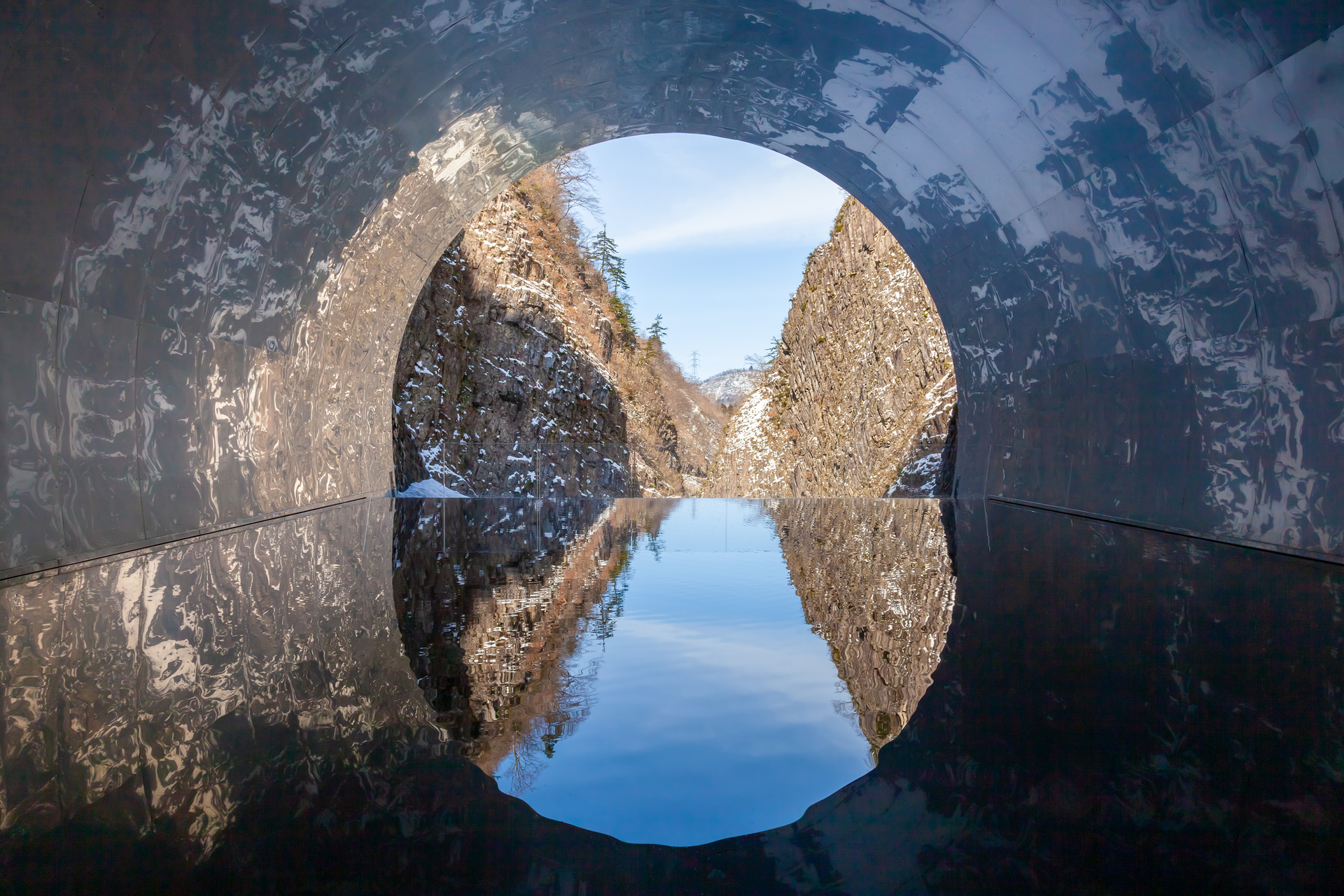
You walk 750 meters into a mountain. The tunnel is cool and dim, with occasional windows opening onto a gorge of towering columnar rock. Then you reach the end, and the floor becomes water. A thin sheet of it, perfectly still, reflecting the gorge outside and the stainless steel walls around you. The rock, the sky, and your own silhouette merge into a single image that seems to have no boundary between up and down, inside and outside.
This is the Tunnel of Light at Kiyotsu Gorge—a collaboration between nature and the Chinese architect Ma Yansong’s MAD Architects, created for the Echigo-Tsumari Art Triennale in 2018. The installation transformed a utilitarian sightseeing tunnel into one of the most photographed spots in Japan, increasing annual visitors fivefold.
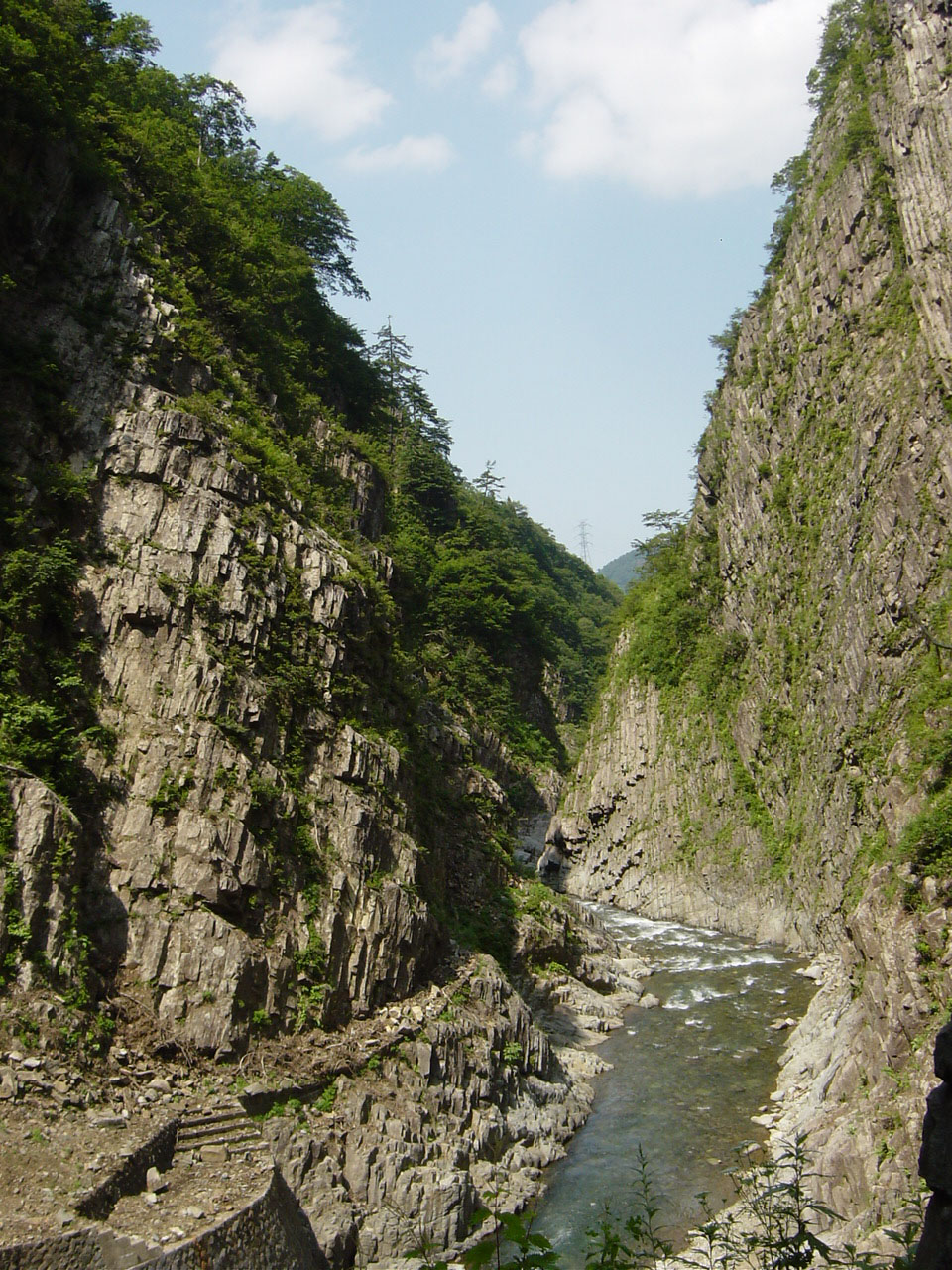
But the gorge itself predates any art by millions of years. Kiyotsu Gorge is one of Japan’s three great gorges (alongside Kurobe Gorge in Toyama and Osugidani in Mie), designated a National Scenic Beauty and Natural Monument. Its walls of columnar jointing—hexagonal rock columns formed by cooling magma—rise tens of meters above the Kiyotsu River.
From Tokyo, it is a 70-minute bullet train ride to Echigo-Yuzawa Station, then 25 minutes by bus. A comfortable day trip.
What Makes Kiyotsu Gorge Special
Tunnel of Light
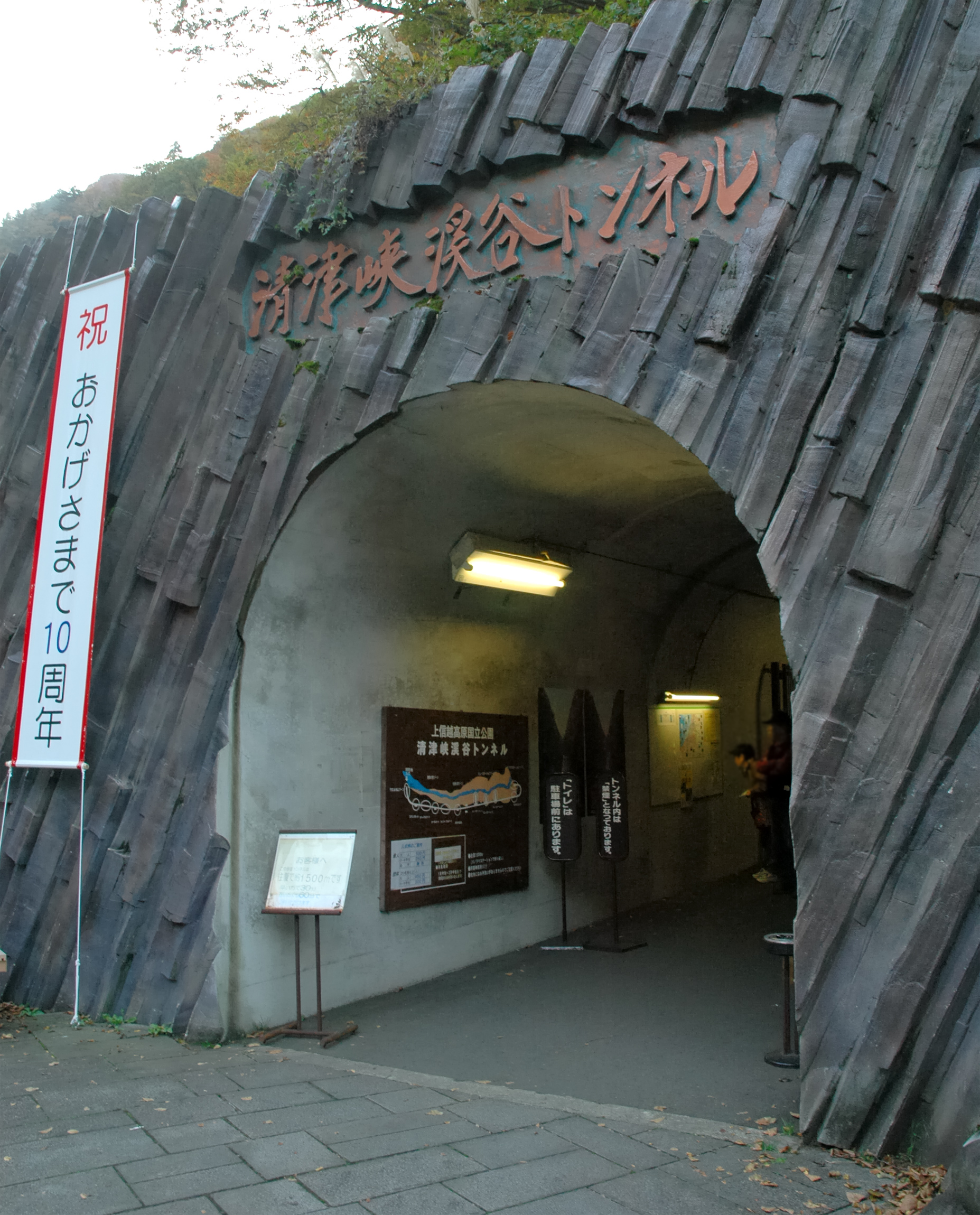
The Kiyotsu Gorge Tunnel stretches 750 meters into the mountain, originally built in 1996 as a pedestrian sightseeing route. In 2018, MAD Architects redesigned it as a permanent art installation for the Echigo-Tsumari Art Triennale.
Inside the tunnel, three observation points offer different art-enhanced views of the gorge through windows in the rock. But the climax is the Panorama Station at the very end: a semi-circular opening where the tunnel meets the gorge, with a floor covered in a thin layer of water (about 5 centimeters deep). The walls are polished stainless steel. The gorge’s cliffs, sky, and your own reflection merge into a single composition.
The experience transcends photography. While the mirror pool looks stunning in pictures, standing in it—feeling the cold water, seeing yourself dissolve into the reflected landscape—is something a screen cannot convey.
Columnar Jointing: Millions of Years in the Making
The geological heart of Kiyotsu Gorge is the columnar jointing visible on both walls. When volcanic magma cooled slowly underground millions of years ago, it contracted into regular hexagonal columns. Erosion by the Kiyotsu River exposed these columns, creating cliff faces tens of meters high that look almost artificially carved.
This columnar jointing is among the finest in Japan. While Kurobe Gorge is famous for its dramatic V-shaped valley, Kiyotsu stands out for the sculptural beauty of its rock formations and the clarity of its river water—a combination of geological wonder and pristine nature.
Echigo-Tsumari Art Triennale
The tunnel is a permanent installation within the Echigo-Tsumari Art Triennale framework (held every three years). It is open to visitors year-round during the operating season, regardless of whether the triennale is being held. The wider Tokamachi area has hundreds of outdoor art installations—Kiyotsu Gorge can be the starting point for a broader art-focused trip.
Best Time to Visit
By Season
Spring (late April–May): The tunnel reopens from winter closure in early April. Fresh green is beginning to appear. Golden Week is busy; mid-May onward is calmer.
Summer (June–August): 22–30°C outside, but the tunnel interior stays around 17°C—a natural air conditioner. The mirror pool photographs best on sunny summer days. Weekends may have entry restrictions due to crowds.
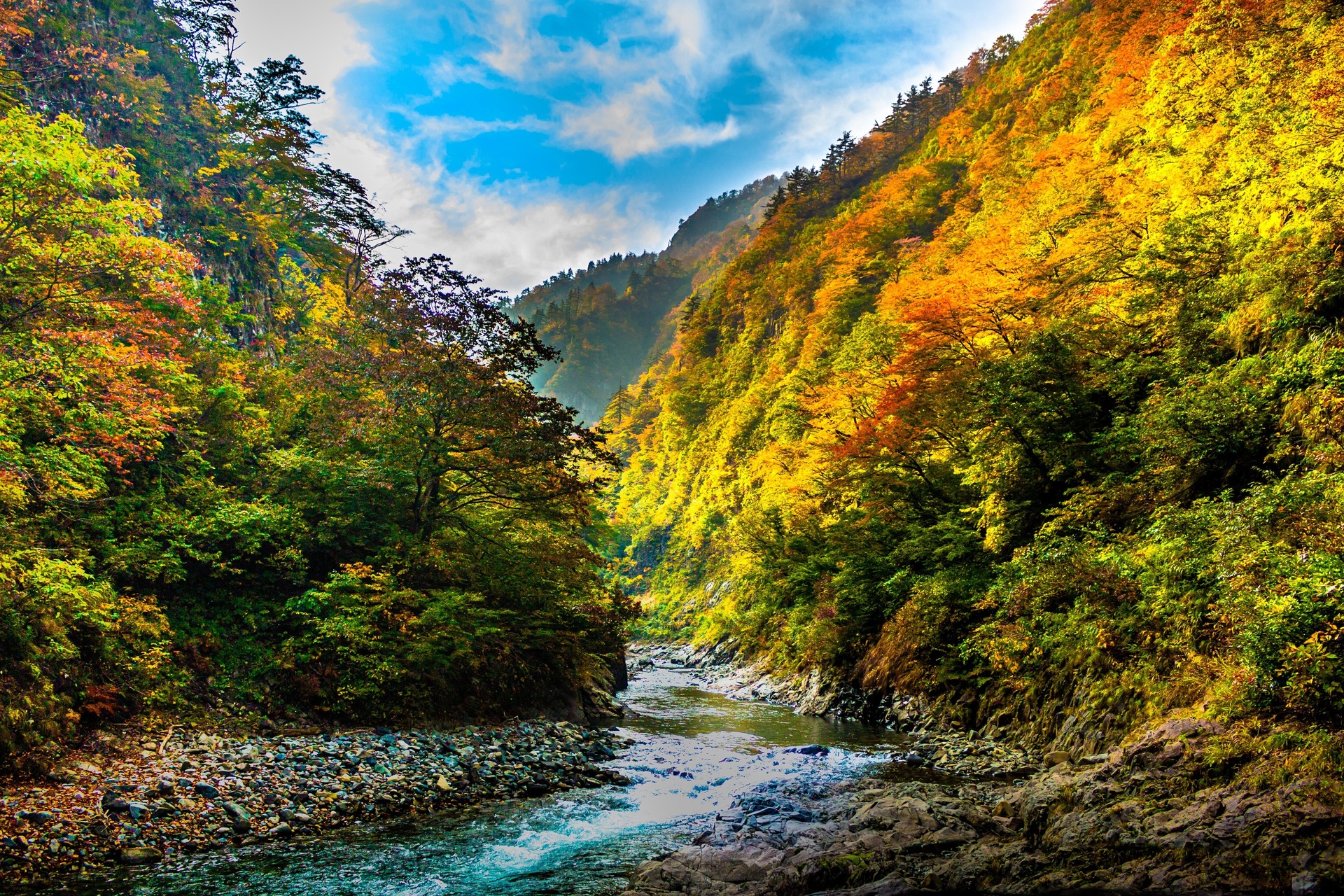
Autumn (September–November): The absolute best season. Mid-October to early November turns the gorge into a canvas of red, orange, and gold. Advance online reservation is required during peak autumn color.
Winter (December–March): Closed. Heavy snowfall in this region makes the tunnel inaccessible. Typically reopens in early-to-mid April depending on snow conditions.
Best Times of Day
- 9:00–10:00 AM (right at opening): Fewest visitors, best chance for people-free mirror pool photos
- Weekdays: Half the visitors compared to weekends. Especially recommended during autumn peak
- Avoid: Weekend afternoons during autumn peak (late October)—waits of over an hour possible
Visiting Guide
Inside the Tunnel
The 750-meter tunnel takes about 20 minutes to walk one way.
| Point | Distance from Entrance | Highlight |
|——-|———————-|———–|
| Entrance | 0m | Ticket counter, history exhibits |
| Observation Point 1 | ~200m | Small window overlooking the gorge, art installation |
| Observation Point 2 | ~350m | Light art-enhanced viewing space |
| Observation Point 3 | ~500m | Only restroom inside the tunnel. Gorge view |
| Panorama Station | 750m | The Tunnel of Light mirror pool |
At the Panorama Station:
- You can walk into the water (about 5cm deep). Sandals or waterproof shoes recommended
- The best photos come from a very low angle, nearly at water level
- During busy times, visitors take turns—wait for the group ahead to finish before stepping in
- Typical time spent: 10–15 minutes
How Long to Spend
| Plan | Time | What’s Included |
|——|——|—————–|
| Tunnel round trip | ~1 hour | Walk both ways + 15 min at Panorama Station |
| Photography visit | 1.5–2 hours | Time at each observation point + waiting for good light |
| Full area visit | 2–3 hours | Above + onsen + riverside walk |
How to Get There
Address: Koide, Tokamachi City, Niigata Prefecture
By Train + Bus
- Echigo-Yuzawa Station → Minami-Echigo Kanko bus to “Kiyotsukyo Iriguchi” (approximately 25 minutes), then walk approximately 30 minutes to tunnel entrance
- From Tokyo: Joetsu Shinkansen to Echigo-Yuzawa (~70 minutes). Total journey approximately 2 hours
- From Osaka/Kyoto: Tokaido Shinkansen to Tokyo, transfer to Joetsu Shinkansen (~3.5 hours total)
- Buses run 5–6 times per day—check the timetable in advance
By Car (Recommended)
- Kanetsu Expressway “Shiozawa-Ishiuchi IC”: approximately 20 minutes
- From Echigo-Yuzawa Station: approximately 25 minutes
- Parking: Free (approximately 150 spaces). During autumn peak weekends, temporary lots open but arrive before 10:00 AM
Practical Information
| Detail | Information |
|——–|————-|
| Open | Early April to late November (closed in winter) |
| Hours | 8:30–17:00 (last entry 16:30) |
| Admission | Adults 1,000 yen, children (elementary/junior high) 400 yen |
| Time needed | 1–2 hours |
| Phone | 025-763-4800 (Tunnel Management Office) |
| Official site | https://nakasato-kiyotsukyo.com/ |
Reservations: During autumn color season (October–November) and Golden Week, online booking is required via the official website. Outside these periods, no reservation needed.
Nearby Attractions
Within Walking Distance
- Kiyotsukyo Onsen: Day-use hot spring baths near the tunnel entrance (600–800 yen). Perfect post-tunnel soak
- Kiyotsu River Riverside Path: Downstream walking path with different angles of the columnar jointing walls
Within 30 Minutes by Car
- Echigo-Yuzawa Onsen: 25 minutes by car. The station area has numerous day-use baths. “Ponshukan” inside the station offers tastings of over 100 Niigata sake brands
- Hoshitoge Rice Terraces: 30 minutes by car. Famous terraced paddies reflecting the sky, called the “Mirror of Heaven.” Part of the Art Triennale area
- Matsunoyama Onsen: 30 minutes by car. One of Japan’s three great medicinal hot springs, with unusually high salt content
Model Itinerary: Kiyotsu Gorge + Echigo-Yuzawa Day Trip
| Time | Spot | Duration |
|——|——|———-|
| 9:00 | Kiyotsu Gorge Tunnel (arrive at opening for quiet visit) | 1.5 hours |
| 10:30 | Kiyotsukyo Onsen day bath | 45 min |
| 12:00 | Drive to Echigo-Yuzawa, lunch (hegi-soba noodles) | 1 hour |
| 13:30 | Ponshukan sake tasting at the station | 45 min |
| 14:30 | CoCoLo Yuzawa for souvenirs | 30 min |
| 15:30 | Shinkansen back to Tokyo (~70 minutes) | – |
What Visitors Say
> “When I reached the end of the tunnel, I literally lost my breath. The reflection on the water blurs the line between what’s real and what’s reflected. Photos don’t do it justice.”
> — Google Maps review
> “Went during autumn peak and waited 45 minutes to get in. Go on a weekday or book in advance. But it was absolutely worth the wait.”
> — Google Maps review
> “My kids loved splashing in the mirror pool. The tunnel stays cool even in summer. Just note that buses are infrequent—driving is much easier.”
> — Google Maps review
Tips for Different Visitors
Photographers
The mirror pool is best shot from an extremely low angle—nearly at water level. Use a wide-angle lens (16–35mm equivalent). On smartphones, try placing the phone just above the water surface. Morning (9:00 AM opening) gives you the best chance of an empty frame. Tripods are allowed but be courteous during busy periods. The tunnel interior is dim—raise ISO or bring a fast lens.
Families with Children
The tunnel is flat and stroller-friendly for the entire 750 meters. Children love wading in the Panorama Station pool (5cm deep). Bring spare socks. The only restroom inside the tunnel is at Observation Point 3. There is a shop and restrooms at the entrance.
Wheelchair Users
The tunnel is fully accessible for wheelchairs for all 750 meters, including the Panorama Station. The walk from the parking lot to the tunnel entrance is a gentle uphill path of about 10 minutes.
Rainy Days
The tunnel is rain-proof. Since the main attraction is inside, rain does not diminish the experience. The walk from parking to entrance (about 10 minutes) requires an umbrella. Rainy days may actually be slightly less crowded.
Frequently Asked Questions
Can I do this as a day trip from Tokyo?
Yes. Joetsu Shinkansen to Echigo-Yuzawa (70 minutes), then bus (25 minutes). Leave Tokyo in the morning, visit the tunnel, enjoy Echigo-Yuzawa’s onsen and food, and return by evening.
When is the best time for autumn colors?
Mid-October to early November. Peak is typically late October. Online reservation is required during this period.
Is it open in winter?
No. The tunnel closes from December through March due to heavy snowfall. It typically reopens in early-to-mid April.
Will my shoes get wet?
The Panorama Station pool is about 5cm deep. Many visitors go barefoot, or wear sandals/waterproof shoes. Bring spare socks.
Do I need a reservation?
Only during autumn color season (October–November) and Golden Week. All other times, walk-in entry is available.
Nearby Power Spots
- Yahiko Shrine — The premier shrine of Echigo (Niigata). A major power spot with a mountaintop shrine (approximately 90 minutes by car)
Summary
Kiyotsu Gorge is where millions of years of geological drama meet 21st-century art. The columnar jointing walls—hexagonal rock columns formed by ancient cooling magma—create a gorge of almost architectural precision. The Tunnel of Light transforms a simple walk into an immersive experience, ending at a mirror pool where the boundary between reflection and reality disappears.
In autumn, the gorge becomes one of Japan’s great color spectacles, the rock walls framed by red and gold. In summer, the tunnel’s natural 17°C interior offers cool refuge. And year-round, the Panorama Station delivers a moment of quiet astonishment that no photograph can fully capture.
At just 70 minutes from Tokyo by bullet train, Kiyotsu Gorge makes for a perfect day trip paired with Echigo-Yuzawa’s famous hot springs, hegi-soba noodles, and sake. Nature, art, food, and relaxation—all in a single day.
—
Want to find the power spot that matches you best?
Japan has countless spiritual places, but what matters most is personal compatibility. Take our free 3-minute compatibility quiz to discover which power spot resonates with you.
-> Take the Free Compatibility Quiz
—
*Information in this article is current as of March 2026. Please check the official website for the latest details.*
あなたに最適なパワースポットを知りたい方へ