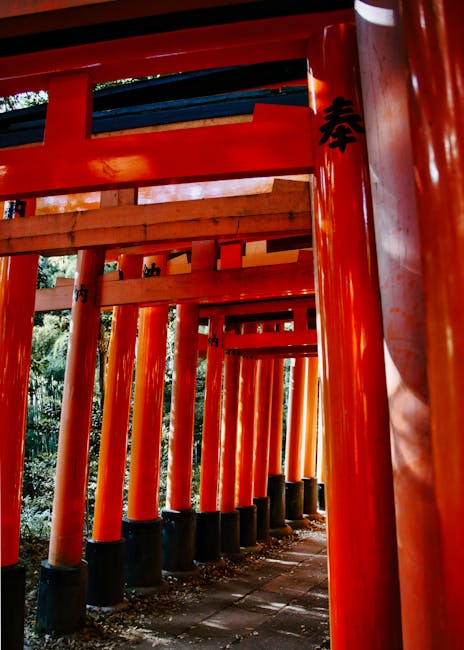
Quick Answer: When Is It Least Crowded?
Earlier is calmer, but a completely empty Senbon Torii is rare these days — even at 7 AM there are many visitors. The grounds are open 24 hours and free to enter, and the shrine is directly in front of JR Inari Station, so you can start as early as your trains or hotel allow.
| Time | What to Expect | Best For |
|---|---|---|
| Early morning | Calmest, not empty | Soft light, mist on some mornings |
| Midday | Busier | Climbing beyond Yotsuji, where crowds thin out sharply |
| After dark | Lit gates, a completely different mood | Night shots around the main hall and Senbon Torii (see our Night Visit Guide) |
Key insight: Plan for “fewer people,” not “no people.” People in the frame can work for you — a lone figure walking through the gates gives the tunnel its scale.
The Shrine’s Photo Rules
The shrine’s official website lists acts that are prohibited on the grounds (a notice dated January 1, 2022). These are the ones that matter for photographers:
- Blocking other worshippers by taking photos on narrow paths
- Taking photos for business purposes, or in places where photography is prohibited (the notice doesn’t list those places, so follow any signs on site)
- Flying drones or other flying objects
- Climbing on stone lanterns or other structures
- Media coverage without permission
- Walking the grounds in a wedding dress or other attire unsuitable for worship
- Entering restricted areas (the main hall and other buildings, inside fences) without permission
Staff will warn anyone they see doing these, and may ask people who don’t follow their instructions to leave.
What This Means for Your Gear
| Equipment | At Fushimi Inari |
|---|---|
| Tripod | Not named in the shrine’s list, but you may not block others on narrow paths — so none inside the Senbon Torii tunnels. Use it in open spots in the lower grounds, such as around the main hall |
| Drone | Prohibited |
| Selfie stick / gimbal | Keep moving in the tunnels |
| Flash | Be considerate — avoid using it near people who are praying |
8 Best Photo Spots (in Walking Order)
Spot 1: Romon Gate (Main Entrance)
| Detail | Information |
|---|---|
| What to capture | Massive vermilion gate, symmetrical |
| Best time | Blue hour (before sunrise) |
| Why special | Built by Toyotomi Hideyoshi in 1589; the shrine says it is among the largest two-story gates (romon) at any shrine |
| Lens | Wide angle |
Pro tip: Include silhouettes of early worshippers for scale and atmosphere.
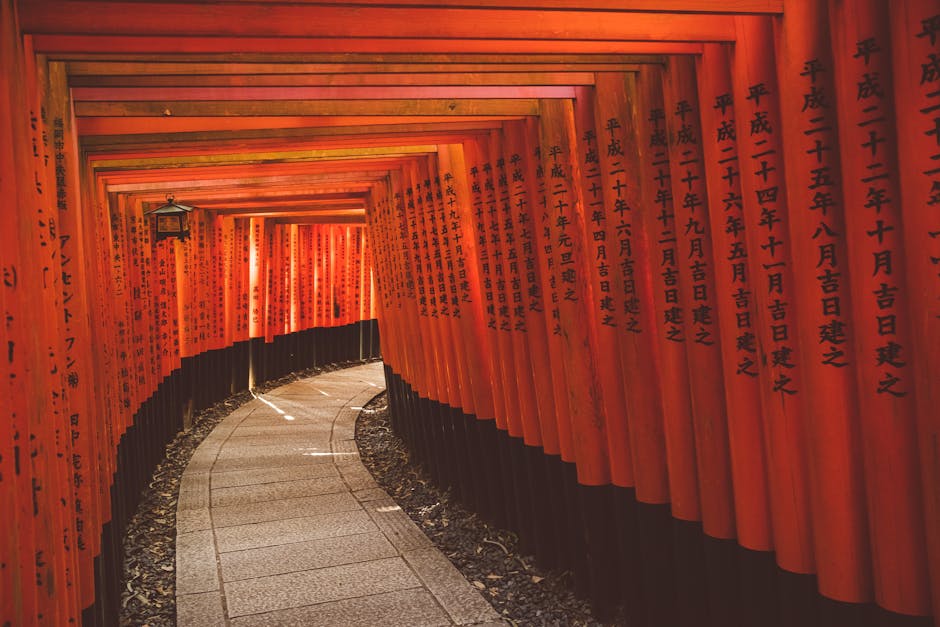
Spot 2: Senbon Torii (Most Famous)
| Detail | Information |
|---|---|
| What to capture | The iconic tunnel of vermilion gates |
| Best time | As early as you can |
| Direction | Shoot looking UP the path (walking direction) |
| Lens | Wide angle (16-35mm) for tunnel effect |
Pro tip: What the shrine prohibits is blocking others on the narrow path, not taking photos. Shoot as you walk (see the handheld settings below), and save carefully composed frames for where the path opens up. Include the path curving ahead for depth.
Spot 3: Okusha Worship Hall
| Detail | Information |
|---|---|
| What to capture | Fox statues, ema boards, and the Omokaru-ishi stones |
| Best time | Morning light |
| Why special | Where the Senbon Torii ends — about 800 gates line the path from the main hall to here |
| Lens | Standard to telephoto (50-135mm) |
Pro tip: The Omokaru-ishi are the round stone tops of a pair of stone lanterns: make a wish and lift one — if it feels lighter than expected, the wish is said to come true. People queue for them at busy times, so shoot from the side rather than from the front of the line.
Spot 4: Ne-agari no Matsu (the Knee Pine)
| Detail | Information |
|---|---|
| What to capture | The enshrined roots of a pine, risen above the ground and split in two |
| Best time | Morning light, right after Okusha |
| Why special | “Ne-agari” (rising roots) sounds like “ne-agari” (rising prices), so it is said to bring rising prices. It is also said to ease aches in the legs and hips, and it is known as “Hiza-matsu-san” (the knee pine) |
| Lens | Standard |
Pro tip: It’s to the left of the Okusha worship hall, at the entrance to the mountain circuit — a short walk from the Omokaru-ishi. People come here to pray, so wait for a gap rather than framing around them.
Spot 5: Kumataka-sha Shrine
| Detail | Information |
|---|---|
| What to capture | The pond, and the place of worship built on stonework that juts out over it |
| Best time | Overcast days (soft light) |
| Why special | The pond, Shin-ike, is also called Kodama-ga-ike (“echo pond”): by tradition, someone searching for a missing person claps toward it, and the direction the echo returns from gives a clue |
| Lens | Wide to standard |
Pro tip: It’s on the path between Okusha and Yotsuji. Use a polarizing filter to reduce reflections on the pond.
Spot 6: Yotsuji Intersection Overlook
| Detail | Information |
|---|---|
| What to capture | Panoramic view of Kyoto city |
| Best time | Daylight |
| Why special | A wide view over the city, about halfway up (about 30 minutes uphill from Okusha) |
| Lens | Standard to telephoto |
Pro tip: Many visitors turn back here. Head down well before dark — the mountain paths have few lights, and you may meet wild animals such as wild boars.
Spot 7: Otsuka Beyond Yotsuji
| Detail | Information |
|---|---|
| What to capture | Otsuka — small stone shrines carved with deity names, left with candles and incense |
| Best time | Daylight hours |
| Why special | Beyond Yotsuji, the mountain becomes a place of folk worship: since the Meiji era, worshippers have dedicated otsuka, and the shrine’s official website says they number in the tens of thousands |
| Lens | Standard |
Pro tip: Each otsuka is someone’s prayer. Never touch them or move the offerings. The path gets quieter and darker beyond Yotsuji, and some solo visitors feel uneasy. From Yotsuji it’s about 30 minutes up to the summit (Ichi-no-mine), and about 40 minutes from the summit back down to the main hall — so start early and head down well before dark.
Spot 8: Gate Inscriptions (On the Way Back Down)
| Detail | Information |
|---|---|
| What to capture | The donor’s name and dedication date on the back of each gate |
| Best time | Walking back down, when the inscriptions face you |
| Why special | Gates have been donated since the Edo period — in hope that a wish will “pass through” (come true), or in thanks for a wish granted — and are still offered today |
| Lens | Standard to telephoto, to stack the rows of lettering |
Pro tip: Going up, you mostly see vermilion; coming down, the inscriptions face you.

Busy Periods & Getting There
- Busiest periods: Cherry blossom weekends, Golden Week, and January 1-3 (extremely crowded)
- Autumn weekdays: Mornings may be crowded with school trips
- By train: The shrine is directly in front of JR Inari Station (2 stops from Kyoto Station, about 5 minutes). Keihan’s Fushimi-Inari Station is a 5-minute walk
- Driving? The shrine’s parking is for worshippers only, the roads around it get very congested, and the shrine asks visitors to use public transport. The lots are also closed from December 30 to January 6
Seasonal Photography Guide
Spring (March-May)
| Condition | When | What to Shoot |
|---|---|---|
| Cherry blossoms | Late March-early April | Gates + pink petals |
| Morning mist | Some mornings | Ethereal tunnel shots |
| Fresh green | May | Vibrant forest canopy |
Settings: Slight overexposure (+0.3-0.7) for bright spring feel
Summer (June-August)
| Condition | When | What to Shoot |
|---|---|---|
| Rainy season | Mid June-mid July | Wet gates (deeper red) |
| Night visits | July-August | Escape heat, moody shots |
| Light rays | Morning through canopy | Sun beams through trees |
Settings: Underexpose slightly for richer reds when wet
Autumn (September-November)
| Condition | When | What to Shoot |
|---|---|---|
| Peak foliage | Mid-late November | Red leaves + red gates |
| Kyoto view | Mid-late November | Yotsuji viewpoint framed by autumn leaves |
| Golden hour | Earlier (4-5 PM) | Warm light on gates |
Best: Late November for red maples contrasting with vermilion
Winter (December-February)
| Condition | When | What to Shoot |
|---|---|---|
| Snow | Rare, check forecast | Snow-covered Senbon Torii |
| Clear days | Any | Crisp, clean images |
| Fewer tourists | Weekdays (not January 1-3) | Calmer gate tunnels |
Snow alert: Snow in Kyoto is rare. Follow local weather — on a snowy morning, the snow-covered Senbon Torii is breathtaking.
Camera Settings Guide
Daytime Gate Tunnel (Handheld)
| Setting | Value | Why |
|---|---|---|
| Mode | Aperture Priority with Auto ISO | |
| Aperture | f/4-8 | Enough depth for the tunnel |
| Shutter | 1/60 sec or faster | Sharp shots while you walk |
| ISO | Let it rise as needed | The tunnels are shaded |
| WB | Daylight or 5500K | Accurate reds |
Night Photography
| Setting | Value | Why |
|---|---|---|
| Mode | Manual | |
| Aperture | f/2.8-4 | Gather light |
| ISO | 1600-6400 | As needed |
| Shutter | 1/30 sec or faster | Handheld inside the tunnels; slower shutters only on a tripod in open spots |
| WB | Tungsten (3200K) | Correct orange lights |
Long Exposure (Blur Moving People)
| Setting | Value | Why |
|---|---|---|
| Mode | Manual | |
| Aperture | f/16-22 | Extended exposure |
| ISO | 100 | Minimum |
| Shutter | 30-120 sec | Walking people blur away |
| Filter | ND 6-10 stop | Essential for daytime |
Result: A long exposure blurs walking people until they almost vanish; anyone standing still will still show. It needs a tripod, so use it only in open spots away from the tunnels, such as around the main hall.
2-Hour Photography Route
Sunrise Shoot (5:30-7:30 AM)
| Time | Location | Shot |
|---|---|---|
| 5:30 | Romon Gate | Blue hour, symmetry |
| 5:45 | Main hall area | First light on buildings |
| 6:00 | Senbon Torii | Key shot – fewer people than later on |
| 6:40 | Okusha | Fox statues, Omokaru-ishi, the Knee Pine |
| 7:00 | Walk back down through the Senbon Torii | Gate inscriptions facing you |
| 7:30 | Back at the Romon Gate | Done before the busier hours |
Sunrise times vary a lot by season, so shift these times to your date — check timeanddate.com.
Want to go further? From Okusha it’s about 30 minutes uphill to Yotsuji (15 minutes to Mitsuji, 15 more to Yotsuji), with Kumataka-sha along the way — add at least an hour for the round trip.
Recommended Gear
Essential
| Item | Why |
|---|---|
| Wide angle (16-35mm) | Tunnel shots, architecture |
| Standard zoom (24-70mm) | Versatile, details |
| Spare batteries | Cold weather drains fast |
Nice to Have
| Item | Why |
|---|---|
| Tripod (compact) | Night shots and long exposure, in open spots only |
| Telephoto (70-200mm) | Compression, details |
| ND filter (6-10 stop) | Daytime long exposure |
| Polarizing filter | Reduce reflections |
| Rain cover | Rainy season protection |
Leave at Home
- Drone (prohibited)
- Large tripod (impractical on stairs)
- Excessive gear (you’ll be climbing)
Frequently Asked Questions
Q: Can I take photos of people praying?
Yes, but be respectful. Don’t use flash near worshippers or block their path.
Q: Best camera for Fushimi Inari?
Any camera works. For low light/night, full-frame or fast lenses help. Smartphone is fine for daytime.
Q: How do I get the “no people” shots I see online?
Mostly, you can’t anymore — a completely empty tunnel is rare. For the fewest people, go as early as you can, or climb beyond Yotsuji in daylight. Frame tightly on a few gates, or let a lone figure give the tunnel scale. Don’t wait inside the tunnel for it to clear — the shrine prohibits blocking others on narrow paths.
Q: Is commercial photography allowed?
No. The shrine prohibits taking photos for business purposes, and media coverage needs the shrine’s permission — for coverage requests, contact the shrine office: 075-641-7331. Walking the grounds in a wedding dress is also prohibited, which rules out bridal photo shoots.
Related Guides
- Fushimi Inari Complete Guide – Full shrine information
- Fushimi Inari from Osaka – Day trip planning
- Fushimi Inari Night Visit Guide – After-dark experience
- Fushimi Inari Hiking Guide – Mountain trail details
Last updated: September 2026 (the shrine’s photo rules, parking, the Romon Gate’s history, and the Kumataka-sha tradition were checked against its official website in September 2026)