The Head Shrine of 30,000 Inari Shrines — What Lies Beyond the Thousand Gates
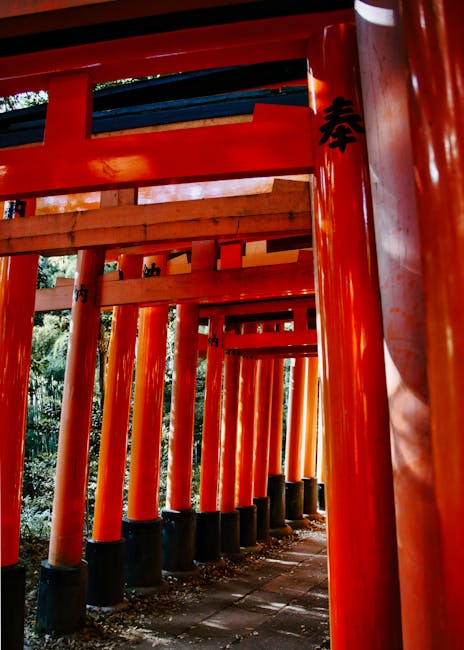
“Is it worth hiking all the way to the top of Mount Inari?”
Short answer: if you have the time and energy, absolutely yes. But many visitors only walk through the famous Senbon Torii and turn back — missing the quietest, most spiritual part of the mountain. This guide covers everything you need to decide how far to go, what to see, and how to make the most of your visit.
Fushimi Inari Taisha, founded in 711 AD, is the head shrine of approximately 30,000 Inari shrines across Japan. The deity Inari governs business prosperity, abundant harvests, and good fortune. It’s one of Japan’s most popular shrines — and it’s free and open 24 hours a day.
Quick Facts
| Detail | Info |
|---|---|
| Admission | Free |
| Hours | 24 hours (the charm counter and goshuin have separate hours — check on the day) |
| Time needed | 1-3 hours |
| Best time | Early morning is calmer than midday, but crowds start early |
| Nearest station | JR Inari (directly in front) |
| Phone | 075-641-7331 |
Find Your Guide
What brings you to Fushimi Inari? Choose your path:
| If you are… | Read this guide |
|---|---|
| Day tripping from Osaka | Complete Day Trip Guide |
| Photography focused | Photography Guide: Best Spots & Times |
| Visiting at night | Night Visit Guide |
| Hiking to the summit | Hiking Guide: Trail & Difficulty |
| Interested in history, charms & spiritual benefits | Continue reading below |
What Makes Fushimi Inari a Power Spot — 3 Reasons
1. The Pinnacle of 1,300 Years of Inari Faith
Founded in 711 AD, Fushimi Inari enshrines Ukanomitama-no-Okami, the deity of abundant harvests. The name “Inari” derives from “ine-nari” (rice growing). From the Muromachi period onward, merchants spread the Inari faith as a guardian of business prosperity, and by the Edo period, “O-Inari-san” was beloved by common people throughout Japan. Today, all 30,000 branch shrines trace their origins to this single mountain.
2. The Entire Mountain Is Sacred Ground
Mount Inari (233 meters) isn’t just a scenic backdrop — the mountain itself is the deity’s domain. Sacred sites dot the slopes: Ichi-no-mine (summit), Ni-no-mine, San-no-mine, the mysterious Kumataka-sha, and countless small stone shrines (otsuka) — the shrine’s official website says they number in the tens of thousands. Walking only the base means seeing just the entrance to this mountain.
3. Open 24 Hours — A Rare Sacred Site
Unlike most shrines with fixed hours, Fushimi Inari welcomes visitors at any hour. At 6 AM, morning mist shrouds the torii gates in an ethereal haze. After dark, the illuminated Senbon Torii takes on an entirely different, more mystical character. Each time of day reveals a different face of this sacred mountain.
The Senbon Torii and Mount Inari’s Power Spots
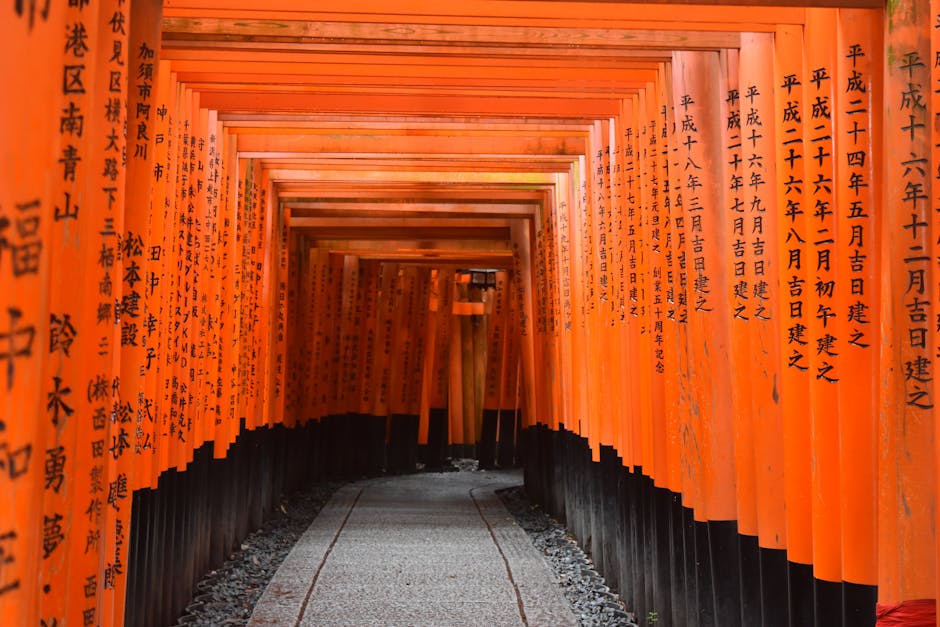
Senbon Torii — Where Prayers “Pass Through”
Approximately 800 torii gates line the path from the main hall to the Okusha worship hall, forming a continuous vermilion tunnel. The gates are said to let prayers “pass through” to the gods.
The gates have been donated since the Edo period, either to have a wish “pass through” or in thanks for a wish granted. On the back of each gate, you’ll find the donor’s name and dedication date. Gates are still accepted as offerings today; applications can be made at the shrine office or at the teahouses on Mount Inari.
One visitor described walking through the gates like this:
“As I walked on through the Senbon Torii with its rows of vermilion gates, there were moments when, strangely, my mind grew calm even amid the bustle, and I felt as if I had stepped a little away from everyday life.”
「朱色の鳥居が連なる千本鳥居を進むと、にぎわいの中にも不思議と心が落ち着く瞬間があり、日常から少し離れたような感覚になりました。」— Translated by the editors from a visitor post on Hotokami (visited February 2026, original post)
Omokaru-ishi — The Wish-Granting Stones
At the Okusha worship hall, a pair of round stones sits atop stone lanterns. Make a wish, then lift a stone: it is said that if it feels lighter than expected, your wish will come true, and if heavier, it may be harder to come true. Expect a queue at busy times.
Ne-agari no Matsu — The “Rising Roots” Pine
Ne-agari no Matsu is to the left of the Okusha worship hall, at the entrance to the mountain circuit. The pine itself has died; what is enshrined today is the part of its roots that rose above the ground and split in two. It has long been worshipped by ordinary people: because “ne-agari” (rising roots) sounds like “ne-agari” (rising prices), it is said to bring rising prices, and it is also said to ease aches in the legs and hips. It is also known as “Hiza-matsu-san” (the knee pine). It’s a short walk from the Omokaru-ishi stones.
Ichi-no-mine (Summit) — The Highest Sacred Site on the Mountain
Ichi-no-mine (Upper Shrine) stands at the summit of Mount Inari (233 m). The shrine here venerates Suehiro-Okami, whose name means “spreading wider” — an auspicious sign for business expansion and financial growth.
Crowds thin out sharply beyond Yotsuji, so at the summit you can pray in relative quiet.
Fox Statues — What They Hold and What It Means
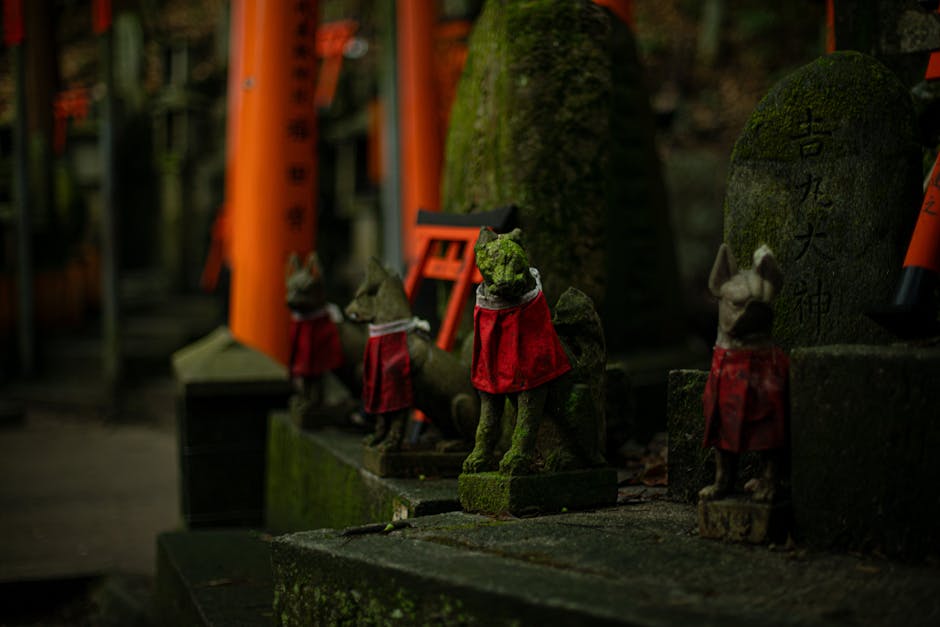
White fox (kitsune) statues appear throughout the grounds — foxes are Inari’s divine messengers, originally valued for protecting crops by hunting mice. Look closely at what each fox holds in its mouth:
- Key — Opens the storehouse of wealth (prosperity and savings)
- Sacred jewel — Represents Inari’s spiritual power (wish fulfillment)
- Scroll — Symbolizes wisdom (academic success and knowledge)
- Rice stalk — The source of abundance (bountiful harvests)
Should You Hike to the Summit? Honest Advice
Many people search “Is it worth climbing Mount Inari?” or “Should I skip the upper trails?” Here’s an honest breakdown:
Why Some Say “Don’t Bother”
1. Physical challenge: 4 km round trip, summit elevation 233 m, 2-3 hours. The upper sections have steep stone steps
2. No dramatic viewpoint at the summit: The view over Kyoto is lower down, at Yotsuji (the halfway point)
3. Atmosphere change: Beyond Yotsuji, tourist crowds vanish and the mountain path becomes quieter and darker — some solo visitors feel uneasy
Why You Should Go Anyway
- Pray at the summit: Ichi-no-mine is the highest sacred site on the mountain
- Escape the crowds: Beyond Yotsuji, you’ll have the path largely to yourself
- Sense of accomplishment: Completing the circuit brings a genuinely uplifting feeling
Trail Section Guide
| Section | Time | Difficulty | Highlights |
|---|---|---|---|
| Main hall → Senbon Torii → Okusha | 20 min | Easy | Thousand Torii Gates, Omokaru-ishi stones |
| Okusha → Mitsuji | 15 min | Moderate | Continued torii-lined path |
| Mitsuji → Yotsuji | 15 min | Somewhat steep | Wide view over Kyoto (many turn back here) |
| Yotsuji → Ichi-no-mine (summit) | 30 min | Strenuous | Ichi-no-mine, Ni-no-mine, San-no-mine shrines |
| Ichi-no-mine → Yotsuji → Main hall | 40 min | Downhill | Can descend via a different route |
Recommendation: Short on time? Turn back at Yotsuji after taking in the view. Want to pray at the summit? Continue to Ichi-no-mine.
If you’re unsure whether to go, here’s what one visitor who climbed to the top wrote:
“I hesitated a little, but decided to go after all. Many people headed back down partway, and the crowds gradually thinned. … There were many small shrines along the way, and I stopped to rest at each one before reaching the summit.”
「少し躊躇しましたが、やはり行ってみることにしました。途中で下山する人も多く、だんだんと人が少なくなって行きました。…道中はたくさんの祠があり、その都度立ち止まって休憩しながら山頂到着。」— Translated by the editors from a visitor post on Hotokami (visited February 2026, original post)
Spiritual Benefits and Blessings
Business Prosperity and Financial Fortune
Fushimi Inari’s best-known blessing. The Inari deity began as a god of abundant harvests, and the idea of a rich harvest came to be linked with thriving business. Business owners and entrepreneurs from across Japan make regular pilgrimages. The torii gate donations themselves are an act of praying for business success, and the tradition has continued for centuries.
Career Success and Professional Growth
Beyond business owners, the shrine offers blessings for career advancement. The Oyama-meguri pilgrimage — overcoming physical challenges to reach the summit — is seen as symbolic of professional achievement.
Spiritual Purification
Walking through the sacred forest of Mount Inari has long been seen as purifying.
Best Omamori (Charms): Top 5 Picks
If the charm counter feels overwhelming, here are five picks by purpose from the charms introduced on the shrine’s official website. Names and offering fees follow the official site (checked September 2026; the site shows only some of the charms, and the counter has others too).
1. Tassei Mamori (Achievement Charm) — 1,000 yen
The official site describes it as “a charm for letting your wish pass through” — the same words used for the torii gates. For work or personal goals.
2. Shobai Hanjo Mamori (Business Prosperity Charm) — 1,000 yen
A fitting charm from the head shrine of business prosperity, for anyone running a shop or business.
3. Takara Mamori (Treasure Charm) — 1,500 yen
Described on the official site as a charm for inviting financial fortune.
4. Byoki Heiyu Mamori (Recovery Charm, in a paulownia box) — 2,000 yen
Described on the official site as a charm for full recovery from illness. It comes in a wooden box, which also makes it suitable to bring to someone who is ill.
5. Gakutoku Mamori / Gokaku Mamori (Study / Exam Charms) — 800 yen each
Gakutoku Mamori for success in studies, Gokaku Mamori for entrance exams.
Where to get them: The charm counter near the main hall. Hours can change by season and event, so check on the day. During peak periods (New Year, autumn), expect queues. The official site also suggests replacing charms once a year.
Best Times to Visit
Spring (March-May) ★★★★★
Cherry blossoms (late March to early April) create stunning contrasts with vermilion gates. Temperatures of 15-22°C are perfect for hiking. May brings beautiful fresh greenery throughout the sacred forest. Avoid: Cherry blossom weekends and Golden Week — visit before 8 AM.
Summer (June-August) ★★★☆☆
Rainy season (mid-June to mid-July) brings fewer tourists and the wet torii gates glow a deeper vermilion. Late July through August exceeds 30°C with high humidity — climb before 9 AM. Bring water, a hat, and sunscreen. Summer night visits offer a cool, mystical alternative.
Autumn (September-November) ★★★★★
Peak autumn foliage (mid to late November) plus vermilion torii creates spectacular colors. The Yotsuji viewpoint overlooking Kyoto framed by autumn leaves is unforgettable. Weekday mornings may be crowded with school trips.
Winter (December-February) ★★★★☆
Crisp, serene atmosphere with fewer tourists. January 1-3 is extremely crowded, and the shrine’s parking lots are closed from December 30 to January 6 — come by train. On rare snowy mornings, the snow-covered Senbon Torii is breathtaking.
Worship and Visiting Guide
How to Worship (Step by Step)
1. Enter through the Romon Gate
Just steps from JR Inari Station, this magnificent gate — built by Toyotomi Hideyoshi in 1589 — marks the entrance. Bow once before entering.
2. Purify at the Temizuya
Right hand holds ladle → rinse left hand → switch → rinse right hand → cup water in left palm to rinse mouth → hold ladle vertically to cleanse the handle.
3. Worship at the Main Hall
Two bows, two claps, one bow (nihai-nihakushu-ichihai): bow twice deeply, clap twice at chest height, offer your silent prayer, bow once more.
4. Walk Through the Senbon Torii
Follow the path from the right side of the main hall. Walk slowly — when taking photos, keep moving to avoid blocking others.
5. Try the Omokaru-ishi
At the Okusha worship hall, focus on your wish and lift a stone. It’s said that if it feels lighter than expected, your wish will come true.
6. Oyama-meguri (If Time Permits)
The full mountain circuit takes about 2-3 hours. Visit Kumataka-sha, Mitsuji, and Yotsuji at your own pace.
Time Estimates
- Main hall worship only: 30 minutes
- Including Senbon Torii to Okusha: 1 hour
- Full Oyama-meguri (summit round trip): 2-3 hours
What to Wear
- Shoes: Sneakers or walking shoes (essential for Oyama-meguri). No heels or sandals — there are many stairs
- Bring: Water bottle, small towel, hat (summer), warm layers (winter), flashlight (evening visits)
Essential Information
Access
By Train
- JR Nara Line: “Inari Station” (2 stops from Kyoto Station, about 5 minutes). The shrine is directly in front of the station exit
- Keihan Main Line: “Fushimi Inari Station,” 5-minute walk
By Bus
- Kyoto City Bus Route Minami 5 (南5) to “Inari Taisha-mae,” then a 7-minute walk east
By Car
- From Meishin Expressway “Kyoto Minami IC”: approximately 20 minutes
- Parking for worshippers only (no parking for other purposes). Roads around the shrine get very congested, and the shrine itself asks visitors to use public transport
- The shrine’s parking lots are closed from December 30 to January 6
Basic Information
- Address: 68 Fukakusa Yabunouchicho, Fushimi-ku, Kyoto 612-0882
- Phone: 075-641-7331
- Worship hours: 24 hours (the charm counter and goshuin have separate hours — check on the day)
- Admission: Free
- Time required: 1-3 hours
- Goshuin (shrine seal): Available at the counter near the main hall, and also at worship halls on the mountain. Offering fees and hours can change — check on the day
- Official website: https://inari.jp/
Nearby Attractions
Local Dining
Nezameya (Traditional Inari Sushi) — A long-established shop in front of the shrine, known for its inari sushi. Hours and closing days can change, so check its website before you go.
Kyozuan Fushimi Inari (Tofu and Soy Milk Sweets) — On the approach. Sweets made with tofu and soy milk, good for a rest after your visit.
Torisei Honten (Yakitori and Sake) — Run by a Fushimi sake brewery. Note that it’s not right next to the shrine but in the Fushimi sake-brewery district (Kamiaburakake-cho, Fushimi Ward) — pair it with the sake breweries below.
Eating inside the grounds: The shrine prohibits eating and drinking anywhere in the grounds except designated areas (the free rest area), including eating while walking. Enjoy food from the approach shops inside the shop or outside the grounds.
Nearby Sightseeing
Tofukuji Temple (15-minute walk) — One of Kyoto’s Five Great Zen Temples, famous for stunning autumn foliage from Tsuten Bridge. Tsuten Bridge and the gardens charge admission; fees and hours change by season, so check the temple’s website.
Fushimi Sake District (by train) — One of Japan’s premier sake regions. Places such as the Gekkeikan Okura Sake Museum introduce the history of sake making (admission differs by facility).
Suggested Itineraries
Half-Day (3 hours)
9:00 AM — Arrive at JR Inari Station
9:05 AM — Main hall worship
9:30 AM — Senbon Torii to Okusha
10:00 AM — Omokaru-ishi stones
10:30 AM — Rest at Kyozuan
11:00 AM — Souvenir shopping on approach street
12:00 PM — Lunch at Nezameya
Full Day (about 8.5 hours)
8:00 AM — Arrive (less crowded than midday)
8:05 AM — Main hall worship
8:30 AM — Begin Oyama-meguri
9:30 AM — Take in the view of Kyoto from Yotsuji
10:00 AM — Pray at Ichi-no-mine (summit)
11:30 AM — Descend to Okusha and Ne-agari no Matsu
12:00 PM — Lunch at inari sushi restaurant
1:00 PM — Explore shopping street
2:00 PM — Walk to Tofukuji Temple
3:30 PM — Take the train to the Fushimi sake district and tour the breweries
4:30 PM — Relax at Torisei
Frequently Asked Questions
Q: How do I get here from Osaka?
A: JR Special Rapid to Kyoto, then JR Nara Line to Inari (about 5 minutes from Kyoto). Allow about 50 minutes in total. See our complete Day Trip Guide for step-by-step instructions.
Q: How long does a visit take?
A: Main hall alone: about 30 minutes. Including Senbon Torii: 1 hour. Full mountain circuit: 2-3 hours. See our Hiking Guide for trail details.
Q: Is the mountain hike suitable for beginners?
A: It’s moderately challenging with many stairs and a 4 km round trip. However, you can turn back at any point — many people stop at Yotsuji (about halfway), where there’s a wide view over the city. Sneakers and water are essential. See our Hiking Guide for difficulty levels.
Q: When is the best time to photograph without crowds?
A: Earlier is calmer, but these days there are many visitors even in the early morning, and a completely empty Senbon Torii is rare. The shrine prohibits blocking other visitors on the narrow path to take photos, as well as commercial photography — step aside to a wider spot before shooting. See our Photography Guide for spots and tips.
Q: Is nighttime worship safe?
A: At night, stay around the main hall and the Senbon Torii. The mountain paths have few lights, and you may meet wild animals such as wild boars — don’t hike the mountain at night, alone or in a group. See our Night Visit Guide for safety details.
Q: Where can I get a goshuin (shrine seal)?
A: At the counter near the main hall. Worship halls on the mountain, such as the Okusha and Gozendani Hōhaisho, have their own goshuin too — collectors should combine with the Oyama-meguri. Offering fees and hours can change, so check on the day.
Q: Is there parking?
A: There is parking for worshippers, but the surrounding roads get very congested and the shrine asks visitors to use public transport. The shrine’s parking lots are closed from December 30 to January 6.
Q: Can I bring my pet?
A: The shrine prohibits walking or visiting with dogs or other pets (service animals needed for worship are an exception). If traveling with a pet in Kyoto, leave it at a pet hotel before your visit, or combine your trip with pet-friendly walks such as along the Kamo River.
Guides for Different Visitors
Wheelchair and Stroller Users
The area around the main hall is relatively flat and accessible. However, the Senbon Torii area and beyond involves many stone steps and is not wheelchair or stroller accessible. You can still worship at the main hall and get omamori. For questions, contact the shrine office (075-641-7331). Note that the shrine prohibits leaving strollers anywhere other than designated places.
Rainy Day Visitors
Rain actually enhances the Fushimi Inari experience — wet torii gates glow a deeper, more vivid vermilion, and crowds thin significantly. The mountain paths can be slippery, so wear shoes with good grip. Bring an umbrella rather than a raincoat for easy photography. The covered shopping street near the entrance offers shelter for breaks.
Goshuin Collectors
Besides the counter near the main hall, worship halls on the mountain have their own goshuin, so plan for the full 2-3 hour mountain circuit if you collect them. A visitor in June 2026 wrote:
“At the main hall, Gozendani Hōhaisho, and Koshigami Fudō Shrine, handwritten goshuin are available. The other, colored ones are pre-written, but all of them are 500 yen.”
「御朱印は、本殿と御膳谷奉拝所、腰神不動神社は直筆あり。他カラーのものは書き置きですが、すべて500円です。」— Translated by the editors from a visitor post on Hotokami (visited June 2026, original post)
Offering fees and hours can change, so check on the day.
Related Guides
- Fushimi Inari from Osaka: Day Trip Guide – Train routes, costs, and itinerary
- Fushimi Inari Photography Guide – Best spots, times, and camera settings
- Fushimi Inari Night Visit Guide – Safety, lighting, and what to expect
- Fushimi Inari Hiking Guide – Trail difficulty, toilets, and rest stops
Summary: 5 Key Takeaways
1. Head shrine of 30,000 Inari shrines: Japan’s most important site for business prosperity and financial fortune
2. Charms by purpose: Tassei Mamori for letting a wish “pass through,” Shobai Hanjo Mamori for business, Takara Mamori for financial fortune (names and fees checked on the official site)
3. Hike at least to Yotsuji: There’s a wide view over Kyoto at the halfway point. To pray at the summit, continue to Ichi-no-mine
4. Even early mornings are busy: Earlier is calmer, but even at 7 AM there are many visitors. For quiet, climb beyond Yotsuji
5. Ne-agari no Matsu is to the left of the Okusha worship hall: What’s enshrined is the root of a pine that has died — an easy stop together with the Omokaru-ishi stones
Last updated: September 2026 (charms, parking, access, and shrine rules checked on the official website in September 2026; the 4 km distance checked on Kyoto City’s official tourism site the same month). Please check the official website for the latest information before your visit.