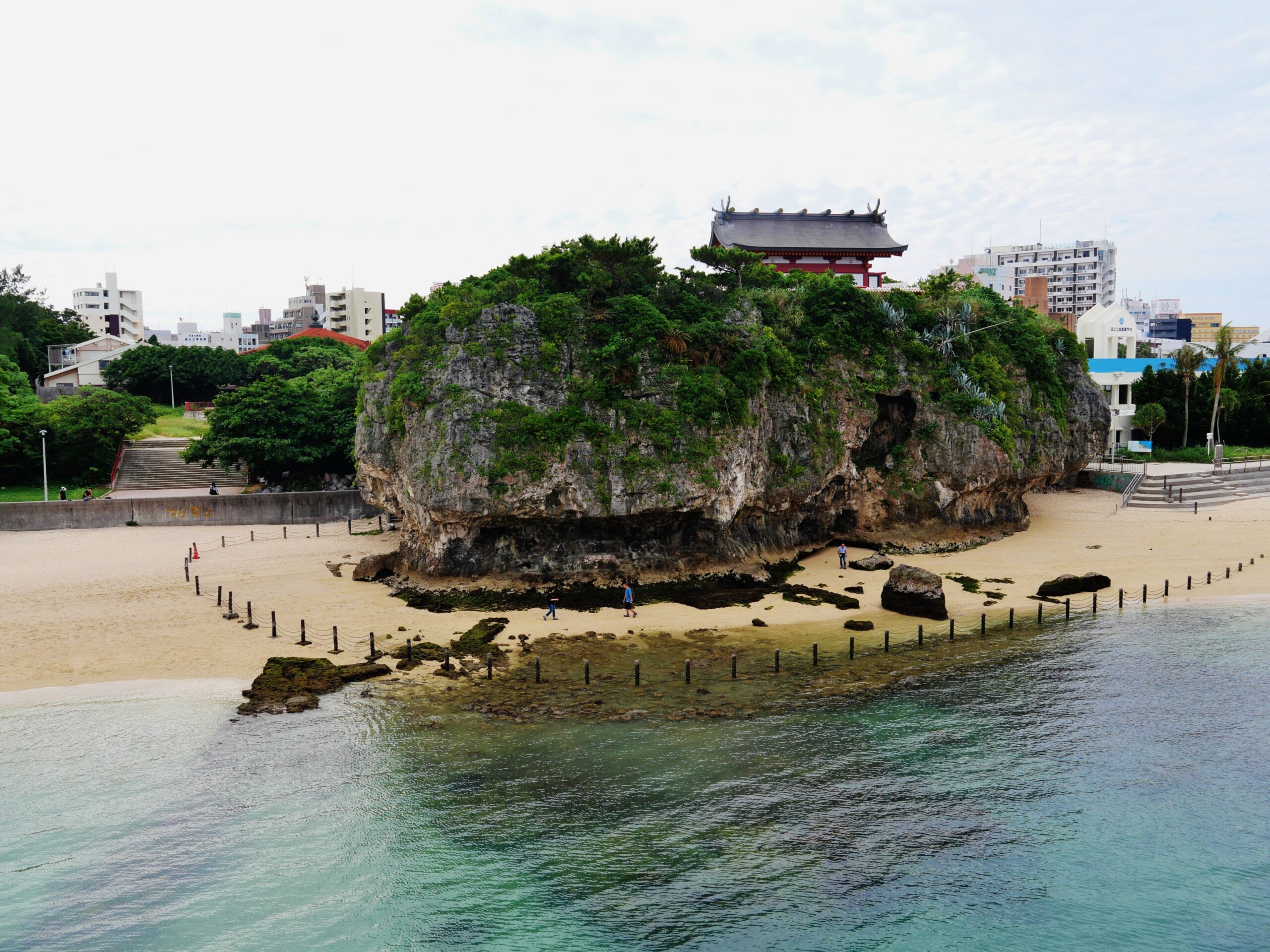
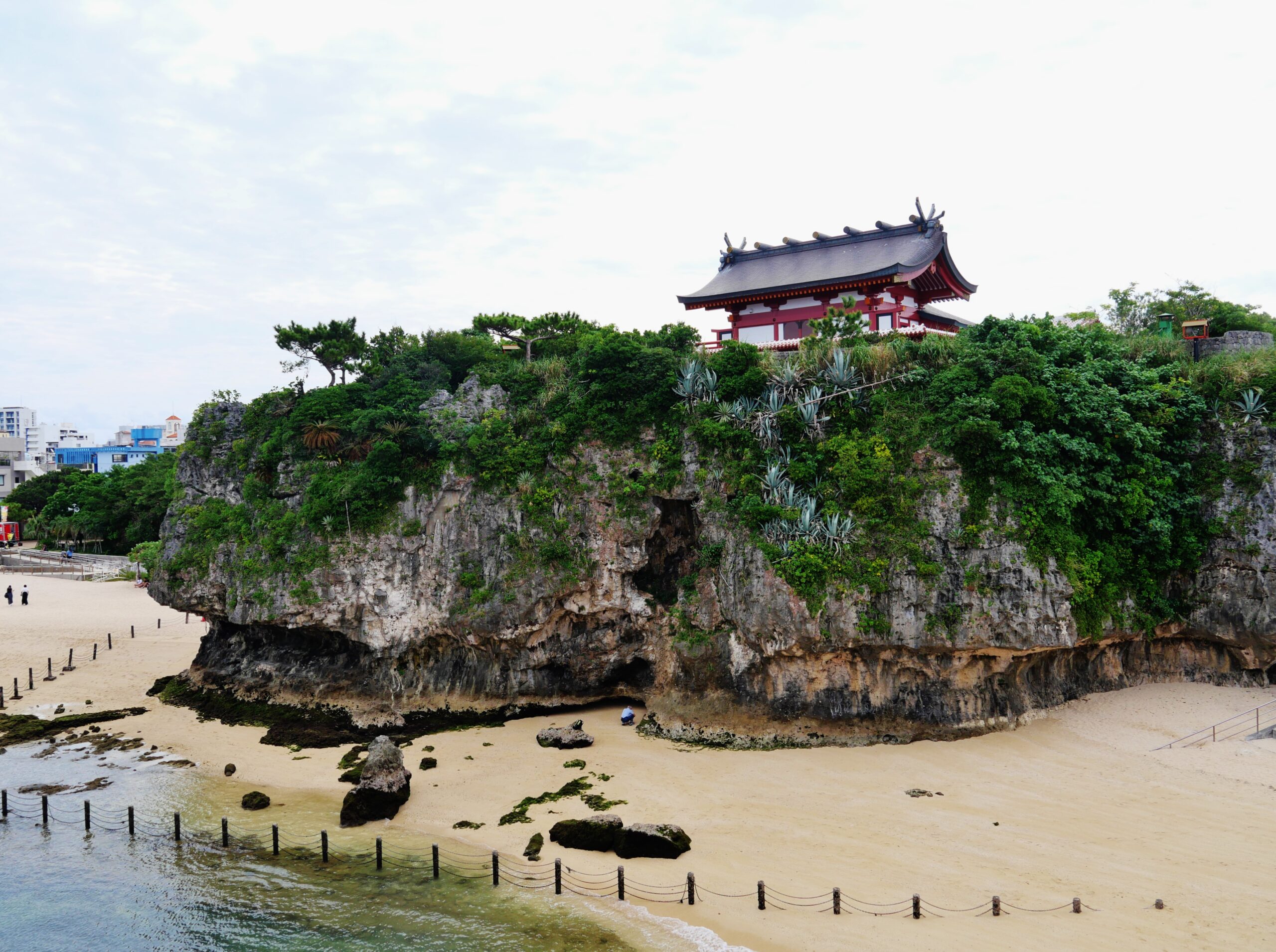
A shrine perched on a cliff directly above a public beach in the middle of a city—that alone makes Naminoue Shrine one of the most visually striking sacred sites in Japan. But what draws visitors beyond the scenery is the spiritual weight of this place: Naminoue-gu is the highest-ranked of the Ryukyu Hassha (the eight royal shrines of the Ryukyu Kingdom) and has served as the guardian shrine of all Okinawa for centuries.
Standing at the cliff’s edge, looking out over turquoise water, you are gazing toward Nirai Kanai—the Okinawan paradise believed to lie beyond the sea, from which all blessings flow. This is not a metaphor. This is the specific direction and place where the Ryukyuan people have prayed for protection, safe voyages, and abundant harvests since before written records began.
The shrine is walkable from central Naha, combinable with Naminoue Beach for a swim, and reachable from Kokusai Street in 10 minutes by taxi. For international visitors with limited time in Okinawa, this is one of the most rewarding and accessible power spots on the island.
What Makes Naminoue Shrine Special
The Highest-Ranked Shrine of the Ryukyu Kingdom
The Ryukyu Kingdom (1429–1879) maintained eight royal shrines collectively known as the “Ryukyu Hassha.” Naminoue Shrine held the top position—making it the most important shrine in the entire kingdom. While the Ryukyu Islands had their own indigenous spiritual tradition centered on utaki (sacred groves) and priestesses, Shinto shrines were introduced through contact with mainland Japan. Naminoue Shrine represents the intersection of these two spiritual worlds.
The shrine’s founding predates the unified Ryukyu Kingdom. Local tradition holds that a fisherman discovered a luminous object on this cliff and that the site became a place of prayer long before any formal shrine buildings existed. Over time, the Kumano deities were enshrined here: Izanami-no-Mikoto, Hayatamao-no-Mikoto, and Kotosakaoo-no-Mikoto—the same deities worshipped at the great Kumano shrines on the Japanese mainland.
Nirai Kanai: The Paradise Beyond the Sea
To understand why Naminoue Shrine was built on this particular cliff, you need to understand Nirai Kanai—one of the most important concepts in Okinawan spirituality.
Nirai Kanai is the Okinawan concept of a paradise beyond the eastern sea—not an afterlife, but a source realm from which the gods bring all good things: harvests, healthy children, rain, and safe return for sailors.
Naminoue Shrine faces the open sea. When you stand at the cliff and look outward, you are looking toward Nirai Kanai. This is precisely why this cliff was chosen as Okinawa’s most sacred spot—it stands at the threshold between the human world and the divine realm across the sea.
This differs fundamentally from mainland Shinto, which locates spiritual power in mountains and forests. In Okinawa, the ocean is the primary spiritual direction. Understanding this transforms a visit to Naminoue from sightseeing into something more meaningful.
Destruction and Rebirth
During the Battle of Okinawa in 1945—one of the bloodiest battles of the Pacific War—Naminoue Shrine was completely destroyed. The cliff itself was scarred by shelling. In a wider context, approximately one-quarter of Okinawa’s civilian population perished during the battle, and nearly every cultural site on the island was reduced to rubble.
The shrine’s reconstruction began in the postwar years, with the current main hall completed in 1953. For Okinawans, rebuilding Naminoue Shrine was not simply restoring a building. It was an act of cultural recovery—a declaration that Okinawan spiritual identity had survived. Today, the rebuilt shrine serves over 250,000 worshippers during the New Year period alone, making it the single busiest hatsumode (first shrine visit of the year) destination in Okinawa Prefecture.
The Cliff Itself
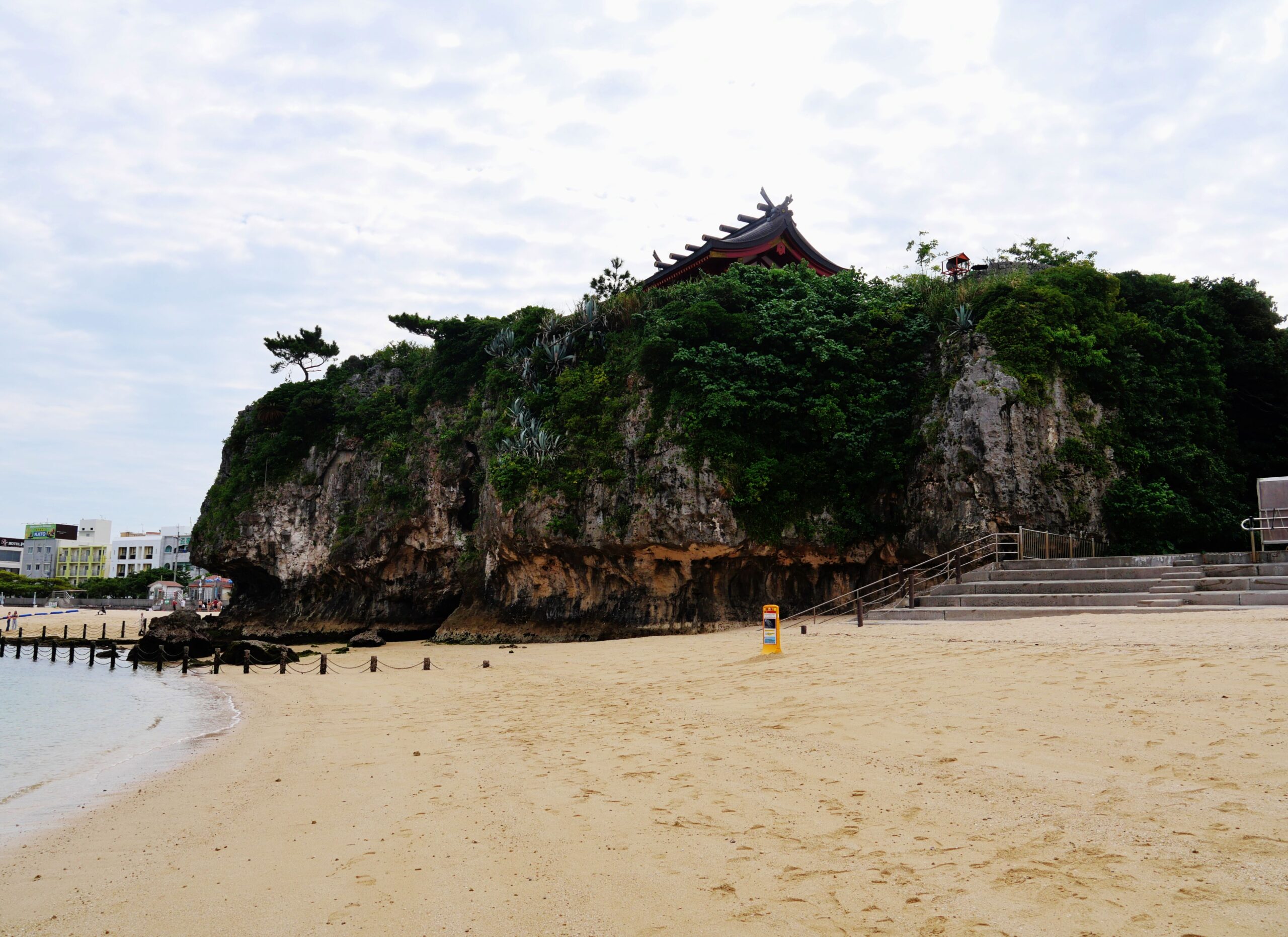
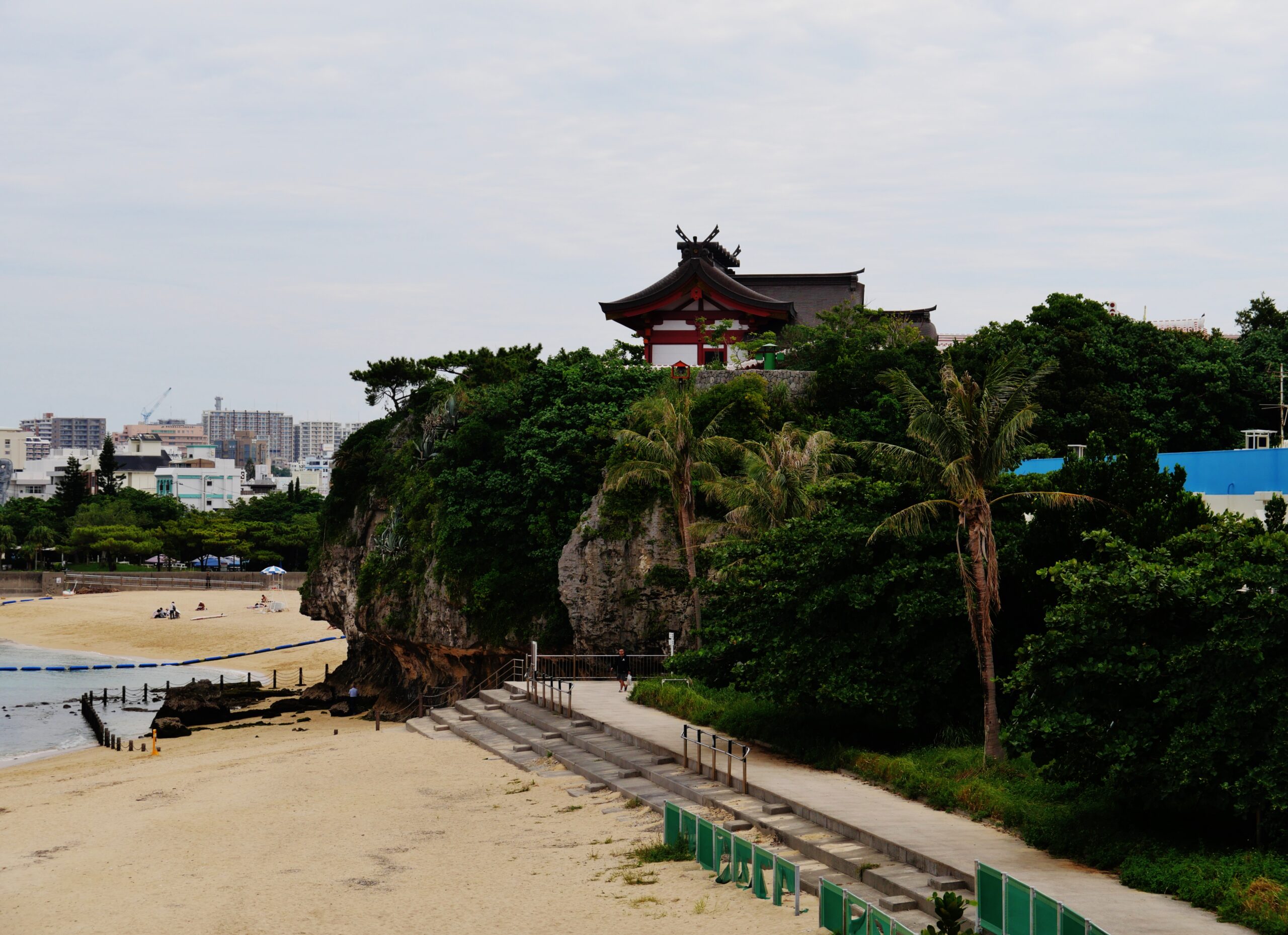
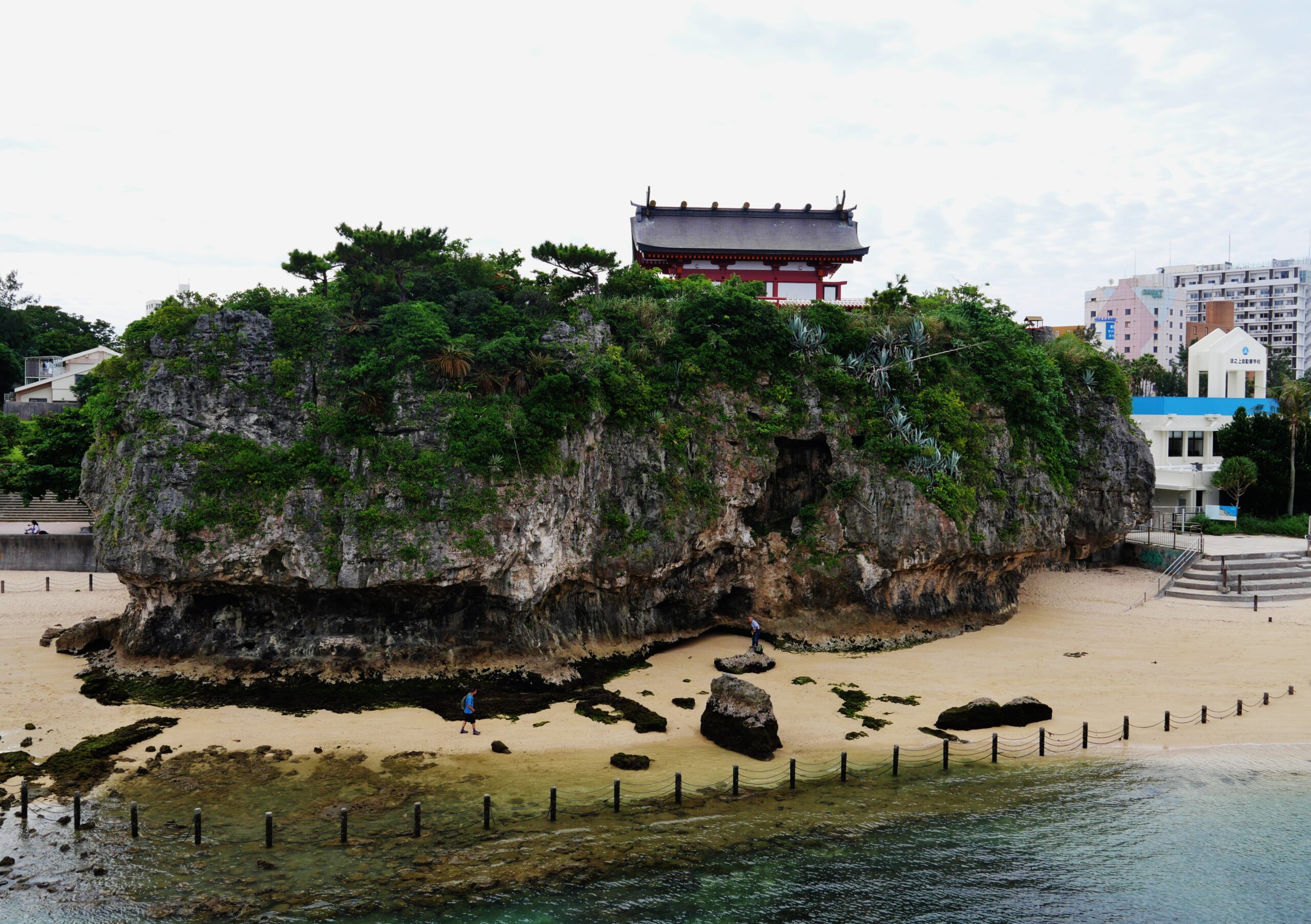
The Ryukyu limestone cliff rises roughly 20 meters above the beach, shaped by centuries of wind and wave erosion. The cliff face shows layers of ancient coral reef limestone—a reminder that this land was once beneath the sea. A modern highway bridge passes directly beside the cliff, creating a surreal contrast: tropical beach, ancient limestone, sacred shrine, and 21st-century infrastructure all in one frame.
Spiritual Benefits
Naminoue Shrine is associated with a broad range of blessings, reflecting its role as the guardian shrine of all Okinawa:
- Protection from Evil (Yakuyoke): The primary destination in Okinawa for yakuyoke—prayers to ward off misfortune. Okinawans visit during their yakudoshi (unlucky years) as a matter of course.
- Safety at Sea and in Travel: Blessings for safe voyages—whether by sea or air—have been sought here for centuries, given the shrine’s ocean-facing position toward Nirai Kanai.
- Business Prosperity: The association with abundant harvests from Nirai Kanai extends to modern business success.
- Matchmaking (En-musubi): Couples visit to pray for lasting relationships.
- Bountiful Fishing: Historically one of the shrine’s core blessings. Fishing communities still make offerings here before major seasons.
Best Time to Visit
Year-Round Warmth
Okinawa’s subtropical climate means Naminoue Shrine is comfortable to visit in every season. There is no “bad” time, but each period offers a different experience:
Winter (December–February): Temperatures range from 15–20C (59–68F). Comfortable for walking and worship. The beach is too cool for swimming but beautiful for photography. Far fewer tourists than summer. New Year (January 1–3) is the major exception—over 250,000 people visit for hatsumode, and the shrine grounds become extremely crowded. If you want to experience the energy, arrive early on January 1st. If you want a peaceful visit, avoid the first three days entirely.
Spring (March–May): Temperatures of 20–26C (68–79F). The shrine grounds are lush and green. An excellent time for a calm visit with pleasant weather.
Summer (June–October): Best for combining the shrine with the beach. Temperatures of 28–33C (82–91F). Naminoue Beach is officially open April to October. Mornings are best—worship at 8:00 AM, swim by 10:00 AM before midday heat peaks. Typhoon season runs July to October; check forecasts.
Autumn (November): Temperatures around 22–26C (72–79F). Fewer tourists than summer. The beach is technically closed but water is still warm enough for wading.
Best Times of Day
- 7:00–8:00 AM: The shrine opens early. Morning light on the cliff is beautiful, and you will have the grounds nearly to yourself.
- Late Afternoon (4:00–5:30 PM): Sunset colors over the ocean behind the shrine create dramatic photography conditions. The cliff face glows amber and orange.
- Avoid Midday in Summer: Between 11:00 AM and 2:00 PM in July–September, the combined heat and sun exposure on the exposed shrine grounds can be intense. There is limited shade.
Visitor’s Guide: How to Worship
Prayer Etiquette
Naminoue Shrine follows the standard Shinto worship format:
1. Torii Gate: Bow once before passing through. Walk to either side, not the center (the center path is reserved for the deity).
2. Temizuya (Purification Fountain): Rinse your left hand, then right hand. Pour water into your cupped left palm and rinse your mouth (do not drink directly from the ladle). Tilt the ladle to rinse its handle.
3. Main Hall: Toss a coin into the offering box (JPY5 coins are considered auspicious—the word for “five yen” sounds like “good connection” in Japanese). Bow twice, clap twice, make your prayer silently, then bow once more.
Unique Charms and Amulets
Naminoue Shrine’s amulet office offers several distinctive items:
- Ocean Safety Charm (Kaijou Anzen): Unique to this ocean-facing shrine. Popular with divers, surfers, and anyone traveling by sea or air. (JPY800)
- Yakuyoke Charm: For protection against misfortune. The shrine’s most popular amulet. (JPY800)
- Matchmaking Charm (En-musubi): For those seeking romantic connections. (JPY800)
- Traffic Safety Charm: For safe driving and travel. (JPY800)
- Bingata-style Charm Bag: Some seasonal charms feature designs inspired by Okinawa’s traditional bingata textile dyeing—a beautiful souvenir unique to this shrine. (Availability varies)
Goshuin (Shrine Seal)
Naminoue Shrine offers a goshuin (calligraphic stamp and seal) for JPY300–500. The design features bold brushwork with the shrine name and date. Available during amulet office hours (approximately 9:00 AM–5:00 PM). During busy periods like New Year, expect a wait of 10–20 minutes.
Beach and Shrine Combo Plan
This is what makes Naminoue Shrine truly unique among Japanese power spots: you can combine a spiritual visit with a beach day in a single morning, all within walking distance.
Model Course: Morning Worship to Afternoon Beach (4 hours)
| Time | Activity | Details |
|——|———-|———|
| 8:00 AM | Arrive at Naminoue Shrine | Walk from Asahibashi Station (15 min) or take a taxi |
| 8:00–8:30 AM | Worship at Main Hall | Morning prayer in the quiet of early hours |
| 8:30–9:00 AM | Explore shrine grounds | View the cliff edge, visit amulet office when it opens |
| 9:00–9:15 AM | Walk down to Naminoue Beach | The beach is directly below the shrine cliff (3 min walk) |
| 9:15–11:00 AM | Swim and relax at the beach | Lockers, showers, and changing rooms available (JPY200–300) |
| 11:00–11:30 AM | Rinse off and change | Beach facilities close at varying times by season |
| 11:30 AM–12:00 PM | Lunch at a nearby restaurant | See recommendations below |
Naminoue Beach Essentials
- Open: Officially April–October (swimming). Accessible year-round for walking.
- Facilities: Restrooms, showers, changing rooms, lockers (JPY200–300). Beach umbrella and chair rental available in summer.
- Water: Clean and monitored. Lifeguards on duty during official swim season.
- Size: Approximately 100 meters of sand. Naha’s only public beach—can get crowded on summer weekends.
- Umisora Park: Adjacent elevated park connecting the shrine to the beach, with benches, walking paths, and panoramic ocean views. Free admission.
Understanding Okinawan Spirituality
If you have visited shrines in Kyoto or Tokyo, Naminoue Shrine may feel subtly different. Here is why:
Utaki vs. Shrines: Okinawa’s indigenous sacred sites are called “utaki”—natural places (groves, caves, cliffs) where the divine resides, with no buildings. Sefa Utaki (UNESCO World Heritage Site) is the most famous example. Shrines like Naminoue-gu represent a later layer, introduced through mainland contact, overlaying Shinto ritual onto locations already considered sacred in the Ryukyuan belief system.
The Direction of Prayer: In mainland Shinto, the sacred direction is inward—toward mountains or the inner sanctum. In Okinawan spirituality, the sacred direction is outward—toward the sea and horizon. At Naminoue Shrine, facing the ocean means facing the same direction Okinawans have prayed toward for centuries.
Noro Priestesses: The Ryukyu Kingdom’s spiritual life was led by female priestesses called “noro.” The highest-ranking, the Kikoe-okimi, held authority comparable to the king in spiritual matters. This matriarchal spiritual tradition still echoes in modern Okinawan practice.
Practical Information
Access
Address: 1-25-11 Wakasa, Naha, Okinawa Prefecture 900-0031
From Yui Rail (Okinawa Monorail):
- Asahibashi Station: 15-minute walk southwest. Cross the Kumoji River and follow the signs toward Naminoue Beach.
- Kencho-mae Station: 15-minute walk west. Head toward the waterfront and follow coastal signs.
- Miebashi Station: 12-minute walk (the closest station, though less commonly listed in guides).
By Taxi:
- From Kokusai Street: approximately 10 minutes, JPY700–1,000
- From Naha Airport: approximately 15 minutes, JPY1,500–2,000
- From Shuri Castle: approximately 20 minutes, JPY1,500–2,500
By Car:
- Small parking lot available near the shrine (limited spaces, fills quickly on weekends and holidays)
- Coin parking lots in the surrounding Wakasa and Tsuji neighborhoods: JPY200–400/hour
By Bus:
- Naha Bus Route 2 or 5 to “Nishi-Muido” (西武門) bus stop, then 5-minute walk
Visiting Details
| Item | Details |
|——|———|
| Hours | Shrine grounds open 24 hours. Amulet office approximately 9:00 AM–5:00 PM. |
| Closed | Open year-round |
| Admission | Free |
| Visit Duration | 30–45 minutes (shrine only); 3–4 hours (shrine + beach combo) |
| Phone | 098-868-3697 |
| Website | http://naminouegu.jp/ |
Surroundings and Nearby Attractions
Within Walking Distance
- Gokoku-ji Temple: Directly adjacent (2-minute walk). This Shingon Buddhist temple, also destroyed in WWII and rebuilt, pairs with the shrine in the traditional Japanese pattern of shinbutsu-shugo (shrine-temple coexistence).
- Tsuji District: The surrounding neighborhood features local restaurants, izakaya, and Okinawan soba shops. A good area for lunch—Okinawa soba runs JPY600–900 per bowl.
- Fukushu-en Garden: A Chinese-style garden in Kume (10-minute walk). Built to commemorate the Okinawa-Fujian Province connection. Free admission.
Short Taxi Ride (10–20 minutes)
- Kokusai Street (Kokusai-dori): Naha’s main tourist street, 10 minutes by taxi. Souvenir shops, restaurants, and the Makishi Public Market—a two-floor market where you buy fresh seafood downstairs and have it cooked upstairs. An essential Okinawan food experience.
- Shuri Castle: The reconstructed Ryukyu Kingdom palace, 20 minutes by taxi. Combines well with Naminoue for a “political power + spiritual power” day itinerary.
What Visitors Say
Here is what actual visitors have shared about their experiences at Naminoue Shrine:
> “The view from the shrine grounds looking out over the ocean is stunning. It’s hard to believe this is in the middle of Naha city. The combination of the cliff, the beach below, and the shrine creates a scene you won’t find anywhere else in Japan.”
> — Google Maps review
> “We visited early in the morning before heading to the beach. The shrine was peaceful and the ocean breeze made the whole experience very pleasant. The amulets are beautifully designed with Okinawan motifs.”
> — Google Maps review
> “A bit small compared to mainland shrines, but the setting is absolutely unique. The cliff overlooking the turquoise water makes you understand why this was considered a sacred spot. Don’t skip this if you’re in Naha.”
> — Google Maps review
The consensus is clear: the shrine may be modest in size, but the dramatic cliff-top setting and ocean views create an experience no other Japanese shrine can replicate.
Practical Tips for Different Visitors
For Photographers
Best angles: (1) From the beach looking up at the cliff and shrine—morning light is ideal. (2) From the adjacent highway bridge, showing cliff, beach, ocean, and city together. (3) Sunset from the shrine grounds, with golden light over the ocean (4:00–5:30 PM). Tripods are fine outside busy periods.
For Families with Children
The shrine visit takes only 20–30 minutes—manageable for children. The beach combo is the real draw: worship in the morning, build sandcastles afterward. Naminoue Beach has lifeguards during swim season and gentle waves. Umisora Park between the shrine and beach is good for children to run around.
Wheelchair and Stroller Access
The main approach is paved with a moderate uphill slope. The worship area is flat. The descent to the beach requires stairs on some routes; check for the ramped pathway via Umisora Park. Beach accessibility is limited on sand.
Rainy Day Visits
The shrine visit is brief enough that light rain does not significantly affect the experience. The beach combo does not work in rain—instead, combine with indoor attractions: Okinawa Prefectural Museum (15 min by taxi), Kokusai Street shopping, or Makishi Public Market.
Frequently Asked Questions
How long does a visit to Naminoue Shrine take?
The shrine itself can be visited in 20–30 minutes, including worship, viewing the cliff, and purchasing charms. If you add Naminoue Beach, plan 3–4 hours total. Including lunch in the Tsuji area, a half-day (4–5 hours) is comfortable.
Is Naminoue Shrine worth visiting if I’ve already seen Shuri Castle?
Yes—they offer completely different experiences. Shuri Castle represents the political power of the Ryukyu Kingdom; Naminoue Shrine represents its spiritual heart. The ocean-cliff setting is unlike anything at Shuri. The two are about 20 minutes apart by taxi and combine well in a single day.
Can I swim at Naminoue Beach year-round?
Official swim season with lifeguards runs from April to October. Outside this period, the beach is open for walking but swimming is not officially supervised. Water temperatures remain above 20C (68F) even in winter, so some locals do swim year-round, but facilities may be closed.
Is the shrine busy? When should I avoid crowds?
The shrine is busiest during New Year (January 1–3, over 250,000 visitors) and Obon (mid-August). Regular weekdays are rarely crowded. Summer weekends see moderate crowds due to beachgoers. Early morning (before 9:00 AM) is the quietest time on any day.
What is the difference between Naminoue Shrine and Sefa Utaki?
Naminoue Shrine is a Shinto shrine with buildings, torii gates, and formal worship rituals, influenced by mainland Japanese religion. Sefa Utaki is an indigenous Okinawan sacred site (utaki) with no buildings—the natural rock formations themselves are the sacred space. Both are essential for understanding Okinawan spirituality. Sefa Utaki is about 50 minutes from Naha by car.
Nearby Power Spots
- Sefa Utaki — UNESCO World Heritage Site, Okinawa’s most sacred utaki (50 min by car from Naha)
- Shikina-gu — Fellow Ryukyu Hassha shrine near Shikinaen Garden (15 min by car)
Summary
Naminoue Shrine offers something no other power spot in Japan can: a sacred cliff-top shrine directly above a swimmable urban beach, facing the open sea toward Nirai Kanai—the Okinawan paradise from which all blessings are believed to flow. As the highest-ranked of the Ryukyu Kingdom’s eight royal shrines and the guardian shrine of all Okinawa, its spiritual significance runs centuries deep.
For visitors to Naha, the shrine’s central location makes it one of the easiest power spots to reach—walkable from Yui Rail stations, 10 minutes from Kokusai Street, and combinable with a beach visit in a single morning. Whether you come for the dramatic cliff views, the unique Okinawan spiritual tradition, or the simple pleasure of praying above turquoise water, Naminoue Shrine delivers an experience that stays with you.
The shrine’s story—ancient origins, wartime destruction, and postwar rebuilding—mirrors Okinawa’s own. Visiting here means connecting with a living spiritual tradition that has survived centuries and continues to welcome all who seek blessings from the sea.
—
Want to discover the power spot that’s right for you?
Beyond this location, Japan is home to countless power spots. To find the one most suited to you, try our free compatibility assessment (takes just 3 minutes).
-> Take the Free En Profile Assessment
—
*Information in this article is current as of March 2026. Please verify the latest details via the official website before visiting.*
あなたに最適なパワースポットを知りたい方へ