Located in Nachikatsuura Town, Wakayama Prefecture, Nachi Falls stands as Japan’s tallest single-drop waterfall, plunging 133 meters with a waterfall basin 10 meters deep. Also known as “Ichi-no-Taki” (First Waterfall), this magnificent cascade has been revered as a sacred site of Kumano worship since ancient times and is enshrined as the sacred body of Hirou Shrine. In 2004, it was registered as a UNESCO World Heritage Site as part of “Sacred Sites and Pilgrimage Routes in the Kii Mountain Range.”
Nachi Falls is counted among Japan’s Three Famous Waterfalls alongside Kegon Falls (Tochigi Prefecture) and Fukuroda Falls (Ibaraki Prefecture), attracting approximately 1.5 million visitors annually. The sight of approximately one ton of water cascading down every second is overwhelming—the spray and thunderous roar can be felt from hundreds of meters away.
Standing before the falls, visitors are immediately struck by the overwhelming energy of nature. Pure mist rises from the waterfall basin surrounded by primeval forest, purifying the body and spirit of all who visit. From within the Hirou Shrine grounds, the waterfall can be viewed up close, allowing visitors to experience over 1,300 years of Kumano worship history while enveloped in sacred atmosphere. Together with the adjacent Nachisan Seiganto-ji Temple, it serves as a crucial destination on the Kumano Sanzan pilgrimage.
The Allure of This Sacred Site
History and Origins
The origins of Nachi Falls worship are said to date back to Emperor Jimmu’s eastern expedition. When Emperor Jimmu landed on the Nachi coast from Kumano Sea, he discovered something brilliantly shining in the mountains—said to have been Nachi Falls. Since then, Nachi Falls has been revered as a sacred place.
After the introduction of Buddhism, Nachi Falls became an important training ground for Shugendo mountain asceticism. During the Heian period, rigorous practices called “Nachisan Sennichi-gyo” (Thousand Day Practice) were performed, with many ascetics tempering their minds and bodies by standing under the waterfall. Successive retired emperors and cloistered emperors, including Emperor Kazan and Emperor Go-Shirakawa, made pilgrimages to Kumano and worshipped at Nachi Falls.
From the Kamakura period onward, pilgrims poured in from across the country in such numbers that it was called “Ari no Kumano Mairi” (Pilgrimage to Kumano Like Ants). People of that era walked the “Kumano Kodo” ancient pilgrimage routes to visit the Kumano Sanzan (Kumano Hongu Taisha, Kumano Hayatama Taisha, and Kumano Nachi Taisha), with Nachi Falls considered particularly sacred among them.
Due to the separation of Shinto and Buddhism in the Meiji era, the waterfall itself became independent as the sacred body of Hirou Shrine, while the adjacent Nachisan split into Seiganto-ji Temple and Kumano Nachi Taisha. Even today, strong traces of Shinbutsu-shugo (syncretism of Shinto and Buddhism) remain, preserving a unique form of faith that fuses Shinto and Buddhism.
Natural Features
Nachi Falls is one of Japan’s largest single-drop waterfalls, with a drop of 133 meters, a waterfall mouth 13 meters wide, and a basin 10 meters deep. Approximately one ton of water cascades down every second, its thunderous roar echoing for hundreds of meters.
The primeval forest surrounding the waterfall is a warm-temperate evergreen broadleaf forest, with giant trees including chinquapin, oak, and machilus. This forest is designated a Natural Monument of Japan as “Nachi Primeval Forest,” preserving untouched nature.
Particularly noteworthy is that the waterfall’s water volume remains stable throughout the year. Thanks to the abundant rainfall in the Nachisan mountain range and the forest’s water retention capacity, the falls never dry up even in drought years, always presenting a beautiful appearance. Additionally, the negative ions rising from the waterfall basin keep the surrounding air purified, offering forest bathing benefits.
What Makes This Spot Special
Nachi Falls’ greatest feature is that the waterfall itself is enshrined as a sacred body. Hirou Shrine has no main hall—worship is conducted directly facing the waterfall itself. This worship style of pressing palms together toward the great waterfall visible beyond the torii gate is rare even in Japan.
Additionally, by paying an admission fee of ¥300, visitors can enter the “Otaki Haijo Butai” (Waterfall Worship Platform) for closer viewing. Looking up at the 133-meter waterfall from the closest point to the basin is overwhelmingly powerful beyond words. “Emmei-sui” (Life-Prolonging Water), said to bestow blessings of longevity, can also be received here.
Every year on July 9th and December 27th, the “Nachi Fire Festival” is held, where 12 great pine torches parade before the waterfall—a spectacular sight not to be missed. The July fire festival in particular, also called the Nachi Fan Festival, is designated an Important Intangible Folk Cultural Property of Japan.
Spiritual Benefits and Effects
Known Spiritual Benefits
As the sacred body of Hirou Shrine, Nachi Falls is said to bestow diverse blessings.
Longevity: The waterfall’s water is called “Emmei-sui” (Life-Prolonging Water), said to extend one’s lifespan when drunk. This life-prolonging water can actually be received at the Otaki Haijo Butai.
Purification of Body and Spirit: The negative ions and spiritual energy released from the waterfall wash away impurities of body and mind, providing refreshment. Especially recommended for those carrying worries or stress.
Fortune and Good Luck: In Kumano worship, completing pilgrimages to the Kumano Sanzan is believed to extinguish karmic hindrances of present, past, and future lives, with Nachi Falls said to govern “purification of the present life.”
Protection from Misfortune: Since ancient times, it has been believed that the waterfall’s spiritual power wards off calamities and protects visitors.
The Unique Energy of This Site
Nachi Falls is a place filled with energies of “purification” and “rebirth.” The energy of water falling from a height of 133 meters is said to wash away visitors’ emotional burdens and grant the power to make new starts.
The Otaki Haijo Butai closest to the basin is considered where power is most concentrated. Many people report feeling warmth spreading from within their bodies when looking up at the waterfall while receiving its spray.
Visitor Testimonials
“I visited at a turning point in my life. The moment I stood before the waterfall, all my previous worries seemed small, and I gained the courage to take a new step forward.” (Woman in her 40s, Osaka)
“After drinking the Emmei-sui, I somehow feel my health has improved. It might be my imagination, but my annual health checkup results have also gotten better.” (Man in his 60s, Tokyo)
Best Times to Visit
Spring (March–May)
Early April brings beautiful views of cherry blossoms and the waterfall together. Comfortable temperatures of 15-22°C (59-72°F) make visiting pleasant, and fresh green leaves begin to emerge. Golden Week is crowded, so weekdays are recommended. The “Ouka-sai” (Cherry Blossom Festival) on April 14th features kagura performances before the falls.
Recommendation: ★★★★☆
Summer (June–August)
During the rainy season, water volume increases, offering the most powerful views of the waterfall. The “Nachi Fire Festival” on July 9th is the year’s biggest event. Temperatures reach 25-30°C (77-86°F), but the area around the basin is cool, making it popular as a summer retreat. Worshipping amid the chorus of cicadas has its own charm.
Recommendation: ★★★★★
Autumn (September–November)
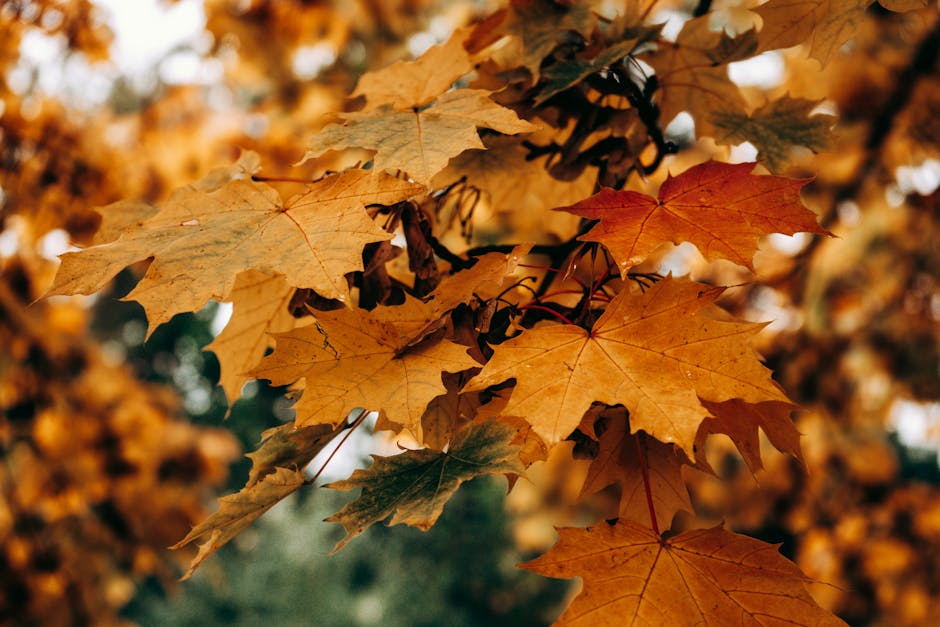
The autumn foliage season from mid to late November paints the primeval forest in reds and yellows, creating magnificent views alongside the waterfall. Temperatures of 12-20°C (54-68°F) are comfortable, and tourist numbers are relatively low. Nachi’s autumn colors are known as “Nachi no Koyo,” one of Kansai’s premier viewing spots.
Recommendation: ★★★★★
Winter (December–February)
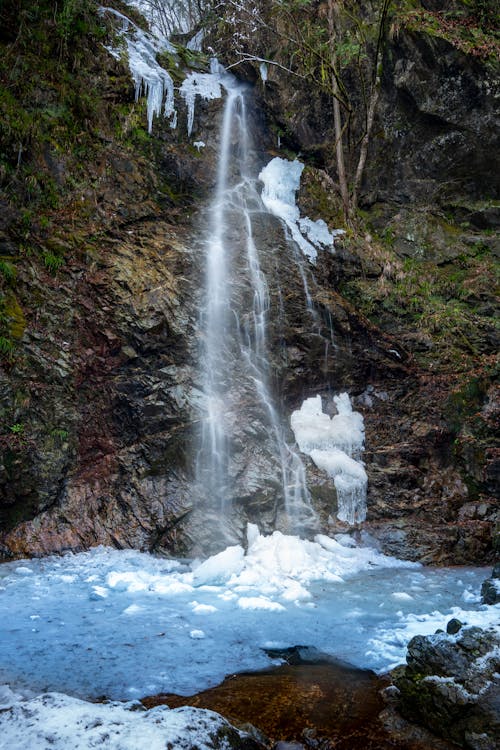
Fewer visitors make this ideal for those wanting quiet time with the waterfall. Temperatures of 5-12°C (41-54°F) require warm clothing. Rarely, parts of the waterfall freeze, creating a mystical sight. The “Otaki Shimenawa Replacement Ceremony” on December 27th is a year-end tradition.
Recommendation: ★★★☆☆
Best Times of Day
Early Morning (7:00-9:00 AM): Few visitors, allowing you to enjoy the fantasy of the waterfall wrapped in morning mist to yourself. Ideal for photography.
Morning (9:00-11:00 AM): Sunlight hits the waterfall, sometimes creating rainbows. The Otaki Haijo Butai is also recommended during this time.
Late Afternoon (3:00-5:00 PM): Western light illuminates the waterfall, showing it glowing golden.
Visitor’s Guide
Basic Worship Etiquette
1. Great Torii Gate: Bow before entering through the Hirou Shrine entrance.
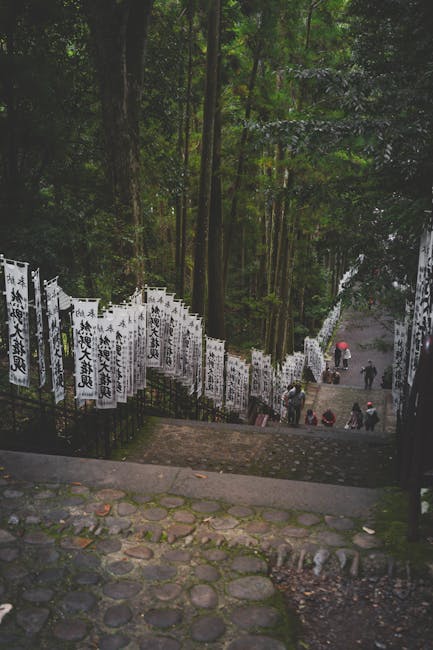
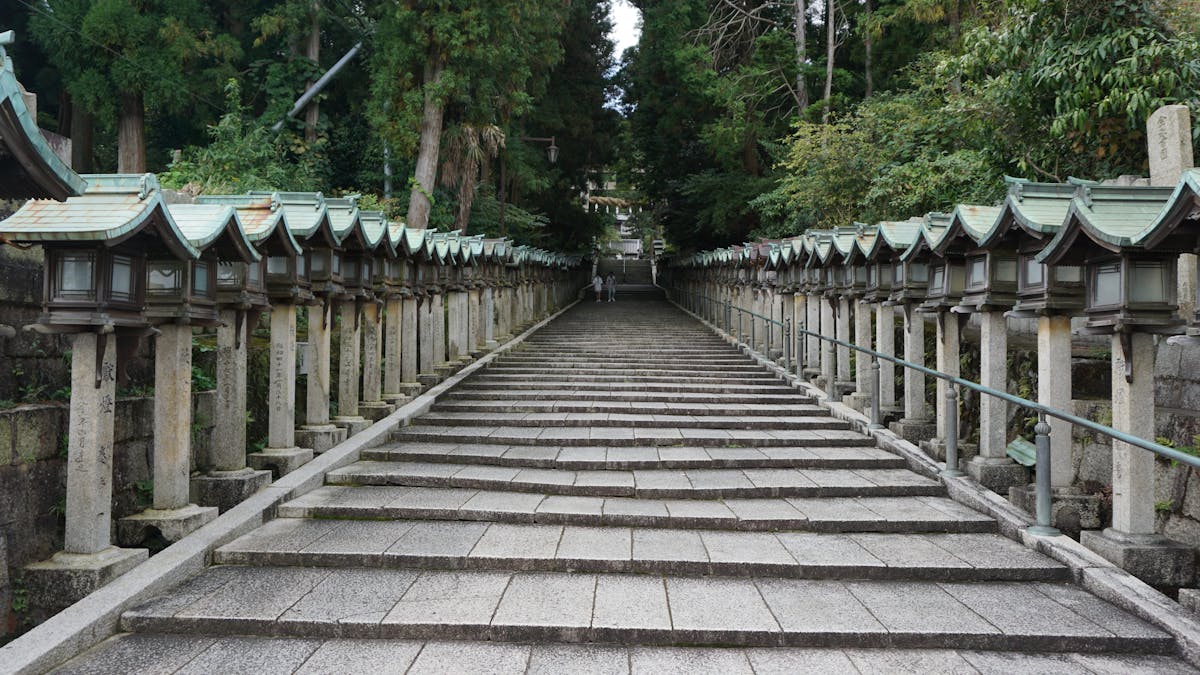
2. Approach: Descend the stone steps toward the waterfall. There are approximately 300 steps, so watch your footing.
3. Hirou Shrine Worship Area:
– Stand facing the waterfall
– Offer your monetary offering
– Bow twice, clap twice, bow once
– Pray while gazing up at the waterfall
4. Otaki Haijo Butai (Paid):
– Pay ¥300 admission to enter
– View the waterfall from the closest point
– Receive Emmei-sui (Life-Prolonging Water)
Highlights and Recommended Route
Suggested Route (Approximately 2 hours)
1. Nachisan Tourist Center Parking (−): Starting point
2. Kumano Nachi Taisha (30 min): Enshrines the principal deity of Nachisan
3. Nachisan Seiganto-ji Temple (20 min): First temple of the Saigoku 33 Pilgrimage
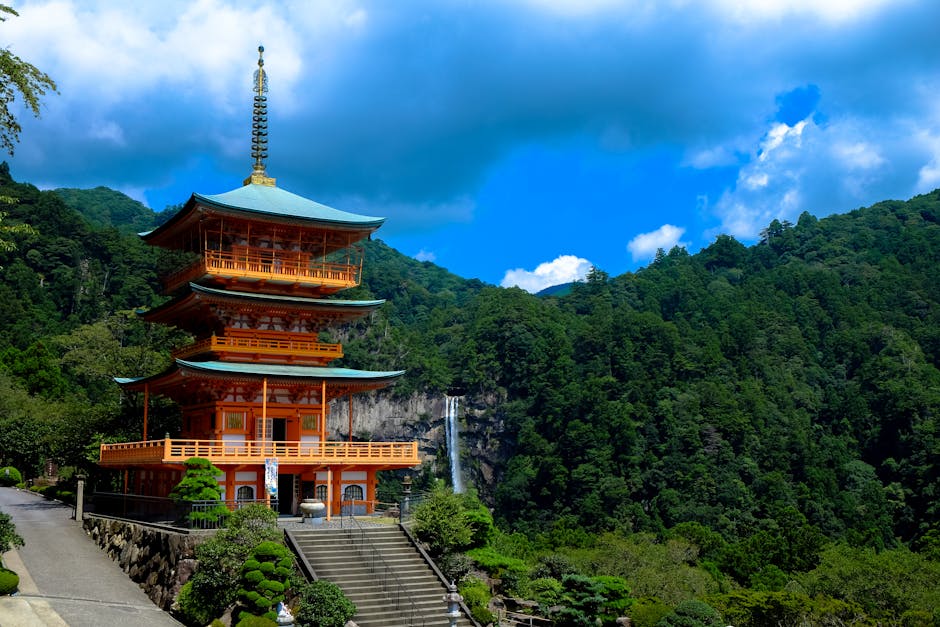
4. Three-Story Pagoda (10 min): Spectacular view point of waterfall and pagoda
5. Walk to Hirou Shrine (15 min): Descend the stone steps
6. Hirou Shrine & Nachi Falls (20 min): Worship the waterfall
7. Otaki Haijo Butai (15 min): Close-up waterfall viewing, Emmei-sui
Goshuin and Amulet Information
Goshuin (Shrine/Temple Seal):
- Hirou Shrine: ¥300
- Kumano Nachi Taisha: ¥300
- Seiganto-ji Temple: ¥300
- Hours: 8:00 AM-4:30 PM
Popular Amulets:
- Emmei Mamori/Longevity Charm (¥800): Power of Nachi Falls’ life-prolonging water
- Nachiguro-ishi Mamori/Black Stone Charm (¥1,000): Uses black stone from Nachi region
- Yatagarasu Mamori/Three-Legged Crow Charm (¥800): Symbol of Kumano Sanzan
- Kachi Mamori/Victory Charm (¥800): Effective for competitions
Dress Code and Items to Bring
- Comfortable walking shoes (many stone steps, some slippery areas)
- Rain gear (weather changes quickly in mountain areas)
- Towel (may get wet from waterfall spray)
- Hat and water essential in summer
- Warm clothing in winter
Basic Information
Access
Address: Nachisan, Nachikatsuura-cho, Higashimuro-gun, Wakayama Prefecture
By Car:
- 25 minutes from Kisei Expressway Nachikatsuura IC
- Approximately 4 hours from central Osaka
- Approximately 3.5 hours from central Nagoya
Public Transportation:
- From JR Kisei Main Line “Kii-Katsuura Station”: Kumano Kotsu Bus toward “Nachisan” approximately 30 minutes, get off at terminal, 15-minute walk
- From JR “Nachi Station”: Bus approximately 25 minutes
Parking: Nachisan Tourist Center Parking (¥500, approximately 100 spaces)
Visiting Information
- Hours: 7:00 AM-4:30 PM
- Otaki Haijo Butai: ¥300
- Closed: None
- Duration: 30 minutes for Nachi Falls only; 2 hours including Kumano Nachi Taisha and Seiganto-ji
Contact
- Phone: 0735-55-0321 (Kumano Nachi Taisha)
- Official Website: https://kumanonachitaisha.or.jp/
Area Information
Nearby Attractions
Kumano Nachi Taisha (15-min walk)
One of the Kumano Sanzan shrines. Principal deity is Kumano Fusumi-no-Okami. The vermillion shrine buildings are beautiful, and visiting together with Nachi Falls is standard.
Nachisan Seiganto-ji Temple (15-min walk)
First temple of the Saigoku 33 Kannon Pilgrimage. The main hall, rebuilt by Toyotomi Hideyoshi, is an Important Cultural Property. The view of the three-story pagoda and Nachi Falls is a must-see.
Daimon-zaka (10 min by car)
Considered the most beautiful section of the Kumano Kodo ancient pilgrimage routes, this stone-paved path of approximately 600 meters through cedar groves allows visitors to experience pilgrimages of old.
Recommended Restaurants
Nachiguro Ame & Nachiguro-ishi (Around Nachisan)
Local Nachi specialties. Black sugar-based candy and Nachiguro-ishi stone souvenirs are popular.
Mitaki Sanso Restaurant (5-min walk)
- Local specialty dishes of Nachisan
- Specialties: Mehari Sushi Set (¥1,200), Kumano Beef Udon (¥1,100)
- Hours: 10:00 AM-3:00 PM
- Closed: Irregular
Katsuura Gyoen (30 min by car)
- Day-trip hot springs and dining at this established Nachikatsuura inn
- Specialty: Tuna Kaiseki Course (¥3,500)
- Hours: 11:30 AM-2:00 PM
- Closed: Irregular
Takehara (In front of Kii-Katsuura Station)
- Fresh tuna dishes
- Specialties: Tuna Bowl (¥1,500), Tuna Cutlet Set (¥1,300)
- Hours: 11:00 AM-2:00 PM, 5:00-9:00 PM
- Closed: Wednesdays
Souvenirs
- Nachiguro Ame: Nachi’s signature confection
- Nachiguro-ishi: Popular as protective black stones
- Kumano Beef Senbei: Regional specialty crackers
- Emmei Mamori: Take home the blessings of Nachi Falls
Model Itineraries
Half-Day Course (Approximately 4 hours)
9:00 AM Arrive at Nachisan Tourist Center Parking
9:15 AM Worship at Kumano Nachi Taisha
9:45 AM Worship at Seiganto-ji Temple & Three-Story Pagoda
10:30 AM Worship at Hirou Shrine & Nachi Falls
11:00 AM Otaki Haijo Butai
11:30 AM Lunch at Mitaki Sanso
12:30 PM Souvenir shopping
1:00 PM Depart
Full-Day Course (Approximately 8 hours)
8:30 AM Arrive at Daimon-zaka entrance
9:00 AM Walk Daimon-zaka & Kumano Kodo (approximately 40 min)
10:00 AM Worship at Kumano Nachi Taisha
10:45 AM Worship at Seiganto-ji Temple
11:30 AM Worship at Hirou Shrine & Nachi Falls
12:00 PM Otaki Haijo Butai & Emmei-sui
12:30 PM Lunch at Mitaki Sanso
2:00 PM Travel to Nachikatsuura
2:30 PM Visit tuna market
3:30 PM Hot spring at Katsuura Gyoen
5:00 PM Depart
Visitor Reviews and Experiences
“The Power of Japan’s Tallest Waterfall” (Man in his 50s, Kanagawa)
“Photos don’t do justice to the real thing. The thunderous roar and spray from the 133-meter drop can be felt with all five senses. The view from the Otaki Haijo Butai was truly overwhelming.”
“A Heart-Cleansing Experience” (Woman in her 30s, Kyoto)
“I visited when I was exhausted from work stress. The moment I stood before the waterfall, tears came for some reason, and by the time I left, my heart felt clear. This is a power spot I want to visit regularly.”
“The Fire Festival is a Must-See” (Couple in their 40s, Hyogo)
“We timed our visit for the July Fire Festival. The sight of great pine torches parading before the waterfall was truly fantastical. A precious experience feeling both Japanese tradition and the power of nature simultaneously.”
Frequently Asked Questions
Q: Are the stone steps difficult?
A: There are approximately 300 steps descending to Hirou Shrine. The return is uphill, so those lacking confidence in their stamina should proceed slowly with rest breaks. Walking sticks are available for borrowing.
Q: Can I visit on rainy days?
A: Yes. In fact, rainy days increase water volume, offering more powerful waterfall views. However, the stone steps become slippery, so please watch your footing carefully.
Q: Can anyone drink the Emmei-sui?
A: Anyone who enters the Otaki Haijo Butai (¥300 admission) can receive Emmei-sui.
Q: How many days are needed to visit all Kumano Sanzan?
A: By car, all can be visited in one day, but for leisurely worship, an overnight stay is recommended.
Nearby Power Spots
- [Fushimi Inari Taisha](https://k005.net/en/powerspot/fushimi-inari-day-trip-osaka-en/)
- [Kiyomizu-dera](https://k005.net/en/powerspot/kiyomizu-dera-en/)
- [Seimei Shrine](https://k005.net/en/powerspot/seimei-shrine-kyoto-day-trip-en/)
- [Sumiyoshi Taisha](https://k005.net/en/powerspot/sumiyoshi-taisha-en/)
- [Atsuta Shrine](https://k005.net/en/powerspot/atsuta-jingu-en/)
Summary
Nachi Falls is Japan’s tallest single-drop waterfall at 133 meters and a sacred site of Kumano worship with over 1,300 years of history. Registered as a UNESCO World Heritage Site in 2004, it attracts visitors from Japan and abroad as one of the country’s premier power spots.
Enshrined as the sacred body of Hirou Shrine, Nachi Falls is said to bestow diverse blessings including longevity, purification of body and spirit, and fortune. The power of looking up at the great waterfall from the Otaki Haijo Butai is an experience beyond words, and receiving Emmei-sui allows visitors to take the waterfall’s power within themselves.
Combined worship at the adjacent Kumano Nachi Taisha and Nachisan Seiganto-ji Temple provides access to the essence of Kumano worship where Shinto and Buddhism merge. Walking the Kumano Kodo ancient route from Daimon-zaka allows visitors to trace the footsteps of pilgrims of old.
At life’s turning points, when wanting to reset body and mind, when seeking a new start—the overwhelming energy radiating from Japan’s tallest waterfall will surely push you powerfully from behind.
—
Want to discover the power spot that’s right for you?
Beyond this location, Japan is home to countless power spots. To find the one most suited to you, try our free compatibility assessment (takes just 3 minutes).
→ [Take the Free En Profile Assessment](https://enguide.info)
—
*Information in this article is current as of December 2025. Please verify the latest details via the official website before visiting.*
あなたに最適なパワースポットを知りたい方へ