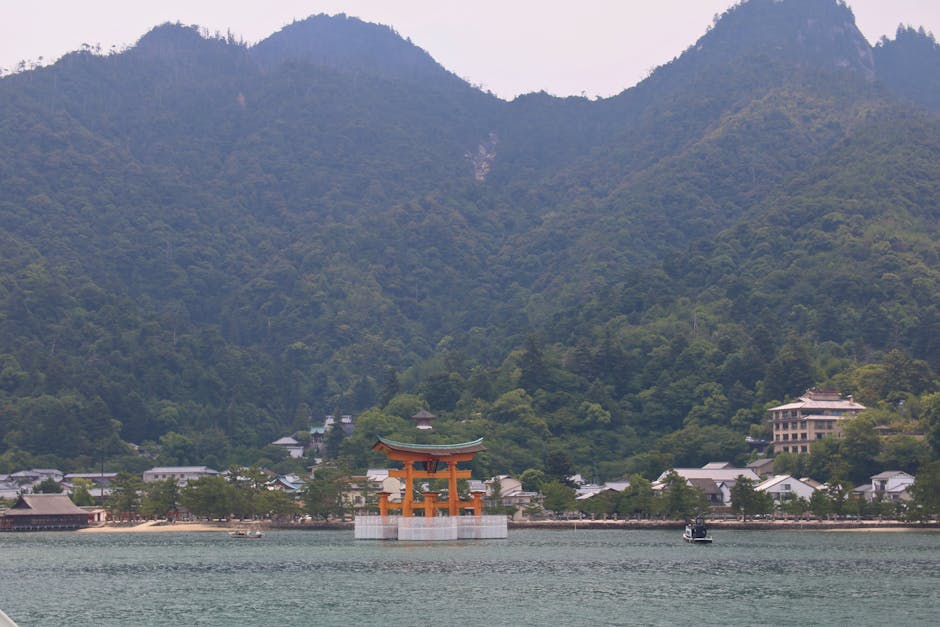
Miyajima is an easy day trip from Hiroshima. The JR train to Miyajimaguchi (宮島口) takes about 27 minutes, and the ferry across takes about 10. The hard part is the tide. You can walk out to the Great Torii of Itsukushima Shrine (嚴島神社) only while the tide level is below 100 cm, and the shrine looks as if it floats only while the level is above 250 cm. Those hours move every day, and in November and December 2026 the usable walking windows all fall in the early morning.
Below: how to read the tide chart for your date, three ways to get there, how the tide sets the order of the day, and one date, November 30, 2026, worked through from the morning ferry to the evening light-up. The shrine itself, its history and the island’s food are covered in the Itsukushima Shrine complete guide. Times and fares were checked on October 23, 2026.
Quick answer: how much time you need
| Time you have | What fits | What decides it |
|---|---|---|
| 2–3 hours | The shrine and the nearby sights on the Tourist Association’s model walk | The shrine’s closing time |
| A full day | The shrine, plus the torii walk or the “floating” view, or both | Your date’s tide windows |
| A night on the island | An early-morning walking window | How early the window closes |
The Miyajima Tourist Association says 2 to 3 hours is the usual length of a visit. A full day pays off when your date’s tide windows fall at hours you can use, so check them first.
Before you pick a date: three checks
1. The tide chart
The Miyajima Tourist Association’s tide chart covers any date in 2026 or 2027. The page is in Japanese: choose your date and it shows two windows, labelled 大鳥居散歩 (walking to the Great Torii) and 海上社殿 (the shrine over the sea). Both come from the tide level, in centimetres:
- Walking out to the Great Torii: while the level is below 100 cm.
- The shrine appearing to float: while the level is above 250 cm.
The Association calls two shortcuts misinformation: that high tide makes the shrine float, and that low tide lets you walk out. The level is what counts, and some days have no walking window at all. The chart is for Hiroshima Port, and the Association notes that times at Itsukushima Port, on Miyajima, are likely to run slightly earlier. So start back toward the beach a little before your walking window closes.
Daylight walking windows are few in November and December, and all early. On the Association’s chart for November 1 to December 31, 2026, these are the only dates with at least 30 minutes of walking window between sunrise and 17:00. Where a window opens in the dark, the time shown starts at sunrise (National Astronomical Observatory of Japan, Hiroshima):
| Date | Walking window in daylight (Hiroshima Port) |
|---|---|
| Sunday, November 1 | 6:30–9:00 |
| Monday, November 2 | 8:00–9:30 |
| Saturday, November 14 | 6:42–7:15 |
| Sunday, November 15 | 6:43–7:45 |
| Monday, November 16 | 6:44–8:00 |
| Saturday, November 28 | 6:55–7:45 |
| Sunday, November 29 | 6:56–8:30 |
| Monday, November 30 | 6:57–9:15 |
| Tuesday, December 1 | 7:15–9:30 |
| Monday, December 14 | 7:08–8:00 |
| Tuesday, December 15 | 7:09–8:15 |
| Wednesday, December 16 | 7:09–8:45 |
| Sunday, December 27 | 7:15–7:45 |
| Monday, December 28 | 7:15–8:30 |
| Tuesday, December 29 | 7:16–9:00 |
| Wednesday, December 30 | 7:16–9:15 |
Every one of these windows is in the early morning and closes by 9:30. The other dates have no daylight window of 30 minutes or more. Some have a short one (on November 7 it is 14:00–14:15), but not one to plan a walk around. Every date in this period has a “floating” window of at least 30 minutes between 8:00 and 17:00, though on December 4 and 20 that daytime part is 16:30–17:00, just as the shrine closes.
2. The shrine’s hours
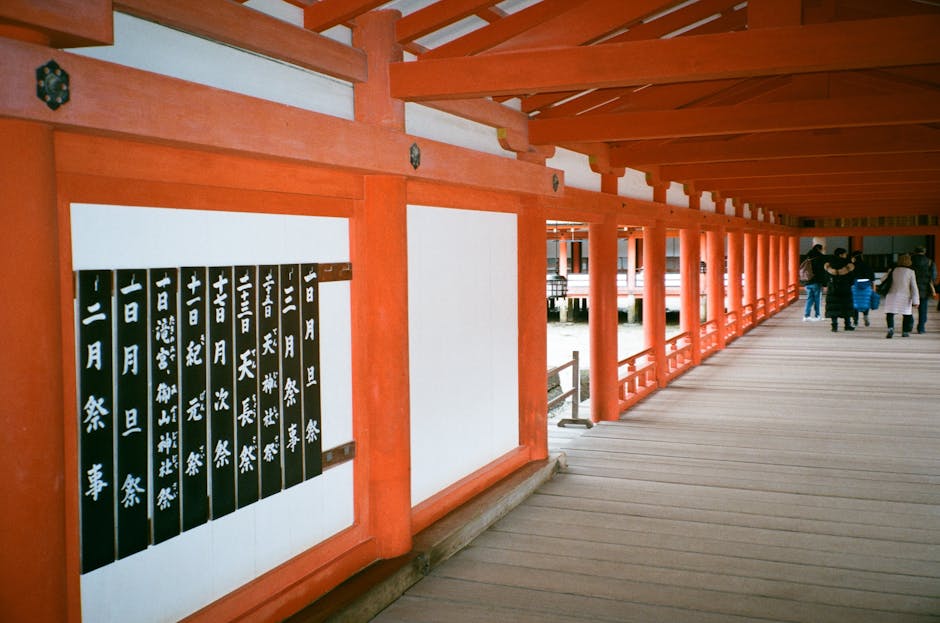
Itsukushima Shrine opens every day. Closing times as of October 23, 2026:
| Dates | Opens | Closes |
|---|---|---|
| January 1 | 0:00 | 18:30 |
| January 2–3 | 6:30 | 18:30 |
| January 4 to end of February | 6:30 | 17:30 |
| March 1 to October 14 | 6:30 | 18:00 |
| October 15 to November 30 | 6:30 | 17:30 |
| December 1–31 | 6:30 | 17:00 |
Adult admission is 300 yen. The Treasure Hall is open 8:00–17:00 all year. The Tourist Association says you cannot go into the shrine during the evening light-up, so the light-up does not extend these hours. For any special evening event, check the shrine’s site.
3. Sunset and the last boat back
Sunset in Hiroshima (National Astronomical Observatory of Japan):
| Date | Sunset |
|---|---|
| October 31 | 17:18 |
| November 15 | 17:06 |
| November 30 | 17:00 |
| December 15 | 17:01 |
| December 31 | 17:10 |
The light-up of the Great Torii and the shrine starts 30 minutes after sunset and runs until 23:00 (Tourist Association). It is cancelled once or twice a year for rituals or events.
Last departures from Miyajima on the regular timetable, as of October 23, 2026:
| Boat | Goes to | Last departure |
|---|---|---|
| JR West Miyajima Ferry (JR西日本宮島フェリー) | Miyajimaguchi | 22:14 |
| Miyajima Matsudai Kisen (宮島松大汽船) | Miyajimaguchi | 20:15 |
| Aqua Net direct boat | Peace Memorial Park | 17:30 (arrives 18:15) |
The last JR train from Miyajimaguchi to Hiroshima is at 23:27 on a weekday (Yahoo! Japan route search). The JR ferry runs a busy-day timetable on the dates in its calendar (in November 2026 the 1st–3rd, 7th–8th, 14th–15th, 21st–23rd and 28th–29th, and in December the 27th–30th). It adds daytime boats but keeps the same first and last sailings: 6:25 from Miyajimaguchi and 22:14 from Miyajima. A New Year timetable runs from December 31, so check that one separately. Matsudai’s busy-day timetable has the same last sailing from Miyajima, 20:15, and Matsudai says it may run extra boats later when needed.
Getting there from Hiroshima: three ways
Adult fares, one way, as of October 23, 2026:
| Route | Time | Fare | Good to know |
|---|---|---|---|
| JR Sanyo Line to Miyajimaguchi, then a ferry | About 27 min by train | 420 yen + 200 yen ferry | No changes on the train |
| Hiroden streetcar line 2 to Hiroden Miyajimaguchi (広電宮島口), then a ferry | 66 min by streetcar | 240 yen + 200 yen ferry | A 1,000-yen day pass covers the streetcar and the Matsudai ferry |
| Aqua Net direct boat from Peace Memorial Park | 45 min | 2,400 yen | Book by 20:30 the day before. Last boat back 17:30 |
The 100-yen Miyajima Visitor Tax is added to the boat fare to Miyajima, apart from the exemptions below.
The short ferries. At Miyajimaguchi, JR West Miyajima Ferry and Miyajima Matsudai Kisen both charge 200 yen one way. The JR ferry takes about 10 minutes and accepts IC cards. Matsudai takes cash, IC cards, contactless credit cards and MOBIRY DAYS. Every JR ferry leaving Miyajimaguchi from 9:10 to 16:10 (every 15 minutes on the regular timetable) sails close to the Great Torii without adding to the crossing time. These torii sailings run only toward Miyajima, not on the way back. At high tide they cannot always do so: the ferry posts a monthly plan of the hours when they take the usual route instead (in November 2026, parts of the mornings of the 9th, 10th and 24th–27th, and on the 27th until about 13:00). Aqua Net Hiroshima also runs a boat between Miyajimaguchi and Miyajima every 20 minutes during the day.
Japan Rail Pass. The JR ferry’s English page lists the Japan Rail Pass and the JR-WEST Rail Pass as valid on the ferry. The visitor tax is charged separately.
The streetcar. Since February 2025 Hiroden has charged a flat 240 yen on all its streetcar lines, including the Miyajima line. Line 2 from Hiroshima Station takes 66 minutes to Hiroden Miyajimaguchi on Hiroden’s route list. The one-day streetcar and ferry pass (1,000 yen, children 550 yen) covers every Hiroden streetcar and the Matsudai ferry, with the visitor tax included, so take Matsudai’s boats with it. A streetcar-only day pass costs 700 yen.
The direct boat. Aqua Net Hiroshima’s World Heritage Route leaves from the pier at Motoyasu Bridge in Peace Memorial Park. The adult round trip is 4,400 yen, and the return half is valid for 2 days. Elementary school children pay 1,200 yen one way, and one child under 6 rides free with each adult. The visitor tax is paid separately. Online booking closes at 20:30 the day before. On the day itself there are no reservations, so buy at the counter if seats are left. Pay with cash or a credit card (no IC cards). The regular timetable has 17 boats each way, leaving Peace Memorial Park from 8:30 to 17:10 and Miyajima from 8:40 to 17:30. The first boat reaches Miyajima at 9:15, when even the longest November–December walking windows above are all but over. On Miyajima the boat leaves from Pier 3, the farthest pier as you walk from the shrine toward the ferry terminal. When the tide is too high or too low, some sailings are cancelled or take a different route, so check your date’s sailings on its site. Each boat has space for one wheelchair, and wheelchair users are asked to contact the booking center in advance.
The visitor tax. It is 100 yen per person for each visit, or 500 yen for a whole year, collected with the boat fare to Miyajima. Preschool children, students and staff on school trips, and holders of a disability certificate (show it at the counter) are exempt.
How the tide sets the order of your day
From the pier it is about 10 minutes on foot to Mikasahama (御笠浜), the beach in front of the shrine, and 2 more minutes to the shrine (the Tourist Association’s model walk). Days tend to take one of these shapes.
Walk early, “floating” later. Go out to the torii in the morning window, then visit the shrine in the “floating” window, while the level is above 250 cm. Every date in the table above is this kind of day, and November 30 is worked through below.
“Floating” window only. This is the usual case on the November and December dates not in the table. Time your shrine visit for the hours above 250 cm, and view the torii from the shore or from a JR torii sailing on the way over (outside the hours in the ferry’s monthly high-tide plan).
“Floating” first, walk later. On some dates outside this period the walking window comes in the afternoon (on October 23, 2026 it was 13:15–14:15). Visit the shrine in a morning “floating” window if there is one, and walk out after lunch.
Neither. The Association notes that, rarely, a day has neither window. The shrine is open every day all the same.
Between the windows there is the Treasure Hall (8:00–17:00), Senjokaku hall (8:30–16:30) and the other stops on the model walk. Mount Misen is the bigger addition. Its ropeway’s official site listed hours of 9:00–16:00 uphill and 9:20–16:30 downhill on October 29, 2026, and says that on certain peak days you must book a seat in advance: in November, the 1st, 7th, 8th, 14th, 15th, 21st, 22nd, 23rd, 28th and 29th, and none in December. Check the site for your day, and see the complete guide for the mountain itself.
Worked example: Monday, November 30, 2026
Here is one date worked through. November 30 is the last day of the 17:30 closing, and the JR ferry runs its regular timetable that day.
| November 30, 2026 | |
|---|---|
| Walking window (below 100 cm) | 5:30–9:15 |
| “Floating” window (above 250 cm) | 12:00–16:45 |
| Low water | 7:27 (45 cm) |
| High water | 14:13 (320 cm) |
| Shrine | 6:30–17:30 |
| Sunrise / sunset | 6:57 / 17:00 |
MON NOV 30, 2026 (example)
7:40   JR ferry from Miyajimaguchi
~7:50  Miyajima pier
~8:00  Mikasahama: walk out to the torii
~8:45  Start back to the beach
~9:00  Senjokaku, the model walk
~12:00 Lunch
13:30  Shrine, as the water rises
14:13  High water (320 cm)
~15:00 Treasure Hall
16:45  "Floating" window ends
17:00  Sunset, from the shore
17:30  Shrine closes, light-up begins
18:10  JR ferry back (last 22:14)
Take a JR train from Hiroshima that reaches Miyajimaguchi in time for the 7:40 ferry. The ride is about 27 minutes, so look up the exact train in a route finder and allow time to walk from the station to the pier. The 7:05 ferry gives you more time on the sand, and the sun rises at 6:57. Start back by about 8:45, a little before 9:15, because the tide at the island’s own port is likely to run slightly ahead of the chart. If you arrive after 9:15, the walk is gone for the day: follow the “floating only” shape instead. The Treasure Hall comes after the shrine because the combined ticket for both (500 yen) is sold only at the shrine entrance.
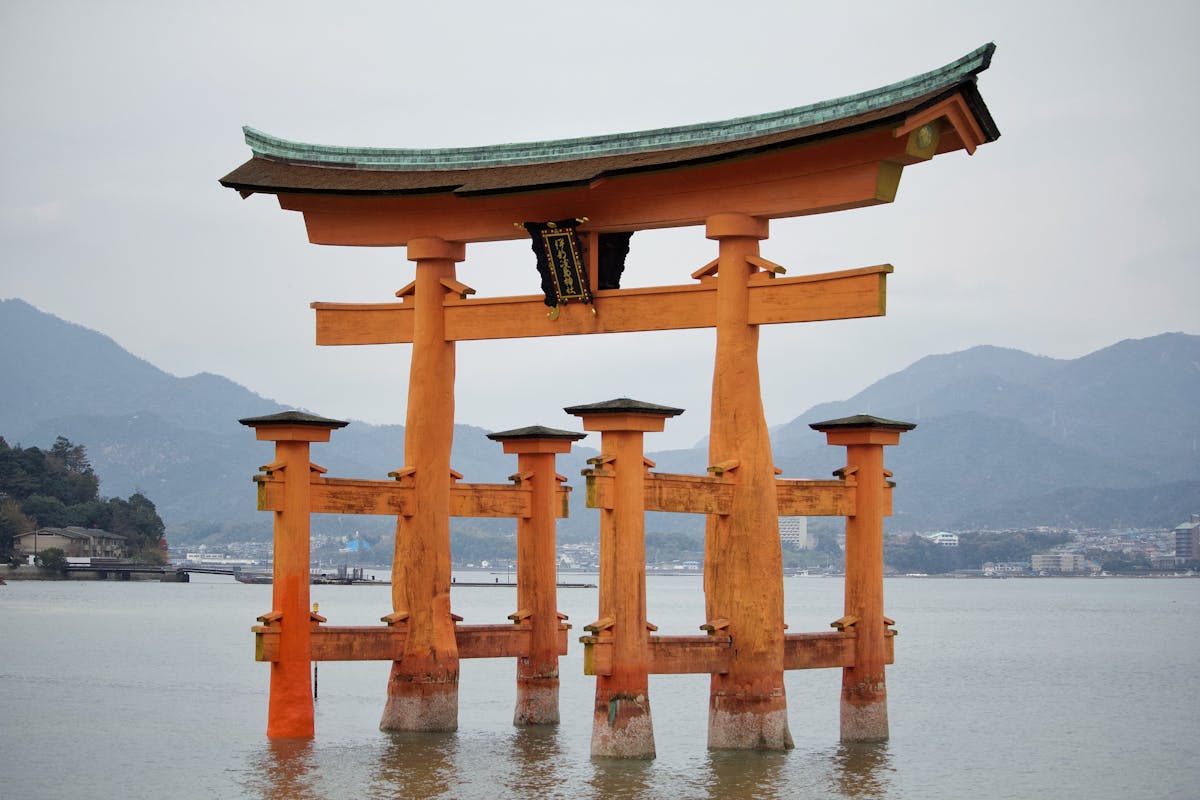
The “floating” window closes at 16:45, before sunset, so on this date you cannot see the shrine float and watch the sun go down at the same time. Watch the sunset from the shore, then the light-up from about 17:30. By then the level has dropped below 250 cm (246 cm at 17:00), so the lights shine on a falling tide. The direct boat’s last sailing is also 17:30, so if you stay for the lights, go back by JR ferry or Matsudai. From December 1 the shrine closes at 17:00, the minute the sun sets.
What’s closed or changed in 2026
- The five-story pagoda next to Senjokaku is under repair and cannot be seen (Miyajima Tourist Association). The Association and the shrine give different end dates, and the work may be extended.
- Reikado Hall on Mount Misen burned down in May 2026. Daisho-in temple says its rebuilding is in preparation.
- Miyajima Aquarium is closed for repairs from December 1, 2026 to March 31, 2027.
- Boats. The JR ferry shows the day’s operating status on its site. The direct boat cancels some sailings when the tide is too high or too low.
Children and wheelchairs
- Children. On the JR ferry, children aged 6 to 11 pay 100 yen, and up to two preschool children ride free with each paying passenger. On Matsudai, elementary school children pay 100 yen, and one preschool child rides free with each paying passenger. Shrine admission is 100 yen for elementary and junior high school students.
- Wheelchairs. About 15 wheelchairs are lent free, on the day only (no reservations), at the Miyajima Tourist Information Center, 9:00–17:30, so pick one up early in your day. On the direct boat from Peace Memorial Park there is room for one wheelchair per boat (see above). The Tourist Association describes the shrine as barrier-free and points to its “Miyajima Anshin Guide Map” (宮島安心ガイドマップ) for where wheelchairs can go and for toilets.
For dogs, shoes and other visiting tips, see the complete guide.
Day trip or overnight?
A day trip can take in the evening. On the regular timetable the JR ferry runs until 22:14, so you can stay for the light-up and still sleep in Hiroshima. A night on Miyajima helps on dates whose daylight window is short and early. On November 16, for example, it runs from sunrise at 6:44 to 8:00. To be on the beach at sunrise from Hiroshima you would need the first JR ferry, at 6:25 from Miyajimaguchi, and a train that gets you there before it. Staying on the island puts you on the beach at first light without the early train and ferry. The complete guide links to the island’s inns.
Frequently asked questions
Can I walk to the Great Torii on my date?
Only if the Tourist Association’s chart shows a window below 100 cm at an hour you can be there. In November and December 2026 the usable windows are all early in the morning (see the table above).
Is the “floating torii” floating at high tide?
Not at every high tide. The Tourist Association says that once the level rises above 250 cm, the shrine and the Great Torii appear to float on the sea. A high tide that stays below 250 cm does not give that view.
What if my date has no walking window?
Plan around the “floating” window: visit the shrine while the level is above 250 cm, and see the torii from the shore or from a JR torii sailing on the way over (Miyajimaguchi departures from 9:10 to 16:10; check the ferry’s monthly high-tide plan).
Can I book the direct boat on the day?
No. Online booking closes at 20:30 the day before. On the day, buy at the counter if seats are left.
When is the last boat back?
22:14 on the JR ferry, the same on its busy days, 20:15 on Matsudai and 17:30 on the direct boat to Peace Memorial Park. Around New Year, check the special timetables.
Sources and last checked
All times, fares and dates on this page were read from these pages on October 23, 2026. Timetables change, so look again before you travel.
- Miyajima Tourist Association: tide chart, how to read the tide levels, FAQ (visit length, model walk, wheelchairs, light-up), light-up, Senjokaku and the five-story pagoda
- Itsukushima Shrine: hours and admission (including where the combined ticket is sold), works in progress
- JR West Miyajima Ferry: timetable and busy-day calendar (the torii sailings are the Miyajimaguchi departures from 9:10 to 16:10), busy-day timetable, fares, English page (Japan Rail Pass), top page (the day’s operating status and the monthly high-tide plan for the torii sailings)
- Miyajima Matsudai Kisen: timetable, fares
- Aqua Net Hiroshima: World Heritage Route (timetable, fares, tide cancellations, Pier 3, wheelchair space), booking
- Hiroden: flat fare, route list, one-day passes
- Hatsukaichi City: Miyajima Visitor Tax
- National Astronomical Observatory of Japan: sunrise and sunset, Hiroshima (November; the October and December pages were also read, for sunset and sunrise)
- Miyajima Aquarium: closure notice; Daisho-in: news and Reikado Hall
- JR train times: Yahoo! Japan route search on October 23 (a weekday). The Mount Misen Ropeway site was read on October 29.
Related guides
- Itsukushima Shrine complete guide: history, the route through the shrine, Mount Misen, food and festivals