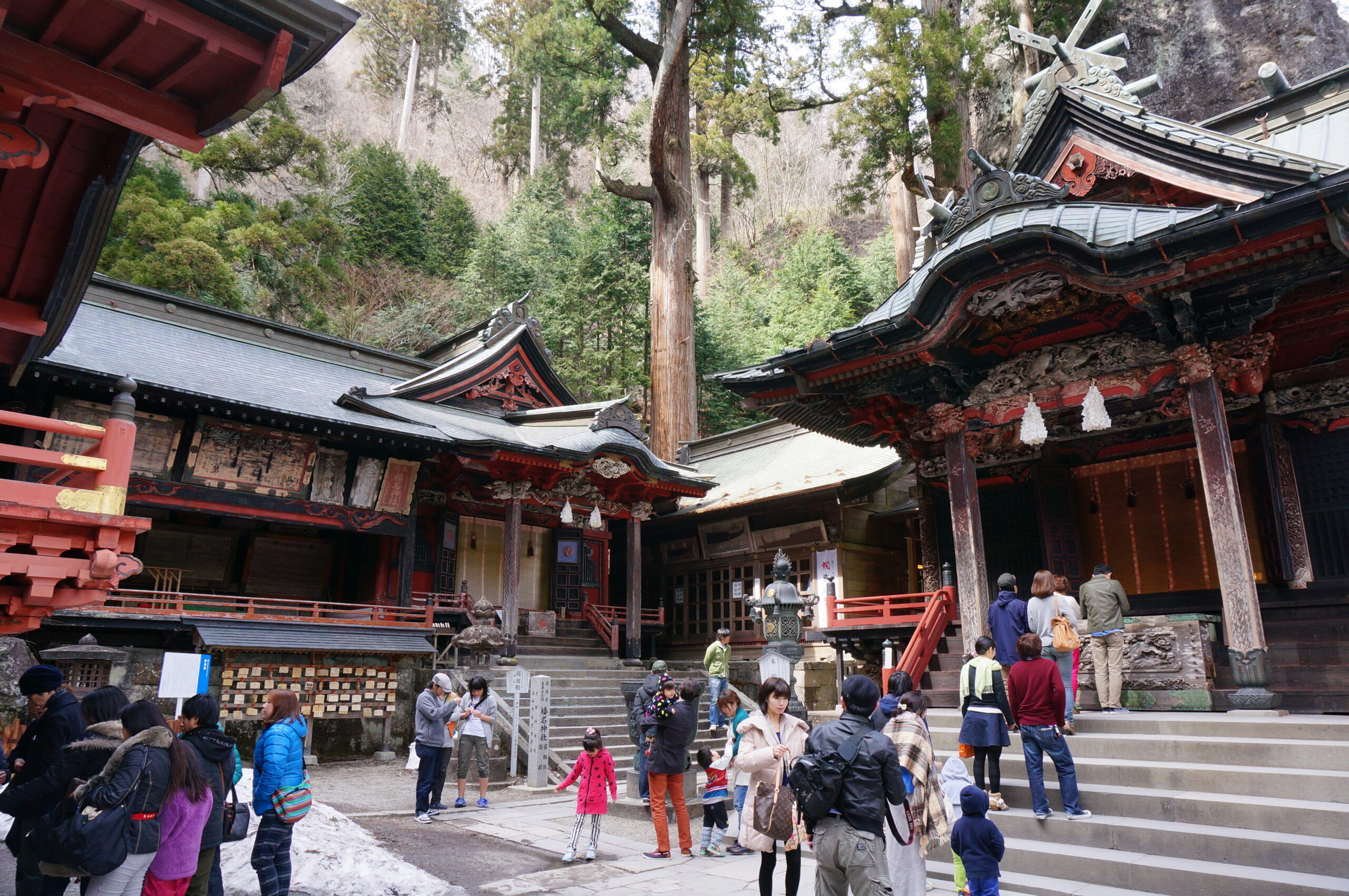
The approach begins in a cedar forest. Within minutes, the world narrows to a gorge. Massive boulders rise on both sides—some the size of buildings, draped in moss, wedged between cliff faces at impossible angles. A waterfall threads down the rock. The path climbs gently for 700 meters, and at the end, you find a shrine built directly against a boulder so enormous it has a name: Misugata-iwa, the “sacred figure rock.”
This is Haruna Shrine, a 1,400-year-old sanctuary in the mountains of Gunma Prefecture. It is called the “all-purpose power spot” because its multiple enshrined deities cover virtually every kind of blessing—fortune, business, love, academics, safe childbirth. But the real draw is the approach itself: a 20-to-30-minute walk through a gorge that feels more like entering a temple built by geology than by human hands.
From Tokyo, it is a two-hour drive or train-and-bus journey. Combined with nearby Ikaho Onsen and Lake Haruna, it makes one of the best day trips in the Kanto region.
—
History
1,400 Years of Mountain Worship
Haruna Shrine was founded in 586 AD. Mount Haruna has been a site of mountain worship and Shugendo (ascetic mountain practice) since ancient times. During the Edo period, the shrine drew pilgrims from across the Kanto plain. The current buildings, reconstructed in 1806, are designated Important Cultural Properties of Japan.
Why “All-Purpose”
The shrine enshrines multiple deities governing fire, earth, water, and wood—the fundamental elements of nature. This breadth of divine patronage, combined with the gorge’s concentrated natural energy and ancient trees, is why Haruna Shrine is considered one of the strongest power spots in the Kanto region.
—
Blessings
| Blessing | Context |
|———-|———|
| General fortune | The “all-purpose” reputation—covers every kind of luck |
| Business prosperity | Merchant devotion dating to the Edo period |
| Romantic connection | A sacred “marriage tree” in the precinct |
| Academic success | Popular with students before exams |
| Safe childbirth | Haniyama-hime, the earth goddess, protects mothers |
| Abundant harvest | Fire and earth deities guard agriculture |
—
What to See — The Approach Is the Experience
At Haruna Shrine, the 700-meter approach is not just a path to the main hall—it is the power spot. Every step brings a new formation of rock, water, and wood.
Zuijin-mon Gate — The Entrance
The gate marks the boundary between the everyday world and the sacred gorge. Once through, the cedar canopy closes overhead, traffic noise vanishes, and only the sound of the stream remains.
Yatate-sugi — Takeda Shingen’s Arrow Cedar
A 600-year-old cedar standing 55 meters tall. According to legend, the warlord Takeda Shingen drove an arrow into this tree to pray for victory before attacking Minowa Castle. Designated a National Natural Monument.
Missuzu-no-taki — Gorge Waterfall
A slender 15-meter waterfall visible from the path. Its fine spray cools the air even on summer days and provides a natural soundtrack for the walk.
Soryu-mon — The Dragon Gate
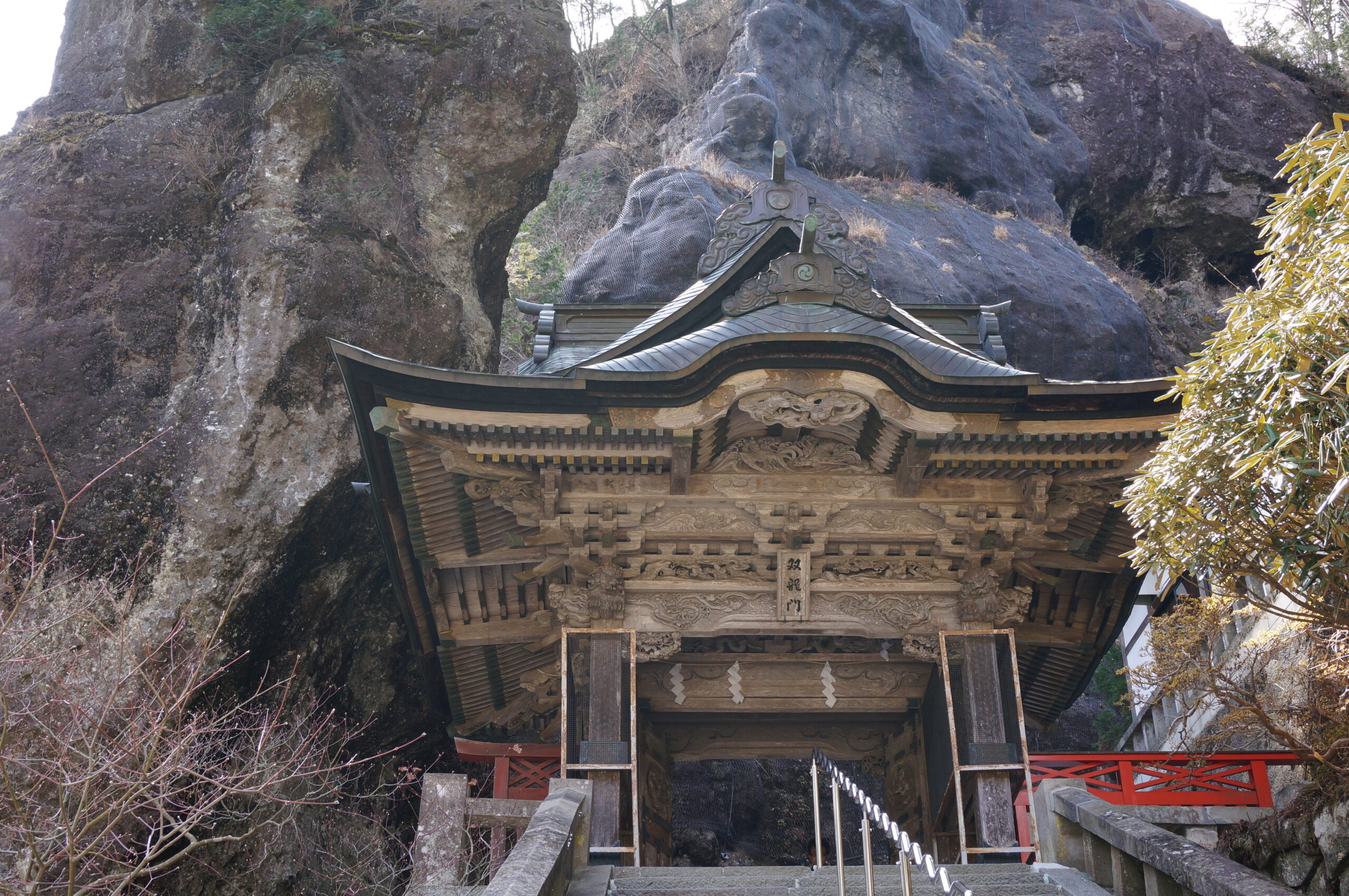
The gate just before the main hall, named for the twin dragon carvings on its panels. It is built at the base of a cliff, and the rock towers directly above the ornate wooden structure—a collision of geological force and human craft that feels almost theatrical. Designated an Important Cultural Property.
Main Hall — Fused with the Rock
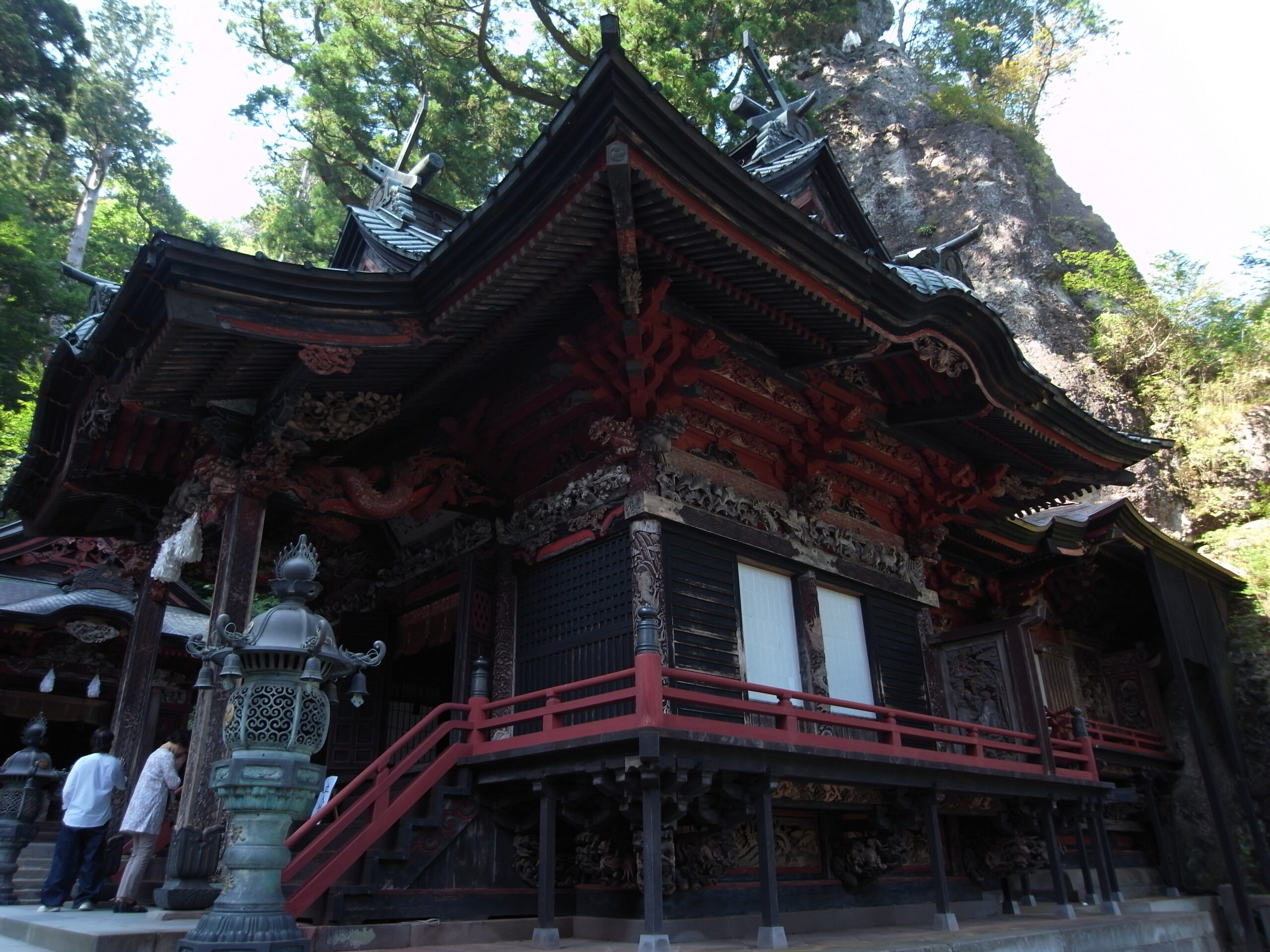
The main hall (*honden*) is built in direct contact with Misugata-iwa, a boulder so large it dominates the entire clearing. The building does not merely sit near the rock—it is constructed against it, as though the architecture is an extension of the geology. This fusion of nature and building is unique among Japanese shrines.
Dragon Carvings — Look Up
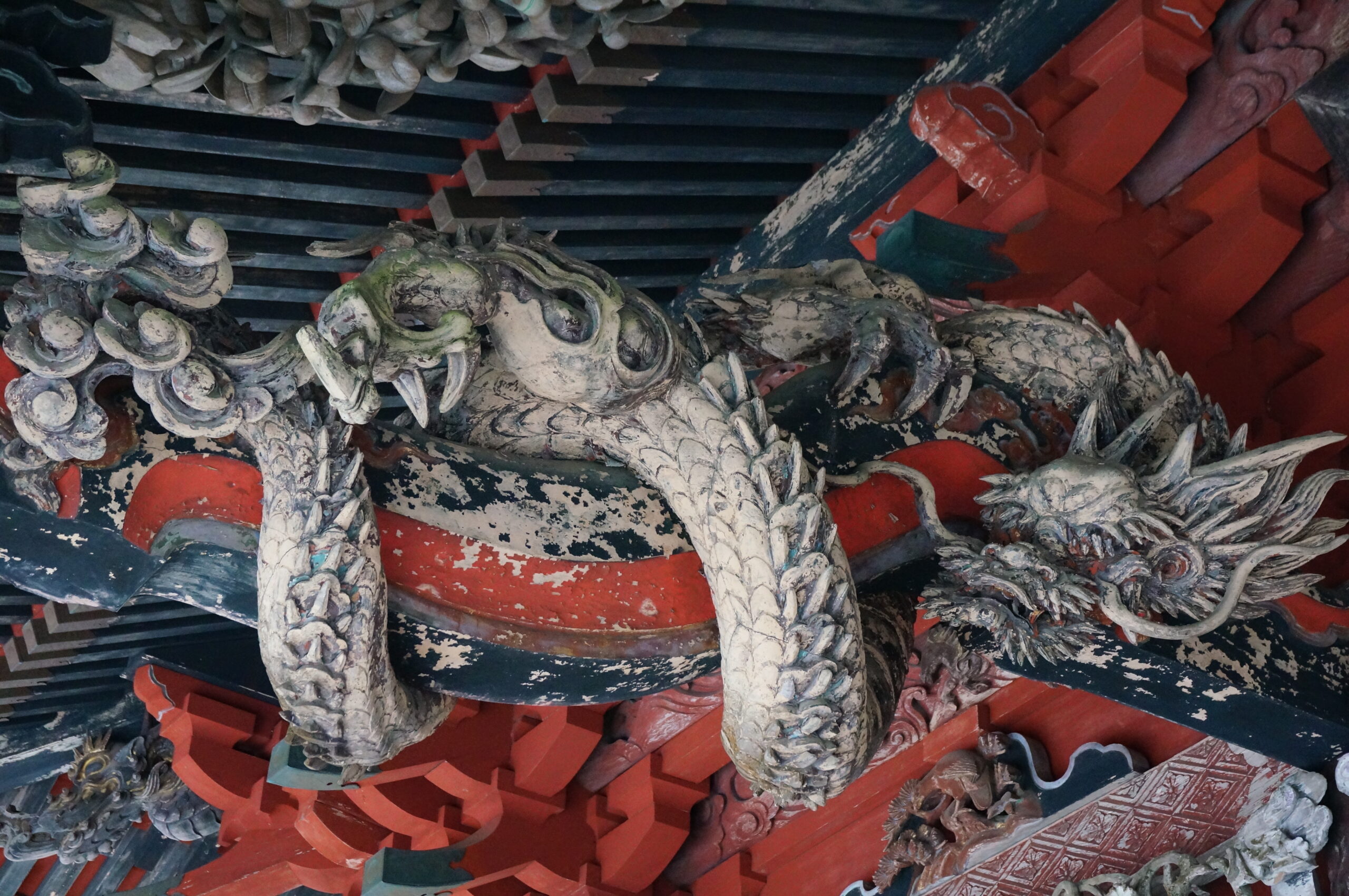
The main hall, worship hall, and Dragon Gate are all decorated with elaborate wood carvings—dragons, lions, flowers, and mythical beasts. Each dragon has a different expression. Take time to look up and study them.
—
When to Visit
| Season | Period | Highlights | Rating |
|——–|——–|———–|——–|
| Fresh green | May — Jun | Peak green. Moss on the boulders glows | ★★★★★ |
| Summer | Jul — Aug | The gorge is 5°C+ cooler than the lowlands | ★★★★ |
| Autumn colors | Late Oct — mid-Nov | The approach becomes a tunnel of red, gold, and green | ★★★★★ |
| Winter | Dec — Feb | Snow on rock and cedar. Fewest visitors | ★★★ |
Best Time of Day
- Early morning (8:00–9:00) — Almost empty. Morning mist in the gorge.
- Mid-morning (9:00–11:00) — Shafts of sunlight penetrate the canopy.
- After 14:00 — The gorge falls into shadow. Visit earlier for best light.
—
Visiting Guide
How to Visit
1. Park or arrive by bus → walk to Zuijin-mon gate
2. Walk the 700 m approach (20–30 minutes uphill)
– See the arrow cedar, waterfall, and Seven Lucky Gods statues along the way
3. Pass through the Dragon Gate
4. Pray at the worship hall (two bows, two claps, one bow)
5. Look up at Misugata-iwa behind the main hall
6. Receive goshuin and charms at the office
7. Walk back down (15–20 minutes)
Total time: 60–90 minutes. Allow 2 hours to explore thoroughly.
What to Wear
The approach is a mountain gorge path. Sneakers minimum; hiking shoes ideal. Heels and sandals are dangerous. The path can be slippery after rain. Even in summer, bring a light jacket—the gorge is noticeably cool.
Goshuin (Shrine Seal)
- Fee: 500 yen
- Hours: 8:30–16:00 (until 15:30 in winter)
- Special: Seasonal limited-edition seals available
Sacred Water Fortune Slip
Haruna Shrine’s famous *omikuji* (fortune slip) appears blank when you receive it. Dip it in the shrine’s sacred water, and the characters slowly appear. A memorable experience and popular on social media. 200 yen.
—
Getting There
From Tokyo
By car: About 2 hours via the Kan-Etsu Expressway
- Maebashi IC → Route 17 → Prefectural Route 33 → about 60 minutes to the shrine
- Shibukawa-Ikaho IC → Prefectural Route 33 → about 50 minutes
By train + bus:
1. Tokyo → Takasaki Station (JR Takasaki Line or Shinkansen, 50–100 minutes)
2. Takasaki Station West Exit → Gunma Bus toward Lake Haruna, about 70 minutes
– Get off at “Haruna Jinja-mae”
– Fare: about 1,200 yen
– Only 6–7 buses per day. Check the timetable.
3. Bus stop to shrine entrance: 15-minute walk
Parking
| Lot | Capacity | Fee |
|—–|———-|—–|
| Municipal free lot | ~70 cars | Free |
| Private lots near entrance | 20–30 cars each | Free — 500 yen |
Note: The municipal lot is a 15-minute walk from the shrine gate. During autumn foliage season, temporary overflow parking may be available.
Essential Information
| | Details |
|——|——|
| Hours | 7:00–17:00 (until 16:30 in winter) |
| Closed | Never |
| Admission | Free |
| Address | 849 Harunasan-machi, Takasaki, Gunma |
| Phone | 027-374-9050 |
| Website | haruna.or.jp |
—
Around Haruna Shrine — Lake, Onsen, Udon
Lake Haruna
About 10 minutes by car. A caldera lake at 1,100 meters elevation with boating, cycling, and winter smelt fishing. The view of Mount Haruna-Fuji reflected in the lake is one of Gunma’s iconic landscapes.

Ikaho Onsen (30 minutes by car)
One of Gunma’s most famous hot spring towns. Its 365 stone steps are lined with shops, and two types of spring water—golden *Kogane-no-yu* and clear *Shirogane-no-yu*—offer different bathing experiences. A natural pairing with a morning at Haruna Shrine.
Food
- Gate-front soba noodles — Several shops at the shrine entrance
- Lake Haruna restaurants — Fried smelt, udon, grilled *manjū* (stuffed buns)
- Mizusawa Udon (30 min by car) — One of Japan’s three great udon styles, served near Mizusawa Kannon temple
Day Trip Itinerary
| Time | Activity |
|——|———-|
| 9:00 | Arrive at Haruna Shrine. Walk the gorge approach |
| 10:30 | Sacred water fortune slip, goshuin, and charms |
| 11:00 | Soba lunch at a gate-front noodle shop |
| 12:00 | Drive to Lake Haruna. Boat ride or lakeside walk |
| 13:30 | Haruna-Fuji Ropeway to the summit for a Kanto Plain panorama |
| 14:30 | Drive to Ikaho Onsen |
| 15:00 | Explore the 365 stone steps, try the free foot bath |
| 16:00 | Day-use onsen bath |
| 17:30 | Head home (Shibukawa-Ikaho IC is 20 minutes away) |
—
Frequently Asked Questions
Can children walk the approach?
Elementary age and older, yes. The path is uphill but not steep. For toddlers, a baby carrier is recommended. Strollers cannot navigate the gorge path. There are no restrooms along the approach—use the facilities at the entrance.
Is wheelchair access available?
Unfortunately, the gorge path has many steps and uneven surfaces that prevent wheelchair access. The atmosphere of the shrine can be felt from the Zuijin-mon gate area.
Are pets allowed?
No, pets are not permitted in the shrine grounds. Lake Haruna’s lakeside paths are pet-friendly if you are traveling with a dog.
Is it worth visiting in the rain?
Many visitors say rainy days are the best time for Haruna Shrine. The moss on the boulders turns vivid green, and mist drifting through the gorge creates a mystical atmosphere. Waterproof shoes and a rain jacket are essential.
Can I combine it with Ikaho Onsen?
Absolutely—this is the classic itinerary. Shrine in the morning, lake at midday, onsen in the afternoon. The drive between them is about 30 minutes.
Is there snow in winter?
Possible from December through February. The approach can be icy, so slip-resistant shoes are essential. Snow-covered boulders and cedars make for dramatic scenery, and you will likely have the shrine nearly to yourself.
—
Summary
Haruna Shrine is not a place you visit for architecture alone, or blessings alone, or scenery alone. It is a place where a 700-meter walk through a geological wonder—towering boulders, ancient cedars, a slender waterfall—delivers you to a shrine that has physically merged with the mountain it honors. The approach is the experience. The rock is the shrine.
From Tokyo, you can reach it in two hours. Pair it with Lake Haruna and Ikaho Onsen, and you have a day that covers nature, spirituality, and one of the best hot spring towns in the Kanto region.
—
*Information in this article is current as of April 2026. Please check the Haruna Shrine official website for the latest updates before your visit.*
あなたに最適なパワースポットを知りたい方へ