“It burned down in the fire—is it even worth visiting now?” “Can I see the main hall?” “It’s a World Heritage Site, but what exactly should I walk through?” If you searched Shuri Castle with questions like these, this guide is for you.
Here is the short answer. Shuri Castle (Shurijo) is the symbol of the Ryukyu Kingdom (1429–1879), which flourished for some 450 years, standing on a hill in Naha, Okinawa. It is a component of the UNESCO World Heritage Site “Gusuku Sites and Related Properties of the Kingdom of Ryukyu.” The main hall (Seiden) and other buildings were lost to fire in October 2019, but today the park has turned its recovery into an attraction in itself—“reconstruction in progress,” shown to the public—letting you come right up to the main hall as it is rebuilt. And on November 23, 2026, the restored main hall is scheduled to open to the public.
In other words, 2026 is a special year for Shuri Castle. It is the last window to watch the rare process of a castle rising again from the ashes, and from late autumn you can also meet a brand-new Seiden. There is also something easy to overlook: Shuri Castle’s true value is not the buildings alone. The stone walls, the castle gates, and above all the sacred sites—the great prayer ground “Kyo-no-uchi” and the Sonohyan-utaki Stone Gate—survived the fire, and the kingdom’s memory of prayer still lives here.
This guide focuses first on what you can actually see in 2026, then covers how to use the free and paid zones, access from Naha Airport, the best seasons and times, tips by visitor type (wheelchair users, pets, families), and how to combine your trip with Tamaudun and Shikinaen—everything you need to decide exactly how you should walk Shuri Castle.
What Makes This Place Special
For 450 Years, the Heart of the Ryukyu Kingdom—a Castle of Prayer and Diplomacy
Shuri Castle was the royal residence of the Ryukyu Kingdom, founded in 1429, and its center of politics, diplomacy, and culture. Ryukyu thrived as a maritime trading state linking China, Japan, and Southeast Asia, and the wealth and culture it gathered came together in this hilltop castle. Its form—Chinese vermilion blended with Japanese architecture and Okinawa’s own design—conveys a beauty found in no other castle, uniquely Ryukyuan.
The main hall and other structures were restored in 1992, and the site was inscribed as a World Heritage Site in 2000. But here is something important to understand: what is inscribed is not the reconstructed buildings themselves, but the “Shuri Castle site”—the ruins beneath them. That is precisely why, even though the 2019 fire destroyed the buildings, the deep historical value that Shuri Castle has accumulated has not been lost.
Shuri Castle in 2026—a “Shown Reconstruction” You Can Only See Now
In the early hours of October 31, 2019, a fire destroyed the main hall and other buildings. The vermilion Seiden that so many people remember is now within the work site.
But Shuri Castle Park reframed this not as “a disappointment because you can’t see it,” but as the value of letting visitors witness the very process of recovery. That is the “shown reconstruction.” Timber is shaped, red tiles are laid, and ornaments are fitted one by one—we can now stand and watch a castle being brought back to life, a sight seen only once in centuries.
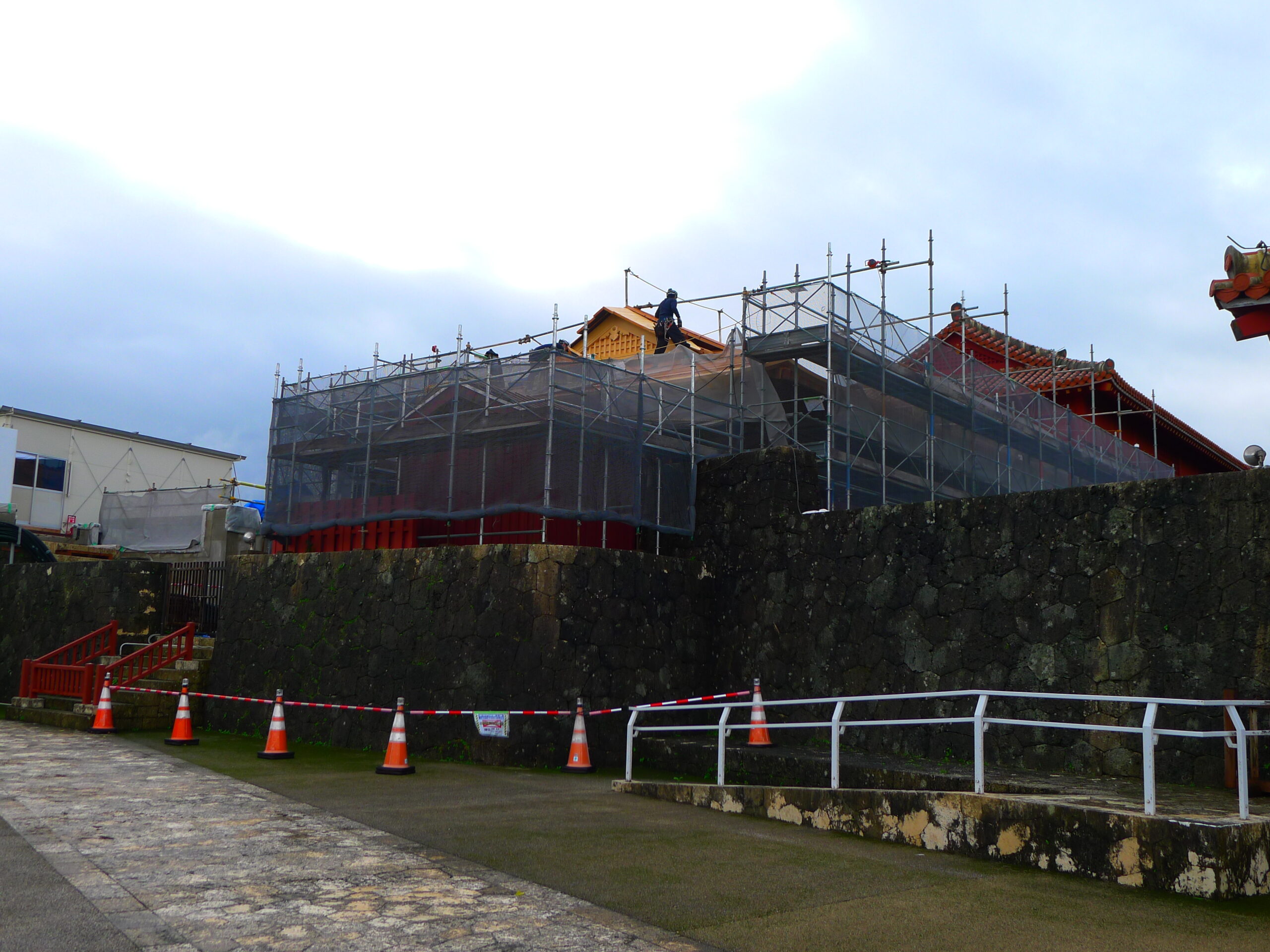
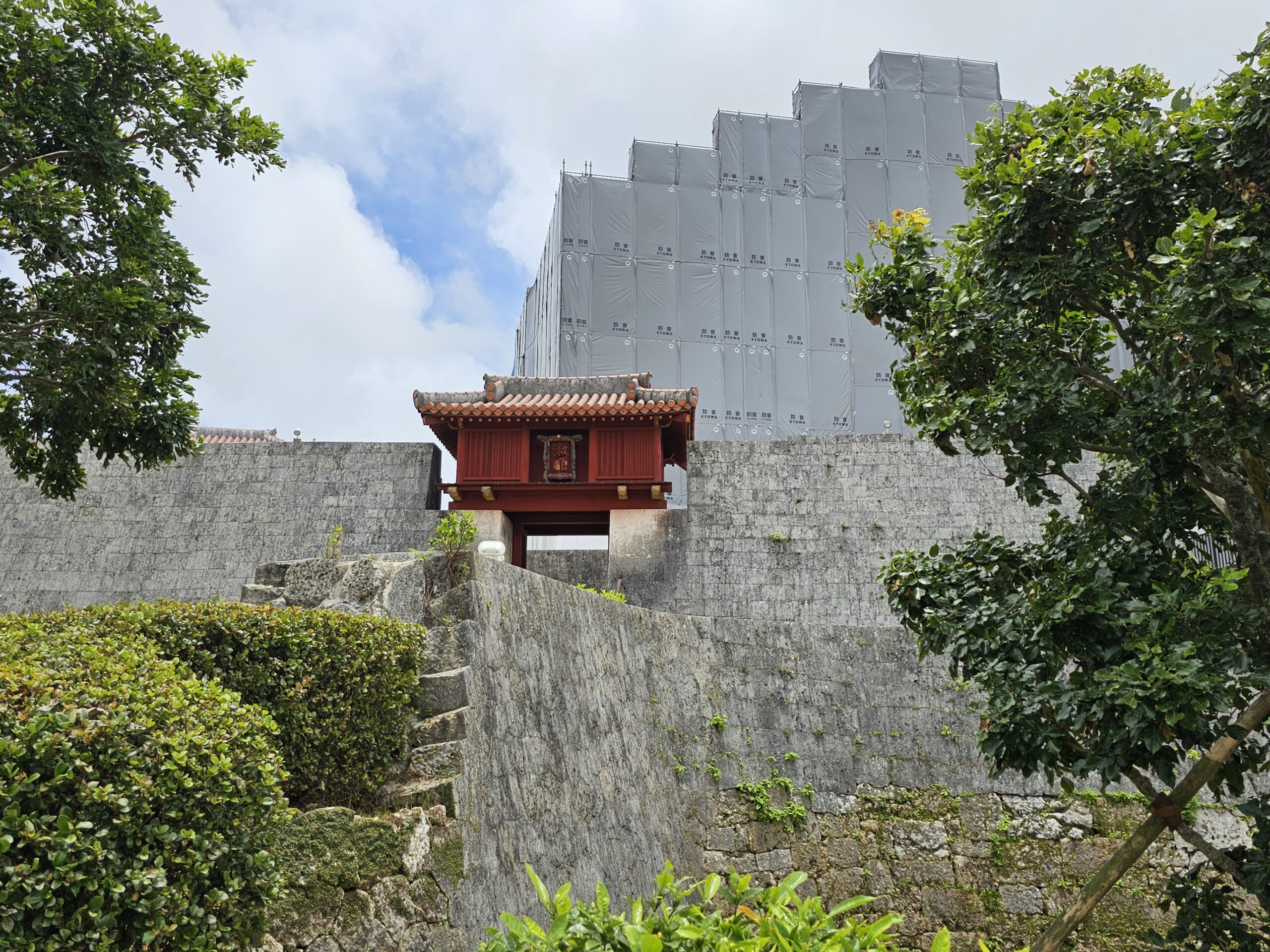
According to official information, work on the main hall began in November 2022. Its exterior was completed in July 2025, and in October 2025 the huge temporary roof (“suyane”) that had covered the work was removed. Since the start of 2026, the main hall under restoration can be viewed from a viewing deck and through clear panels (interior work is closed to visitors for safety). And then—
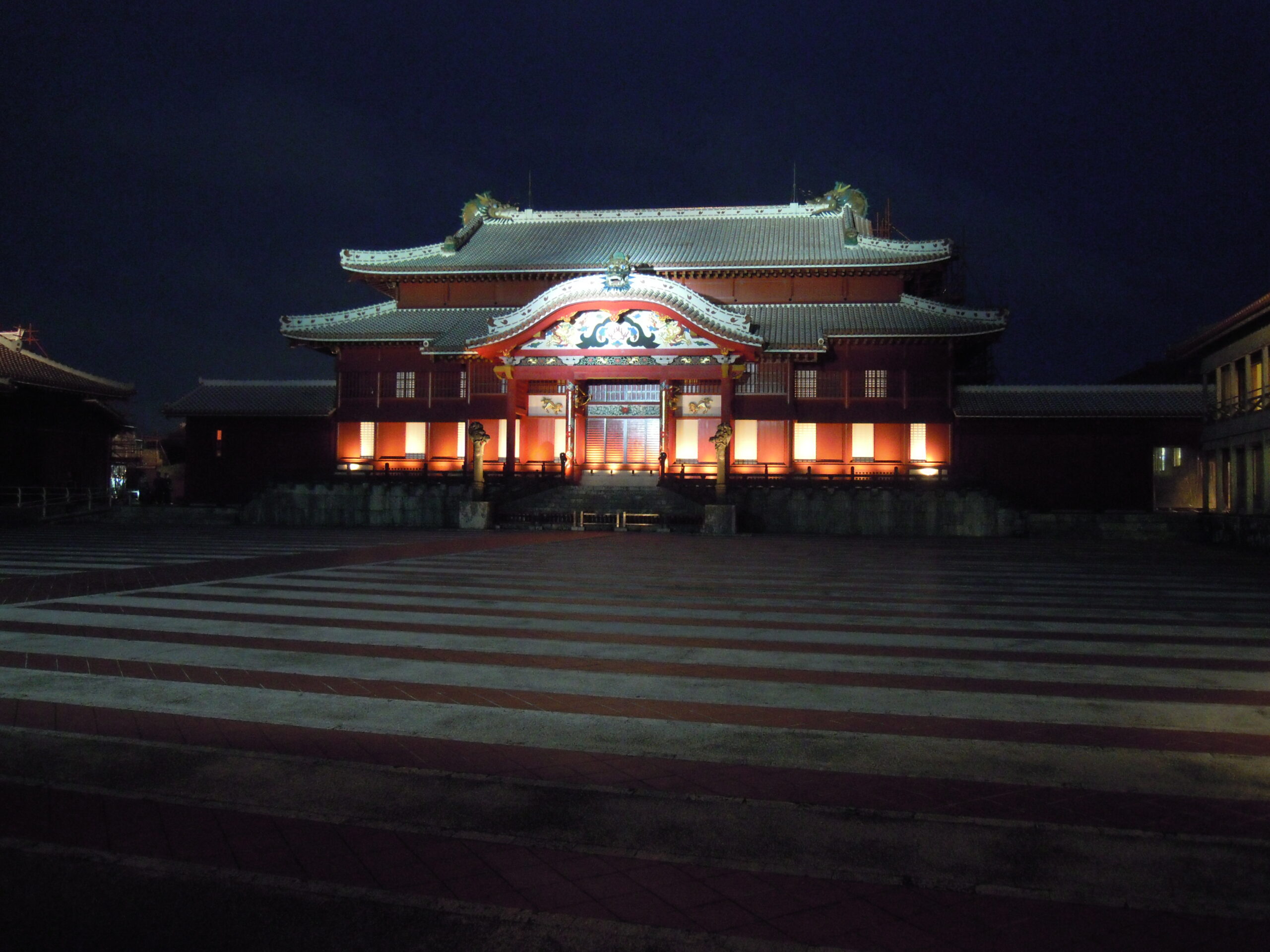
The completion ceremony is scheduled for November 22, 2026, and the public opening of the main hall for November 23, 2026. In other words, from autumn 2026, Shuri Castle shifts from “a castle where you watch the recovery” to “a castle reborn.” Being able to choose which Shuri Castle you want to meet, by timing your visit, is unique to this year.
Not Just Buildings—the “Sacred Sites” and “Ramparts” That Survived the Fire
It is easy to focus on the main hall, but Shuri Castle’s appeal lies in its gates, its stone walls, and above all its places of prayer. Most of these were untouched by the fire and can be walked today.
- Kyo-no-uchi: the castle’s largest sacred precinct. In Ryukyuan faith, the high priestess Kikoe-ogimi and other priestesses prayed here for the royal family’s prosperity, safe voyages, and bountiful harvests.
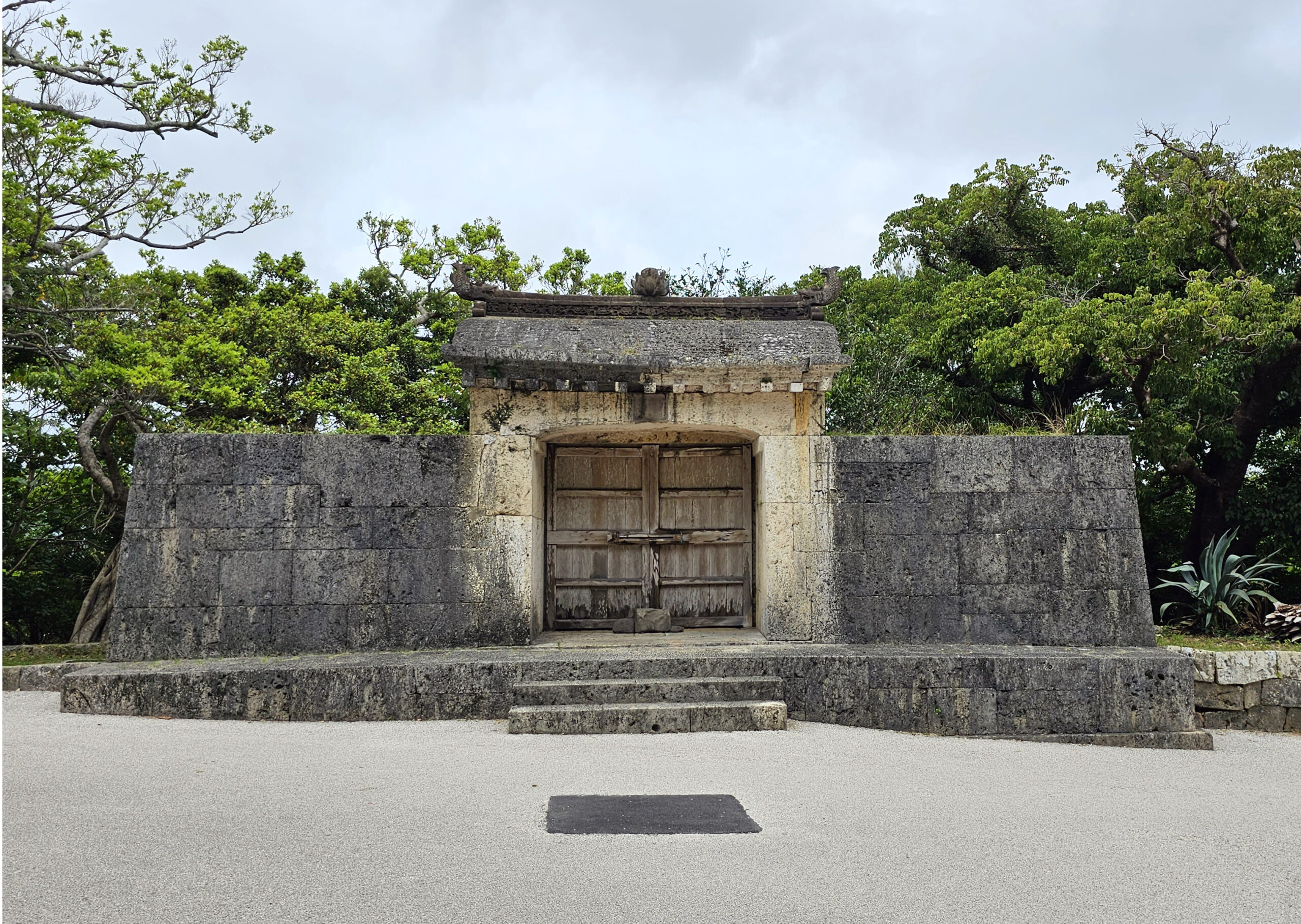
- Sonohyan-utaki Stone Gate: built in 1519, a place of worship where the king prayed for safe travel whenever he set out. It is a component of the World Heritage Site. Though gate-shaped, it is not a gate to pass through but “a gate of prayer to the gods.”
- Suimui-utaki: a place of worship in the Shimo-no-una courtyard, said to be connected to the origin of the name “Shuri.”
- Ryuhi: a spring said to have supplied the royal palace’s drinking water, and the origin of the name of Zuisenmon Gate.
What to Expect Here—”Renewal” and “the Memory of Prayer”
Shuri Castle itself makes no official claim to a specific “blessing” the way a shrine might. Yet there is something real that visitors can take away.
| What you can experience | Why |
|—————-|——|
| Strength to recover and start again | The very site of a castle rising again from the ashes |
| Awe of history and prayer | 450 years of royal memory; sacred grounds like Kyo-no-uchi |
| Quiet and a sense of cleansing | A walled hilltop, with sea breezes and views over Naha |
| Pride and emotion in culture | A castle that crystallizes Ryukyu’s unique sense of beauty |
Shuri Castle may resonate especially with those who want to take a new step, or rebuild something. A castle that once lost everything and is now being revived by people’s hands—its very figure gently pushes the visitor forward. Rather than only “seeing” the grandeur of the buildings, the best way to receive what Shuri Castle offers today is to feel the power of something striving to be reborn.
Best Time to Visit
Season—First, Avoid Typhoon Season
Okinawa’s main island sees frequent typhoon approaches from June through October. Weather data shows June, the rainy season, has the most rainfall, with more typhoons in August and September. Because visiting Shuri Castle is largely outdoors, with many slopes, stone steps, and stone pavements, plan to be flexible on days of heavy rain or typhoons.
| Season | Notes |
|——|——|
| Spring (late Mar–Apr) | Before the rainy season; easy to walk and pleasantly cool. Recommended |
| Rainy season (May–Jun) | Frequent rain. Plan around indoor exhibits |
| Summer (Jul–Sep) | Heat, typhoons, and summer-holiday crowds. Heatstroke care essential |
| Autumn (Oct–Nov) | Heat and typhoons ease. In 2026, the main hall opens on Nov 23 |
| Winter (Dec–Feb) | Relatively easy to walk, though north winds can feel cold |
A special window in 2026 is late autumn: the weather is good, and from November 23 you can meet the restored main hall. (Expect crowds, traffic restrictions, and possibly a ticket system right after opening—be sure to check the latest official announcements.)
Time of Day—Early Morning Feels Best
- Morning: the free zone opens from 8:00 depending on season. Entering right at the 8:30 opening of the paid zone means fewer people and better photos.
- Evening: the walls, Shureimon Gate, and views over Naha take on soft light. Mind the closing time.
- Night: the ramparts are lit from sunset to sunrise (dimmed to about 30% after midnight), covering the walls, Shureimon Gate, the Sonohyan-utaki Stone Gate, and more. However, the paid zone and interior exhibits are closed at night, so enjoy the illumination mainly from the free zone and outer paths.
“What You Can See Now”—How to Walk the Free and Paid Zones
Old guides that assume you can “tour inside the Seiden” as before the fire are no use in 2026. Here is how to walk Shuri Castle today.
Free Zone (no ticket needed)
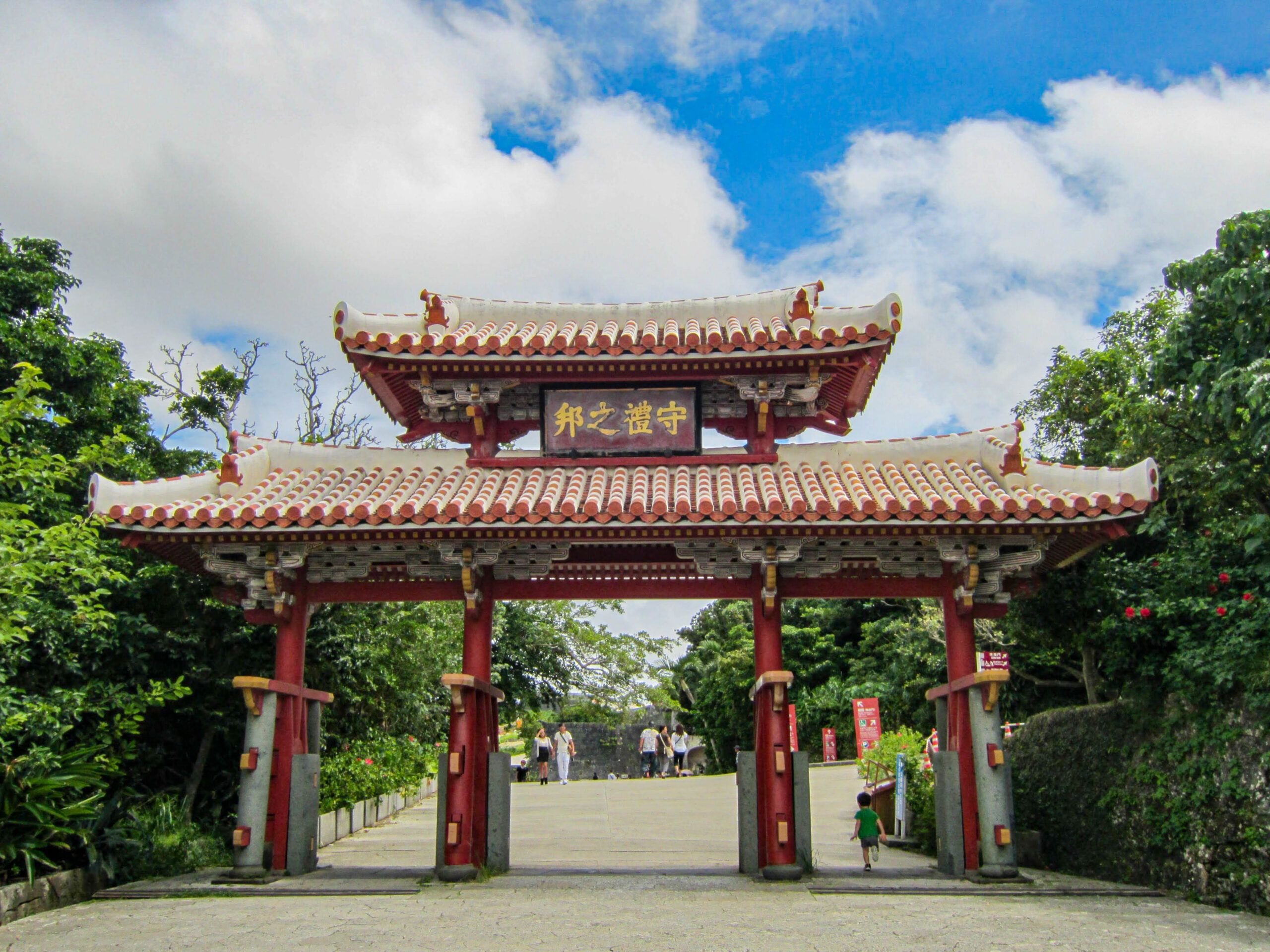
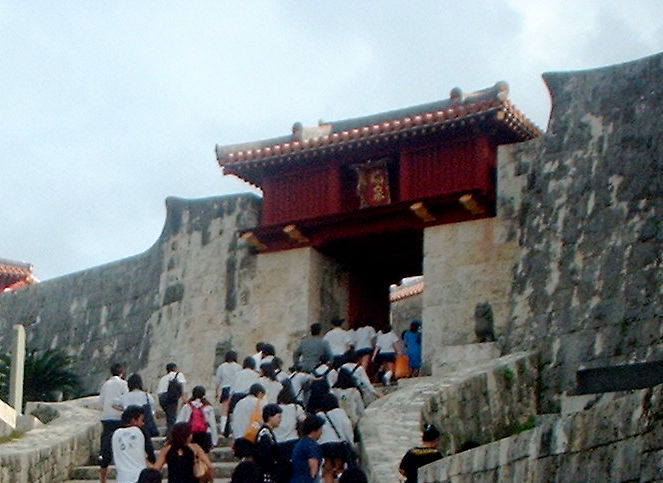
The route from Shureimon Gate toward the castle interior is largely a free zone. Shureimon Gate, the Sonohyan-utaki Stone Gate, Kankaimon Gate, the Ryuhi spring, Zuisenmon Gate, Rokokumon Gate, the Hikagedai sundial, and the Bankoku Shinryo Bell—most of Shuri Castle’s historic highlights can be seen for free. Even if you feel “the entrance fee isn’t worth it without the main hall,” the free zone alone is well worth the walk.
Paid Zone (ticket required)
Beyond Hoshinmon Gate is the paid zone. The highlight is the “Reconstruction Exhibition Room” in the Yohokoriden hall: displays tracing the path from fire to rebuilding, the main hall’s ornaments and prototype pieces, and the video “Shuri Castle: Steps Toward Reconstruction.” It is the best place to truly feel the “shown reconstruction.” From the Agari-no-Azana (eastern lookout), you can take in all of Naha and Naha Port.
| Category | Admission (individual) | Group (20+) |
|——|—————|——————|
| Adult | ¥400 | ¥320 |
| Student (high school) | ¥300 | ¥240 |
| Child (elementary/junior high) | ¥160 | ¥120 |
| Under 6 | Free | — |
An annual passport is ¥800 for adults. Showing a Yui Rail free pass qualifies you for the group rate. Visitors with a disability certificate, plus one caregiver, enter free.
Opening Hours (as of 2026)
The free zone generally opens at 8:00 and the paid zone at 8:30; closing varies by season (e.g., last entry to the paid zone at 18:30 in Apr–Jun and Oct–Nov). From July 1 to September 30, 2026, hours are changed on a trial basis, so if you visit in summer, check the latest official notice. The closing day is customarily “the first Wednesday of July and the following day,” but this varies by year. The park may close in the event of an approaching typhoon.
As a rough guide, allow 30–45 minutes for just the free-zone gates, 90–120 minutes including the paid zone and Reconstruction Exhibition Room, and 2.5–3 hours to walk slowly as far as Kyo-no-uchi and the lookouts.
Access—From Naha Airport, Yui Rail Is the Basics
By Train (Yui Rail)
| Item | Details |
|——|——|
| Nearest station | Yui Rail (Okinawa Urban Monorail) Shuri Station |
| From the airport | Yui Rail from Naha Airport Station to Shuri Station |
| From the station | About 15 min on foot from Shuri Station to Shureimon Gate (also ~15 min from Gibo Station) |
From Naha Airport, Yui Rail is the clearest and most reliable way to reach Shuri Castle. It is about a 15-minute walk from Shuri Station to Shureimon Gate, on a gentle uphill. If walking is a concern, you can take a taxi from Shuri Station.
By Bus
The stop depends on the route. Getting off at “Shurijo-mae” (Shuri Castle Town Line, No. 7/8) is closest, about 1 minute on foot to Shureimon Gate. From “Shurijo Koen Iriguchi” (City Line No. 1/14, etc.) it is about 5 minutes.
By Car / Taxi
About 10 km from Naha Airport, roughly 40–50 minutes (city traffic is prone to congestion). Parking is at the prefectural Shuri Castle Park parking lot (beneath the Suimuikan). No reservation is needed for regular cars, but use is subject to availability.
Parking fee for small cars after the April 1, 2026 revision: ¥500 for the first 60 minutes, then ¥250 per 30 minutes, up to ¥1,000. Note that older information (e.g., “¥400”) is still circulating. Parking is free for holders of a disability certificate. Spaces are limited, so Yui Rail is recommended.
Facilities & Basic Data
| Item | Details |
|——|——|
| Location | 1-2 Shuri Kinjocho, Naha, Okinawa (Shuri Castle Park) |
| World Heritage | Component of “Gusuku Sites and Related Properties of the Kingdom of Ryukyu” |
| Admission | Paid zone from ¥400 (adult); free zone is free |
| Hours | Free zone from 8:00 / paid zone from 8:30 (closing varies by season; summer trial change) |
| Closed | Customarily the first Wednesday of July and the next day (varies; closes for typhoons) |
| Park restaurant | Restaurant Suimui (Suimuikan 1F, 11:00–17:00) |
| Official site | Shuri Castle Park (oki-park.jp) |
Within the park are Restaurant Suimui (Ryukyu/Okinawan cuisine, with Muslim/vegetarian menu options), Cafe Ryuhi (coffee and desserts with views over Naha), rest areas, coin lockers, and a first-aid room. Hours vary by season, so it helps to check before a long visit.
Guide by Visitor Type—”How Should I Walk It?”
For Wheelchair Users, Strollers, and Those Unsure on Their Feet
Shuri Castle has many slopes, stone steps, and stone pavements. That said, the park has wheelchair-accessible elevators, ramps, and accessible toilets, and lends wheelchairs and canes free of charge (the Suimuikan general information desk has wheelchairs—including electric—canes, and strollers; the Hoshinmon desk also has wheelchairs). The Kobikimon Gate has a wheelchair route.
The best approach is to first check the accessible route and toilet locations at the Suimuikan. You can reach the central castle area via maintained routes, but the Kinjocho stone-paved road outside the castle is steeply sloped, so it’s wise not to push on there.
For Visitors with Pets
Park rules allow only small dogs and cats inside, and only when kept on a leash or in a carrier so their movement is controlled. Pets cannot enter buildings (guide, hearing, and service dogs excepted). If you want to take your time with the paid-zone exhibits, take turns with a companion or arrange pet day-care in Naha in advance.
For Photographers
Personal photography needs no application (long occupancy, tripods/equipment setup, and commercial shoots are restricted; drones are prohibited). Photo spots to aim for:
1. Shureimon Gate: the iconic shot, with the “Shurei-no-kuni” plaque.
2. The curve of the ramparts: Ryukyu’s distinctive, smoothly undulating stone walls.
3. Agari-no-Azana / Iri-no-Azana lookouts: sweeping views over Naha and Naha Port.
4. The ramparts across Ryutan Pond: walls and illumination mirrored in the water.
5. The main hall under restoration (until Nov 22, 2026): shot through the viewing deck and clear panels—a “record of recovery you can only capture now.”
For Families with Children
The route through the gates from Shureimon makes for a fun “castle adventure” for kids. The Reconstruction Exhibition Room in the paid zone is also a place to learn about the fire and rebuilding. But summer carries a high risk of heatstroke, so use the Suimuikan, cafe, and first-aid room as rest bases and hydrate often. The stone-paved road is steep, so keep it short with small children.
For Rainy Days
Shuri Castle has many outdoor routes, and stone steps and pavement get slippery in rain. On wet days, build your visit around the Suimuikan, the Yohokoriden Reconstruction Exhibition Room, Restaurant Suimui, Cafe Ryuhi, and the shops. In heavy rain or an approaching typhoon, the park may close, so always check the official site and social media before setting out.
Nearby Sights & Model Course
Half-Day Model (Shuri Castle + Nearby World Heritage)
“`
9:00 Arrive Yui Rail Shuri Station; walk to Shureimon Gate (~15 min)
9:30 Stroll the free zone (Shureimon, Sonohyan-utaki, Kankaimon, Zuisenmon)
10:30 Enter the paid zone. Feel the “shown reconstruction” in the exhibition room; views from Agari-no-Azana
11:30 Walk to Tamaudun; tour the royal mausoleum
12:30 Lunch at Suri Soba or another Okinawa soba shop in Shuri
13:30 Walk down the Kinjocho stone-paved road
“`
Nearby Spots
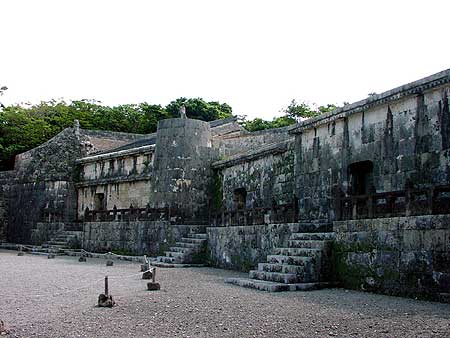
- Tamaudun: the Ryukyu royal mausoleum, built in 1501. A component of the World Heritage Site, within walking distance of Shuri Castle—a solemn stone tomb.
- Shikinaen: the largest villa and garden of the Ryukyu royal family. Also World Heritage. A circuit-style garden centered on a pond, with a beautiful Chinese-style pavilion (reached by car or bus from Shuri Castle).
- Kinjocho Stone-Paved Road: part of the old “Madama-michi” road, begun in the 16th century. Atmospheric stone paving, but steep—wear good shoes.
- Ryutan Pond: an artificial pond created in 1427. The ramparts mirrored in the water and the illumination make for great photos.
- Benzaiten-do, Enkanchi Pond, Enkakuji ruins: waterside and temple ruins around Shuri Castle, good for a quiet stroll.
Souvenirs
The park’s Shop Bingata offers Shuri Castle Park original goods, local products, and folk crafts inspired by traditional designs. Good buys include bingata-pattern accessories, Ryukyu glass, and Shuri Castle reconstruction goods. The “Shuri Castle WAON” card sold at the shop donates part of each purchase to the castle’s reconstruction fund.
Visitor Voices
Here are general trends seen on review sites (individual impressions are the posters’ own).
On travel review sites (such as Tripadvisor and Asoview), some note that “it’s a shame you can’t fully see the main hall while it’s under construction,” while many also give positive reviews—“seeing the recovery up close is something you can only do now; I’m glad I came,” “I want to come again once it’s finished.”
Overall, the trend in today’s reviews is: “If you go expecting the pre-fire vermilion main hall, you’ll feel a gap; but if you visit to ‘watch the recovery and walk the kingdom’s ruins,’ satisfaction is high.” After November 23, 2026, this will likely shift toward “moved by the completed main hall.”
Notes & Safety
1. Beware of old information: pre-fire details on “touring inside the Seiden,” fees, and hours are still widespread. Always check official 2026 information.
2. The main hall opens to the public on November 23, 2026 (planned): it is under restoration before that. Confirm the opening date, tickets, and visitor routes via official updates.
3. Typhoon season (Jun–Oct): possible closures. Have a backup day and indoor spots ready.
4. Many slopes and steps: wear good shoes; wheelchair/stroller users should check the accessible route.
5. Heatstroke care in summer: hat, water, and shaded rests.
6. Pets: small dogs/cats only, not inside buildings: follow the rules.
7. Drones prohibited: no flying within the park.
Frequently Asked Questions
Q. Is there anything to see at Shuri Castle now, in 2026?
A. Plenty. Shureimon Gate, the Sonohyan-utaki Stone Gate, the castle gates and walls, and Kyo-no-uchi were untouched by the fire and can be walked. As a “shown reconstruction,” you can also view the main hall under restoration from the viewing deck and learn about the rebuilding in the exhibition room.
Q. When will the main hall be viewable?
A. Officially, the completion ceremony is planned for November 22, 2026, and the public opening for November 23, 2026. Crowds and a ticket system are expected right after opening, so check the official site before visiting.
Q. How much is admission? Is there anything free to see?
A. The paid zone is ¥400 for adults and so on. Most historic highlights—Shureimon, Sonohyan-utaki, Kankaimon, Zuisenmon—are in the free zone.
Q. How do I get there from Naha Airport?
A. The basics: Yui Rail from Naha Airport Station to Shuri Station, then about a 15-minute walk to Shureimon Gate. By bus, “Shurijo-mae” is closest. By car, about 40–50 minutes.
Q. Can I tour it in a wheelchair or with a stroller?
A. It is a castle with many slopes and steps, but there are accessible elevators, ramps, and toilets, plus free wheelchair and cane rentals. It’s best to check the accessible route at the Suimuikan first.
Q. Can I bring a pet?
A. Only small dogs and cats, kept on a leash or in a carrier. Buildings are off-limits except for service dogs.
In Closing
Shuri Castle is the symbol of the Ryukyu Kingdom, striving to rise again from the ashes.
The 2019 fire took the main hall, but Shuri Castle turned that into a one-time experience: the “shown reconstruction.” You can witness the site where craftsmen bring the castle back to life only until November 22, 2026. And from November 23, a brand-new main hall will welcome you. Being able to choose which Shuri Castle to meet, by timing your visit, is unique to this special year.
And don’t forget: Shuri Castle’s value is not the buildings alone. In the walls and gates that survived the fire, and in Kyo-no-uchi and the Sonohyan-utaki Stone Gate where the royal family prayed, 450 years of the kingdom’s memory still live on. A castle that once lost everything and yet strives to rise again will, surely, gently push the back of anyone hoping to take a new step.
—
We hope this guide helps you on your visit to Shuri Castle.
*Information in this article is current as of June 2026. The main hall’s public opening date (planned for November 23, 2026), opening hours (including the summer trial change), admission and parking fees, facility operations, and pet/accessibility policies are subject to change. Please confirm the latest details on the official Shuri Castle Park website before visiting.*
Key sources:
Find Out Your Compatibility with Shuri Castle
Power spots have a “compatibility” unique to each person.
Two people can visit the same place and one is deeply moved while the other feels little—
this comes from the combination of your own innate energy and the nature of the spot.
Shuri Castle’s power of “renewal” and “rising again” is said to suit especially those who want to take a new step or rebuild something, but whether it truly fits you is determined by the personal energy derived from your birth date and time.
あなたに最適なパワースポットを知りたい方へ