Most visitors to Shikoku know Zentsu-ji as Temple 75 on the famed 88-Temple Pilgrimage. Far fewer realize that this is the actual birthplace of Kobo Daishi (Kukai) — arguably the most influential religious figure in Japanese history.
Born in 774 CE on this very ground, Kukai (posthumously titled Kobo Daishi) founded Shingon Buddhism, designed civil engineering works such as the Manno Reservoir that still functions today, and transformed Japan’s religious and cultural landscape. In 807 CE, he established Zentsu-ji (善通寺) at the site of his childhood home, naming it after his father, Saeki Yoshimichi.
For over 1,200 years, this temple has been the spiritual heart of Shingon Buddhism in Shikoku. Today it welcomes everyone — white-robed pilgrims, history enthusiasts, families on day trips, and travelers seeking the unique experience of the Kaidan-meguri, a pitch-dark 100-meter tunnel pilgrimage beneath the temple’s most sacred hall.
This guide tells you everything you need to know to make the most of your visit: history, what to see, how to walk the dark tunnel, where to park, and where to eat the world-class Sanuki udon served right outside the temple gates.
—
What Makes Zentsu-ji Special
Zentsu-ji is divided by a public road into two precincts — the East Precinct (Garan) and the West Precinct (Tanjo-in, “Birth Hall”). Combined, the grounds cover approximately 45,000 square meters — the size of about nine football fields.
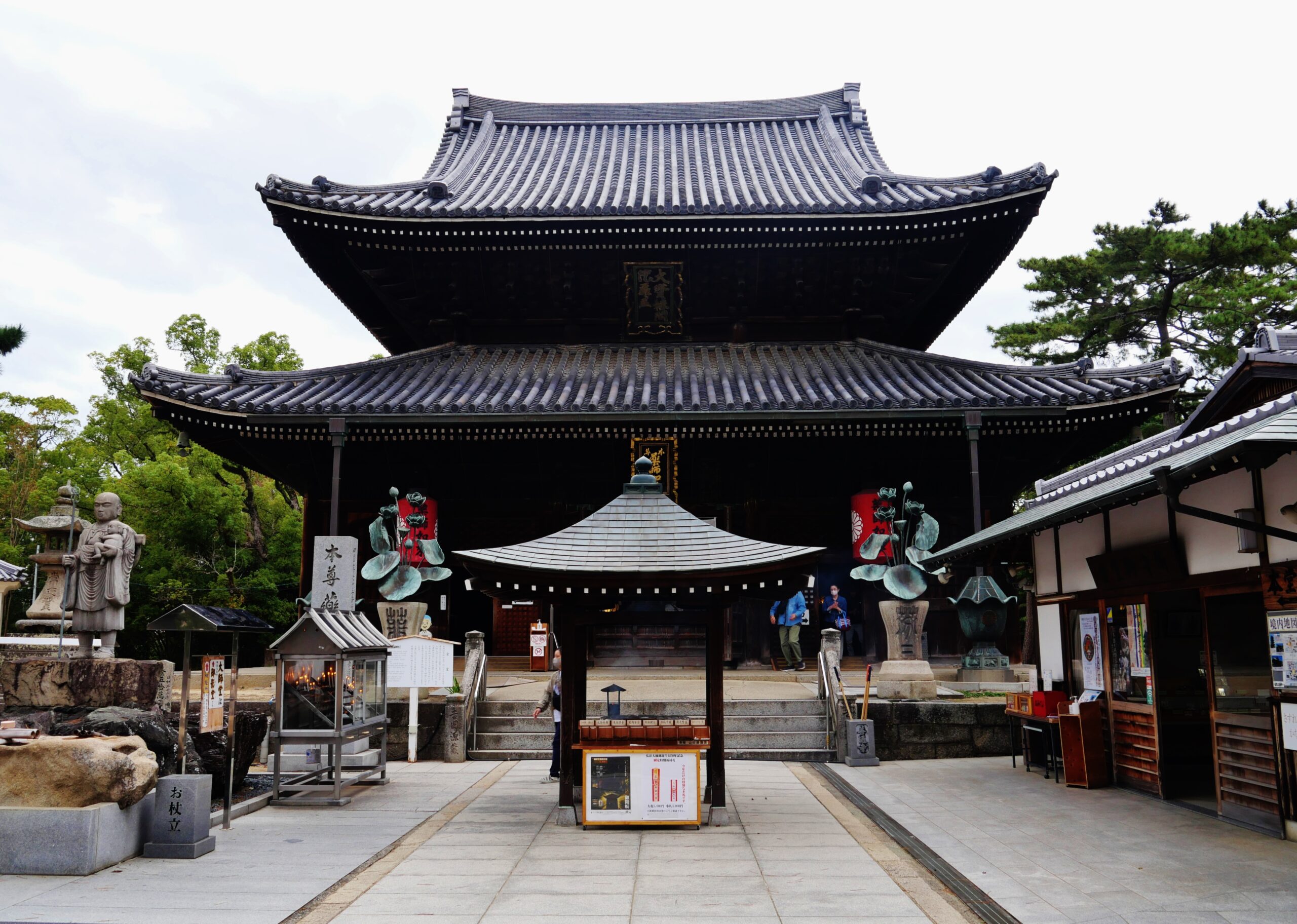
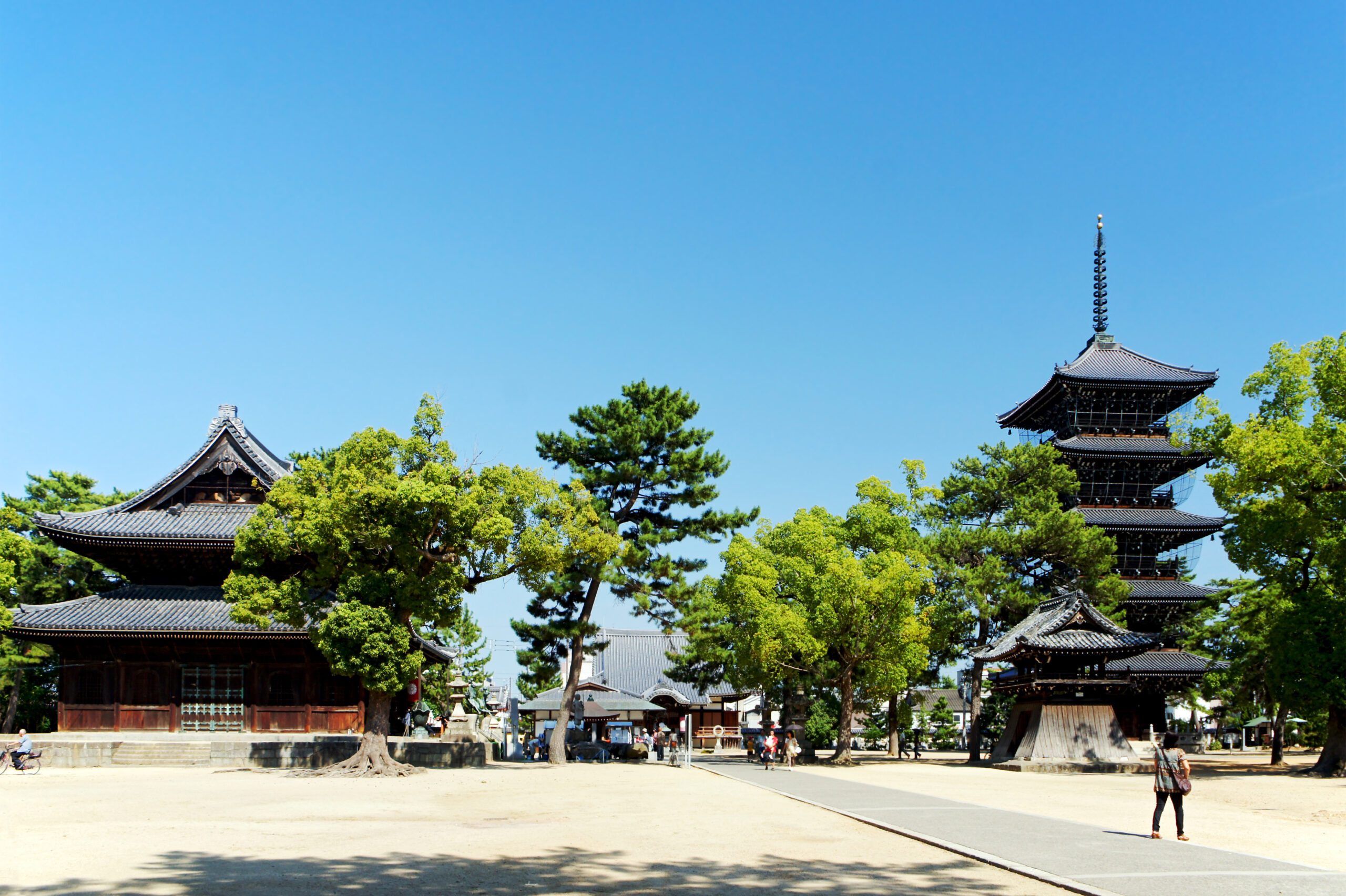
The East Precinct centers on the Kondo (Main Hall), rebuilt in 1699, which houses the principal image of Yakushi Nyorai (the Medicine Buddha). Around it stand the five-storied pagoda, the middle gate, the Shaka-do (Buddha Hall), and several smaller halls.
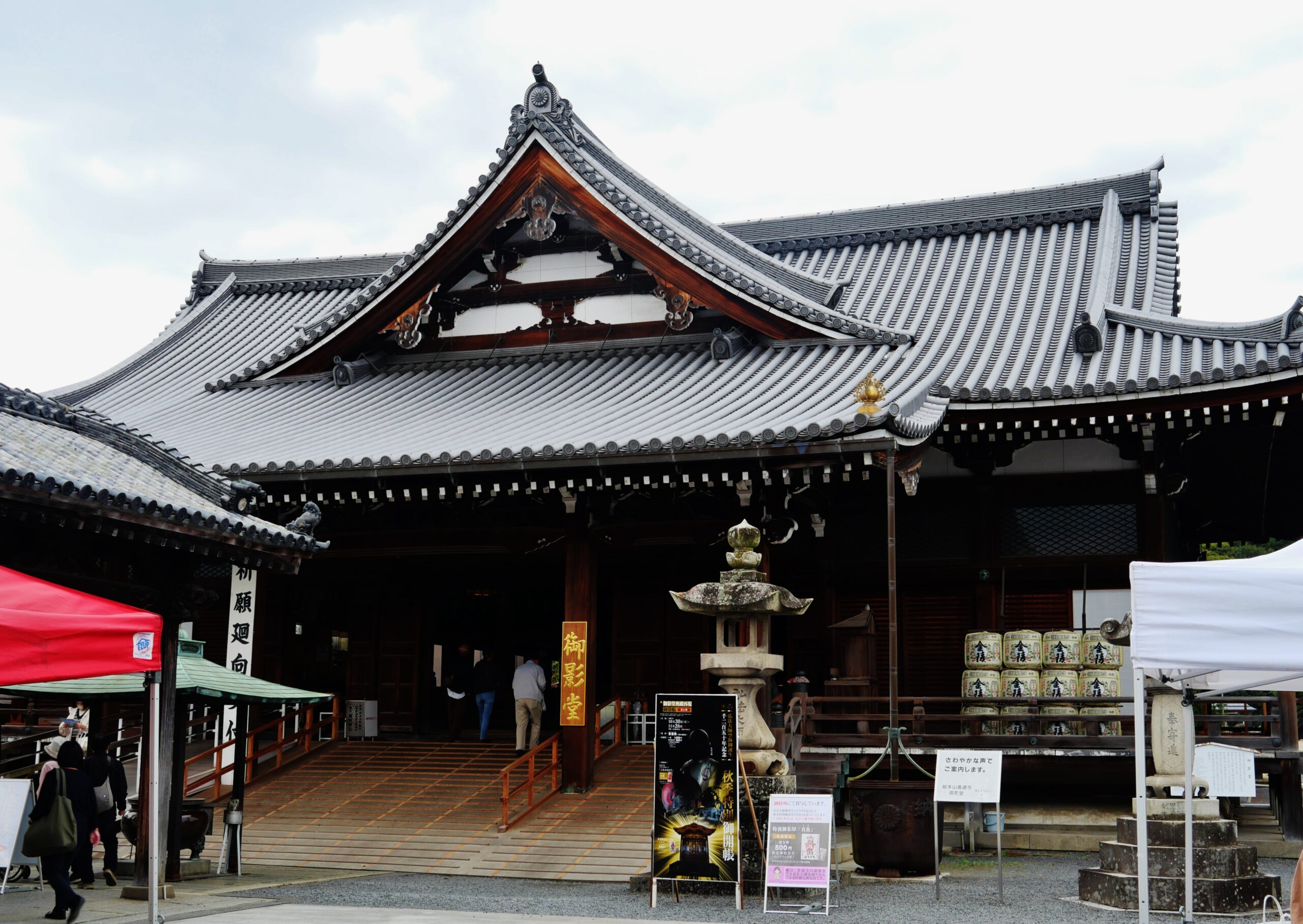
The West Precinct is built directly on the site where Kukai was born. The Mieido (Goeido) — the “Founder’s Portrait Hall” — stands above the spot believed to be the location of his childhood home. This precinct is considered the most spiritually significant area of the temple.
Most visitors walk both precincts in a single visit, starting with the East Precinct (Garan) and finishing in the West (Tanjo-in).
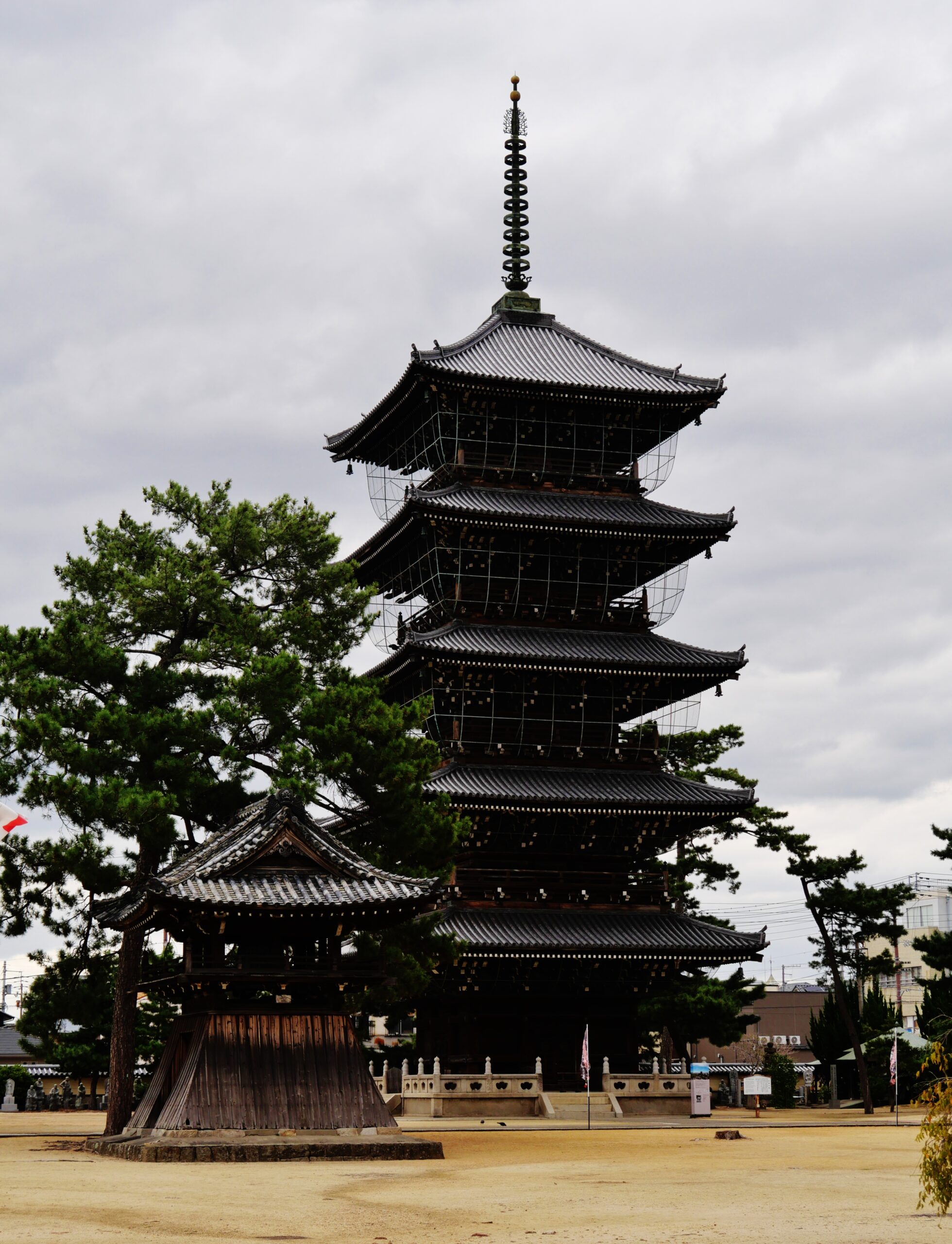
The Five-Storied Pagoda dominates the East Precinct. The current structure was rebuilt in 1902 (Meiji 35) and is registered as a tangible cultural property of Japan. Standing approximately 45 meters tall, it rises above the surrounding rooftops as a landmark visible from across the city.
The pagoda’s interior houses statues of the Five Wisdom Buddhas (Gochi Nyorai), including the cosmic Buddha Dainichi Nyorai at the center. While the pagoda is normally viewed from the outside only, during occasional special openings visitors can climb to the upper levels (check the official website for current information).
The single most memorable experience at Zentsu-ji is the Kaidan-meguri — a pilgrimage through complete darkness beneath the Mieido.
The Kaidan-meguri is a 100-meter underground corridor with zero light. Visitors remove their shoes, descend into the darkness, and follow the wall with their left hand all the way around. Along the way, the corridor passes directly beneath the spot where Kukai’s portrait is enshrined — the act of walking through is said to create a karmic bond (kechien) with Kobo Daishi himself.
The walk takes about 5 minutes. The first 30 seconds can feel disorienting — there is no glow of any kind. But emerging back into daylight produces a strangely cleansed feeling that many visitors describe as the highlight of their trip to Shikoku.
A note for visitors with claustrophobia or anxiety: skipping the Kaidan-meguri is perfectly acceptable. Praying at the Mieido itself also creates a meaningful connection with Kukai.
In the West Precinct stands a massive camphor tree (kusunoki) said to have witnessed Kukai’s childhood. The tree is over 1,200 years old, with a trunk circumference of approximately 13 meters and a height of around 30 meters. It is designated a Natural Monument of Kagawa Prefecture.
Local worshippers often pause to greet the tree before approaching the Mieido. Its roots spread near the spot where Kukai is said to have been bathed at birth — a living witness to a millennium of devotion at this site.
—
Spiritual Benefits and Reputation
The temple is revered for blessings rooted in its connection to Kobo Daishi and the Medicine Buddha:
- Warding off misfortune and bad luck — as a head temple of the Shingon school, the temple provides powerful protection
- Academic success and wisdom — Kukai is regarded as one of Japan’s greatest intellectual figures. Students preparing for entrance exams often visit during winter
- Healing and health — Yakushi Nyorai, the Medicine Buddha, is the principal image enshrined in the Kondo
- Family harmony and prayer fulfillment — the karmic bond created through the Kaidan-meguri is believed to bring broad blessings
- Travel safety — as a key node of the Shikoku Pilgrimage, Zentsu-ji is invoked for safety on the road
The connection with academic success is especially prominent. Kukai himself was one of the most accomplished polymaths in Japanese history — master of calligraphy, poetry, engineering, and religion — and modern visitors come hoping to share in his legacy. January and February see a steady stream of families praying for children’s exam results.
That said, the spiritual fit with any sacred site is personal. Some visitors feel a deep resonance with Zentsu-ji’s solemn Shingon atmosphere, while others find their connection more readily at natural sites like mountains or waterfalls.
—
Best Time to Visit
| Season | Rating | Notes |
|——–|——–|——-|
| Spring (Mar-Apr) | ★★★★★ | Cherry blossoms, mild weather. The Shogoeiku (Apr 3rd Sat/Sun) draws devotees from across Japan |
| Summer (Jun-Aug) | ★★★ | The June 14-15 Onjoe (Kukai’s Birthday) is a major event; afternoons are hot |
| Autumn (Oct-Nov) | ★★★★ | Cooler air, clearer skies. Pleasant for walking both precincts |
| Winter (Dec-Feb) | ★★★★ | Crisp atmosphere; students arrive to pray for exam success |
The 21st of each month is Kobo Daishi’s monthly memorial day. A monthly Mieiku (memorial service) is held at 11:00 AM, and the temple atmosphere is at its most devotional.
The two largest annual events are:
- Shogoeiku (third Saturday/Sunday of April) — the principal memorial service marking Kukai’s traditional death anniversary
- Onjoe (June 14-15) — celebrates Kukai’s birth
Best Time of Day
- Weekday mornings (8:00-10:00) are ideal — you can do the Kaidan-meguri without waiting
- Weekend mid-day (10:00-14:00) is busiest, as pilgrimage bus tours arrive
- Early morning around 6:00 offers a near-empty temple, though the Kaidan-meguri and Treasure Hall open at 8:00
—
How to Visit: Step by Step
1. Enter through the Akamon (South Gate) or Niomon Gate — start with the East Precinct
2. Purify your hands at the chozuya — left hand, right hand, mouth
3. Pray at the Kondo (Main Hall) — the principal image is Yakushi Nyorai
4. Walk around the Five-Storied Pagoda
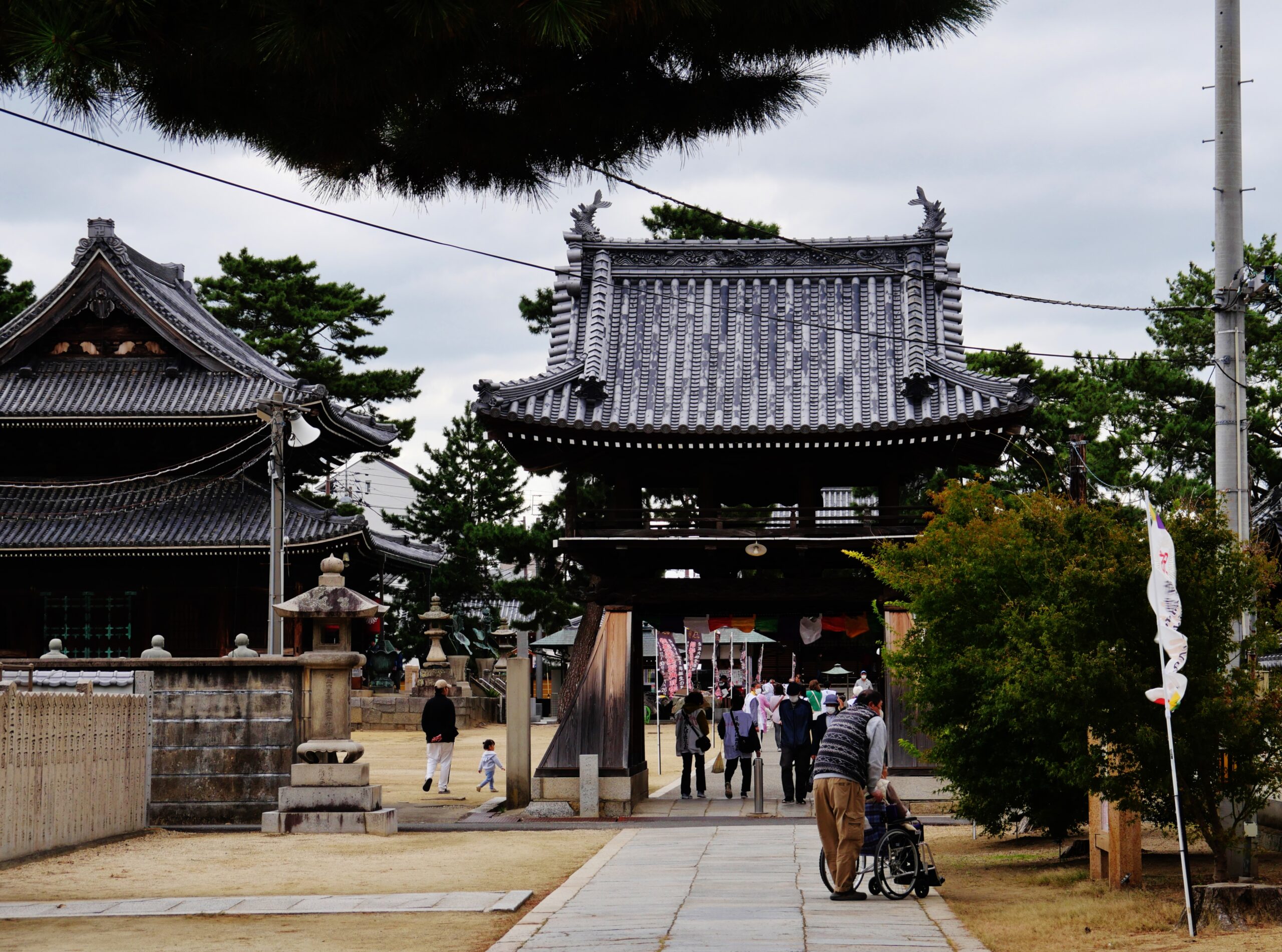
5. Cross the road to the West Precinct via “Akamon-dori”
6. Greet the sacred camphor tree
7. Pray at the Mieido
8. Attempt the Kaidan-meguri (admission for combined ticket: 500 yen adults / 300 yen students)
9. Visit the Treasure Hall — two National Treasures are housed here
10. Receive your goshuin (temple stamp) at the nokyojo — 300 yen
The pitch-dark corridor is safe and well-organized, but worth knowing what to expect:
- Remove your shoes at the entrance; they are kept at the cubbyholes
- Touch the left wall with your left hand and follow it around — this is the official guidance
- Carry minimal items — leave bulky bags at reception if needed
- Keep distance from the person ahead — you’ll feel close in the dark
- If you have claustrophobia, skip it — praying at the Mieido above is equally meaningful
The total time is about 5 minutes. Children can join, but parents should hold hands with younger ones. Some young children find it thrilling; others find it overwhelming. Use your judgment.
If you are walking the Shikoku 88 Temple Pilgrimage, the formal procedure at Zentsu-ji (Temple 75) is:
1. Bow at the gate
2. Purify hands at the chozuya
3. Chant sutras at the Hondo (Kondo). The mantra of Yakushi Nyorai: “On koro koro sendari matogi sowaka”
4. Chant sutras at the Daishi-do (Mieido). The mantra of Kobo Daishi: “Namu Daishi Henjo Kongo”
5. Receive the goshuin at the nokyojo (300 yen)
Temples 74 (Koyamaji) and 76 (Konzoji) are both nearby and often visited the same day.
—
Essential Information
| Item | Detail |
|——|——–|
| Official name | Byobugaura Gogaku-zan Tanjo-in Zentsu-ji |
| Common name | Zentsu-ji, “Odaishi-san” |
| School | Shingon Buddhism, Zentsuji-ha (head temple) |
| Principal image | Yakushi Nyorai (Medicine Buddha) |
| Address | 3-3-1 Zentsuji-cho, Zentsuji City, Kagawa 765-8506 |
| Grounds access | Open 24 hours (precincts are free to enter) |
| Kaidan-meguri & Treasure Hall | 8:00-17:00 (last entry 16:30) |
| Admission | Free for grounds; combined ticket 500 yen adults / 300 yen students for Kaidan-meguri + Treasure Hall |
| Parking | ~260 spaces (200 yen for cars) |
| Founded | 807 CE by Kobo Daishi Kukai |
| Pilgrimage | Temple 75 of the Shikoku 88; #7 of the Eighteen Honzan |
| Phone | +81-877-62-0111 |
| Website | https://www.zentsuji.com/ |
—
How to Get There
JR Dosan Line → Zentsuji Station → approximately 15-minute walk (about 1.2 km)
From Takamatsu Station, take a JR limited express (Nanpu/Shimanto) or local train on the Dosan Line to Zentsuji Station (about 45 minutes by limited express, longer by local). The walk to the temple is flat and signposted.
| Starting Point | Route | Time |
|—————-|——-|——|
| Zentsuji IC (Takamatsu Expressway) | Local signs to Zentsu-ji | ~5 min |
| Takamatsu city | Route 11 → Route 32 | ~45 min |
| Marugame city | Local roads | ~15 min |
Group pilgrimage tours typically arrive between 10:00 and 13:00. If you visit outside this window, both the parking lot and the Kaidan-meguri are dramatically less crowded.
The main pathways through both precincts are paved and largely flat — suitable for wheelchairs and strollers up to the entrances of the major halls. The Kaidan-meguri itself involves stairs and is not wheelchair accessible. The Treasure Hall has step access only.
Pets are generally not permitted inside the temple precincts (service dogs excepted). If traveling with a pet, plan to take turns visiting while one person waits in the car — and never leave a pet in a hot car in summer (Sanuki summers regularly exceed 33°C).
—
Nearby Attractions and Sanuki Udon
| Spot | From Zentsu-ji | Highlights |
|——|—————-|———–|
| Koyamaji (Temple 74) | 5 min by car / 30 min walk | Linked to Kukai’s childhood. Also known as the “Rabbit Temple” |
| Konzoji (Temple 76) | 5 min by car | Birthplace of Chisho Daishi (Enchin), founder of the Jimon branch of Tendai Buddhism |
| Zentsu-ji Treasure Hall | On-site | Houses two National Treasures: the gilt-bronze shakujo head and the “One Letter, One Buddha” Lotus Sutra |
| Miyagawa Seimen-jo | 10 min walk | A beloved local udon shop using rich iriko (sardine) broth |
| Kumaoka Kashiten | 5 min walk | Zentsu-ji’s signature hard biscuit “katapan” — a classic souvenir |
| Kotohira-gu (Konpira-san) | 25 min by car | Famous 785-step shrine climb. Major regional pilgrimage site |
“`
9:00 Arrive at Zentsu-ji parking lot
9:15 East Precinct (Kondo, Five-Storied Pagoda)
10:00 Cross to West Precinct (Mieido, Kaidan-meguri)
11:00 Treasure Hall (National Treasures)
11:30 Lunch: kake udon at Miyagawa Seimen-jo (10-min walk)
13:00 Konzoji (Temple 76)
14:00 Drive to Kotohira-gu; climb to the main shrine (2-3 hours)
17:00 Return journey
“`
Zentsu-ji sits at the heart of Kagawa’s most famous udon belt. Within a short drive, you can hit several legendary shops:
“`
11:00 After temple visit
11:30 Miyagawa Seimen-jo (10-min walk, kake udon)
12:30 Nagata in Kanoka (5-min drive, kamaage udon)
13:30 Continue toward Marugame for more famous shops
“`
—
Visitor Reactions
Drawing on patterns observed across visitor reviews:
> “The Kaidan-meguri was darker than I imagined possible. Coming out the other side, I felt unexpectedly calm. Easily the most memorable thing I did in Shikoku.”
> — Visitor review (paraphrased, Google Maps)
> “We walked here as Temple 75 of our pilgrimage. As Kukai’s birthplace, the air felt different from the other temples. The goshuin felt special, like a milestone.”
> — Pilgrim review (paraphrased)
> “I brought my elementary-school son. He was nervous about the dark tunnel but ended up loving it. The five-storied pagoda completely caught his attention. A good family-friendly destination.”
> — Family visitor (paraphrased)
The temple draws a remarkably diverse audience: Shikoku pilgrims, history buffs, Shingon devotees, families on day trips, and udon enthusiasts. The common threads in feedback are the scale of the grounds, the dignity of the Mieido, and the singular experience of the Kaidan-meguri.
—
Frequently Asked Questions
Q: Can children do the Kaidan-meguri?
💡 A: There’s no age restriction, but the corridor is completely dark. Young children should walk holding a parent’s hand. Some kids find it exciting; others find it overwhelming. Use your judgment.
Q: Do I need to be on the Shikoku Pilgrimage to visit?
💡 A: Not at all. Many visitors come simply as travelers, sightseers, or spiritual seekers. Pilgrim attire is not required.
Q: Is the temple wheelchair-friendly?
💡 A: The main pathways and approaches to the Kondo and Mieido are paved and flat. The Kaidan-meguri (with stairs and darkness) is not wheelchair accessible.
Q: Can I bring my pet?
💡 A: Pets are generally not allowed inside the precincts. Service dogs are an exception. If you must travel with a pet, take turns visiting while someone stays with the animal.
Q: How long should I plan to stay?
💡 A: Allow 1.5 to 2 hours for the East Precinct, West Precinct, Kaidan-meguri, and Treasure Hall. Pilgrims performing full sutra recitations should plan for 2+ hours.
Q: Are there English-speaking guides?
💡 A: English signage is limited. A multilingual pamphlet is available at the reception. For deeper context, consider hiring a guide through Kagawa Prefecture’s tourism office in advance.
Q: Where should I eat?
💡 A: For an authentic local experience, walk 10 minutes to Miyagawa Seimen-jo for kake udon. For Zentsu-ji’s signature souvenir, stop by Kumaoka Kashiten for “katapan” — a famously hard biscuit that dates back over a century.
—
Final Thoughts
Zentsu-ji is one of Japan’s most important Buddhist sites — not just because of its size or its position on the Shikoku Pilgrimage, but because it stands on the actual ground where Kobo Daishi Kukai was born. Few religious sites in the world can claim such a direct connection to their founder.
The grandeur of the Five-Storied Pagoda and Kondo, the solemnity of the Mieido, the 1,200-year-old camphor tree, the disorienting and quietly transformative Kaidan-meguri — each element carries a story stretching back twelve centuries.
The Kaidan-meguri in particular offers something you cannot experience in everyday modern life: a few minutes of total darkness, alone with your own breath, ending in the simple relief of light. That short walk is what visitors remember years later.
The best time to visit is spring during cherry blossom season, or on the 21st of any month when the temple’s devotional rhythm is most palpable. Arrive early on a weekday morning, greet the sacred camphor tree before the bus tours arrive, and you’ll begin to understand why this place has held the heart of Shingon Buddhism for 1,200 years.
—
We hope this guide helps you make the most of your visit to Zentsu-ji.
This article reflects information as of May 2026. Please check the official website for the latest hours, fees, and event schedules before your visit.
—
Want to discover the power spot that’s right for you?
Beyond Zentsu-ji, Japan is home to many sacred power spots. To find out which one best matches your personal profile, try our free compatibility diagnosis (3 minutes).
📚 You May Also Like
Explore more sacred places and power spots across Japan in our Japan Power Spots series.
🌏 This article is part of our Japan Power Spots series for international visitors.
Planning your trip to Japan? Bookmark this page for your spiritual journey!