The Head Shrine of 30,000 Inari Shrines — What Lies Beyond the Thousand Gates
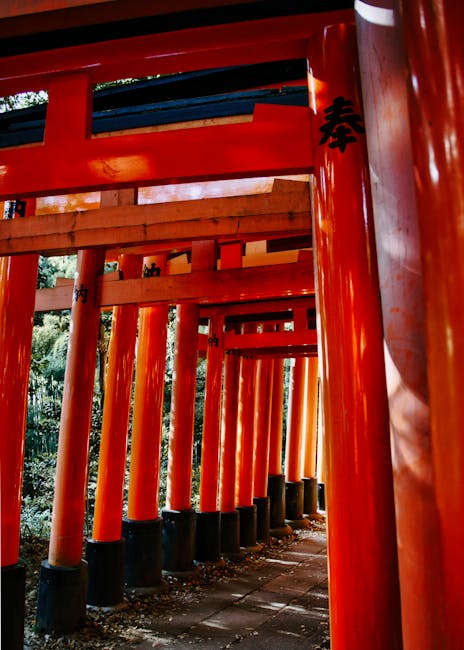
“Is it worth hiking all the way to the top of Mount Inari?”
Short answer: if you have the time and energy, absolutely yes. But most visitors only walk through the famous Senbon Torii and turn back — missing the quietest, most spiritual part of the mountain. This guide covers everything you need to decide how far to go, what to see, and how to make the most of your visit.
Fushimi Inari Taisha, founded in 711 AD, is the head shrine of approximately 30,000 Inari shrines across Japan. The deity Inari governs business prosperity, abundant harvests, and good fortune. Over 3 million people visit annually, making it one of Japan’s most popular shrines — and it’s free and open 24 hours a day.
Quick Facts
| Detail | Info |
|——–|——|
| Admission | Free |
| Hours | 24 hours (shrine office: 8:30 AM – 4:30 PM) |
| Time needed | 1-3 hours |
| Best time | Before 7 AM (avoid crowds) |
| Nearest station | JR Inari (directly in front) |
| Phone | 075-641-7331 |
—
Find Your Guide
What brings you to Fushimi Inari? Choose your path:
| If you are… | Read this guide |
|—————|—————–|
| Day tripping from Osaka | [Complete Day Trip Guide](/en/powerspot/fushimi-inari-day-trip-osaka-en/) |
| Photography focused | [Photography Guide: Best Spots & Times](/en/powerspot/fushimi-inari-photography-en/) |
| Visiting at night | [Night Visit Guide](/en/powerspot/fushimi-inari-night-visit-en/) |
| Hiking to the summit | [Hiking Guide: Trail & Difficulty](/en/powerspot/fushimi-inari-hiking-en/) |
| Interested in history, charms & spiritual benefits | Continue reading below |
—
What Makes Fushimi Inari a Power Spot — 3 Reasons
1. The Pinnacle of 1,300 Years of Inari Faith
Founded in 711 AD, Fushimi Inari enshrines Ukanomitama-no-Okami, the deity of abundant harvests. The name “Inari” derives from “ine-nari” (rice growing). From the Muromachi period onward, merchants spread the Inari faith as a guardian of business prosperity, and by the Edo period, “O-Inari-san” was beloved by common people throughout Japan. Today, all 30,000 branch shrines trace their origins to this single mountain.
2. The Entire Mountain Is Sacred Ground
Mount Inari (233 meters) isn’t just a scenic backdrop — the mountain itself is the deity’s domain. Sacred sites dot the slopes: Ichi-no-mine (summit), Ni-no-mine, San-no-mine, the mysterious Kumataka-sha, and dozens of smaller shrines (otsuka). Walking only the base means receiving just a fraction of the mountain’s spiritual power.
3. Open 24 Hours — A Rare Sacred Site
Unlike most shrines with fixed hours, Fushimi Inari welcomes visitors at any hour. At 6 AM, morning mist shrouds the torii gates in an ethereal haze. After dark, the illuminated Senbon Torii takes on an entirely different, more mystical character. Each time of day reveals a different face of this sacred mountain.
The Senbon Torii and Mount Inari’s Power Spots
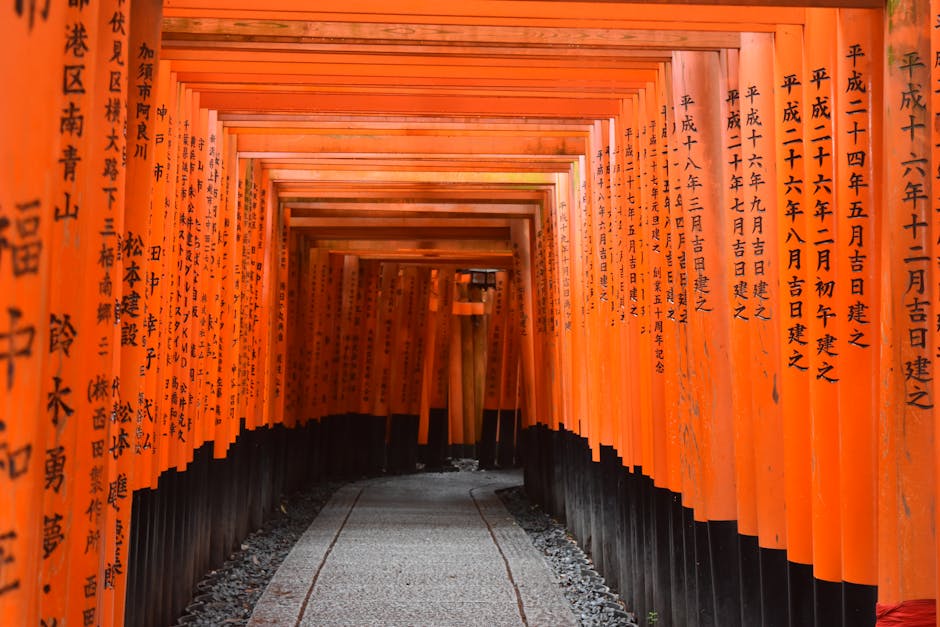
Senbon Torii — Where Prayers “Pass Through”
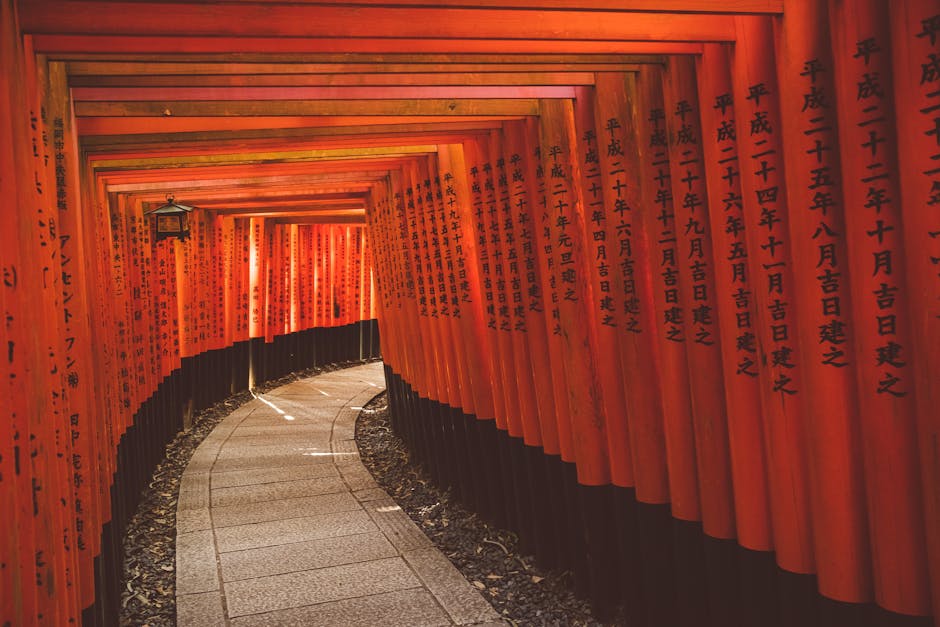
Approximately 800 torii gates line the path from the main hall to the Okusha worship hall, forming a continuous vermilion tunnel. The name “torii” shares a linguistic connection with “tooru” (to pass through), and these gates represent prayers passing through to the gods.
Each gate was donated by a worshipper whose wish was granted — a tradition dating back to the Edo period. A large gate costs approximately 1.3 million yen (about $8,600), while smaller ones start around 400,000 yen ($2,650). On the back of each gate, you’ll find the donor’s name and dedication date, with prayers spanning centuries.
Omokaru-ishi — The Wish-Granting Stones
At the Okusha worship hall, a pair of round stones sits atop stone lanterns. Make a wish, then lift a stone: if it feels lighter than expected, your wish will come true. If heavier, the wish may take more time. This ancient divination practice draws a queue of eager visitors — expect a 10-15 minute wait during peak hours.
Ne-agari no Matsu — The Hidden Money Power Spot
Just before the Senbon Torii entrance stands a pine tree whose roots rise dramatically above the ground. “Ne-agari” (roots rising) sounds like “ne-agari” (prices rising), making this an especially popular spot among stock investors and business owners who pray for market gains. It’s easy to walk past without noticing — look for it on the right side near the bamboo grove.
Ichi-no-mine (Summit) — The Mountain’s Strongest Power Spot
The peak of Mount Inari, known as Ichi-no-mine (Upper Shrine), is where the Inari deity is said to have first descended. The shrine here venerates Suehiro-Okami, whose name means “spreading wider” — an auspicious sign for business expansion and financial growth.
Only about 20% of visitors make it this far, which means you can pray in genuine solitude. The spiritual atmosphere here is palpably different from the crowded base.
Fox Statues — What They Hold and What It Means
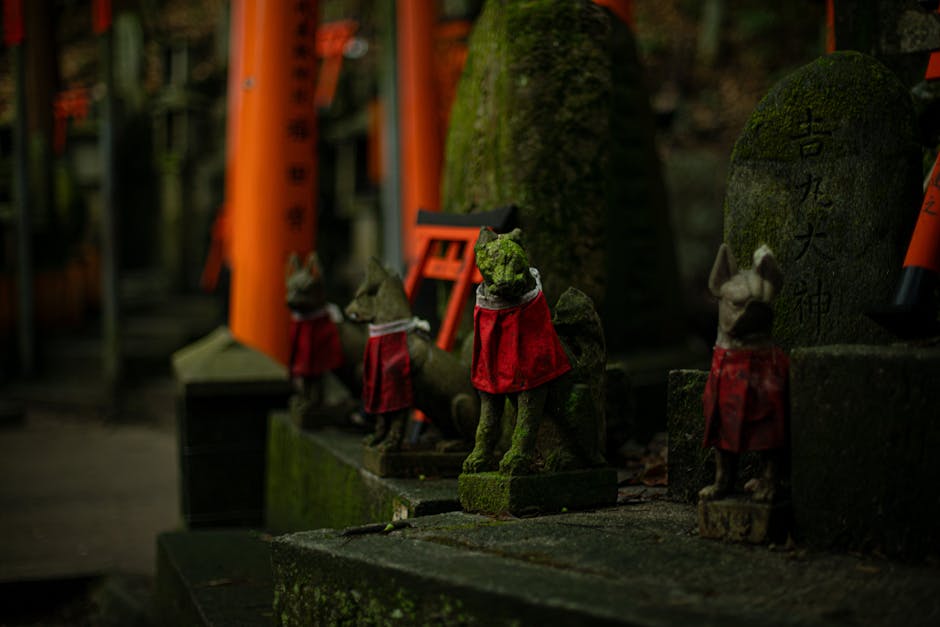
White fox (kitsune) statues appear throughout the grounds — foxes are Inari’s divine messengers, originally valued for protecting crops by hunting mice. Look closely at what each fox holds in its mouth:
- Key — Opens the storehouse of wealth (prosperity and savings)
- Sacred jewel — Represents Inari’s spiritual power (wish fulfillment)
- Scroll — Symbolizes wisdom (academic success and knowledge)
- Rice stalk — The source of abundance (bountiful harvests)
Should You Hike to the Summit? Honest Advice
Many people search “Is it worth climbing Mount Inari?” or “Should I skip the upper trails?” Here’s an honest breakdown:
Why Some Say “Don’t Bother”
1. Physical challenge: 4 km round trip, 233m elevation gain, 2-3 hours. The upper sections have steep stone steps
2. No dramatic viewpoint at the summit: The best panoramic view is actually at Yotsuji (the halfway point)
3. Atmosphere change: Beyond Yotsuji, tourist crowds vanish and the mountain path becomes quieter and darker — some solo visitors feel uneasy
Why You Should Go Anyway
- Ichi-no-mine’s spiritual power: The summit is the mountain’s strongest sacred point
- Escape the crowds: Beyond Yotsuji, you’ll have the path largely to yourself
- Sense of accomplishment: Completing the circuit brings a genuinely uplifting feeling
Trail Section Guide
| Section | Time | Difficulty | Highlights |
|———|——|————|————|
| Main hall → Senbon Torii → Okusha | 20 min | Easy | Thousand Torii Gates, Omokaru-ishi stones |
| Okusha → Mitsuji | 15 min | Moderate | Continued torii-lined path |
| Mitsuji → Yotsuji | 15 min | Somewhat steep | Best panoramic view of Kyoto (many turn back here) |
| Yotsuji → Ichi-no-mine (summit) | 30 min | Strenuous | Ichi-no-mine, Ni-no-mine, San-no-mine shrines |
| Ichi-no-mine → Yotsuji → Main hall | 40 min | Downhill | Can descend via a different route |
Recommendation: Short on time? Turn back at Yotsuji for the best view. Here for spiritual power? Continue to Ichi-no-mine.
Spiritual Benefits and Blessings
Business Prosperity and Financial Fortune
Fushimi Inari’s primary blessing — the same energy that brings abundant harvests nurtures thriving businesses. Business owners and entrepreneurs from across Japan make regular pilgrimages. The torii gate donations themselves are an act of praying for business success, and the tradition has continued for centuries.
Career Success and Professional Growth
Beyond business owners, the shrine offers blessings for career advancement. The Oyama-meguri pilgrimage — overcoming physical challenges to reach the summit — is seen as symbolic of professional achievement. The sense of accomplishment at the top brings confidence that can translate into real-world results.
Spiritual Purification
Walking through Mount Inari’s sacred forest naturally releases stress and negative energy. Many pilgrims report feeling mentally clearer and lighter after completing the mountain circuit — a combination of nature, exercise, and the mountain’s sacred atmosphere.
Best Omamori (Charms): Top 5 Picks
If the charm counter feels overwhelming, here are the most popular choices:
1. Tassei no Kagi Mamori (Achievement Key Charm) — 800 yen
Best for: Business success and goal achievement. Shaped like the key foxes carry in their mouths — the key that unlocks the storehouse of prosperity. Fushimi Inari’s most iconic charm.
2. Shirushi no Sugi Mamori (Cedar Sign Charm) — 500 yen
The classic Fushimi Inari charm, modeled after the sacred cedars of Mount Inari. “Shirushi” means a sign of Inari’s spiritual power. The most traditional choice.
3. Byakko Mamori (White Fox Charm) — 500 yen
Best for: Financial fortune. A white fox-shaped clay bell charm. Popular as a souvenir and said to attract monetary luck. Cute enough to display at home.
4. Byoki Heiyu Mamori (Health Recovery Charm) — 800 yen
For those praying for good health or recovery from illness. Available at the charm counter beside the main hall.
5. Gakugyo Mamori (Academic Success Charm) — 500 yen
Best for: Students and exam-takers. Designed with the scroll motif — the same scroll carried by the wisdom foxes.
Where to buy: Charm counter beside the main hall (8:30 AM – 4:30 PM). During peak periods (New Year, autumn), expect queues — arrive early in the morning.
Best Times to Visit
Spring (March-May) ★★★★★
Cherry blossoms (late March to early April) create stunning contrasts with vermilion gates. Temperatures of 15-22°C are perfect for hiking. May brings beautiful fresh greenery throughout the sacred forest. Avoid: Cherry blossom weekends and Golden Week — visit before 8 AM.
Summer (June-August) ★★★☆☆
Rainy season (mid-June to mid-July) brings fewer tourists and the wet torii gates glow a deeper vermilion. Late July through August exceeds 30°C with high humidity — climb before 9 AM or after 5 PM. Bring water, a hat, and sunscreen. Summer night visits offer a cool, mystical alternative.
Autumn (September-November) ★★★★★
Peak autumn foliage (mid to late November) plus vermilion torii creates spectacular colors. The Yotsuji viewpoint overlooking Kyoto framed by autumn leaves is unforgettable. Weekday mornings may be crowded with school trips — early morning or evening recommended.
Winter (December-February) ★★★★☆
Crisp, serene atmosphere with fewer tourists. January 1-3 draws 2.7 million visitors (extreme congestion) — visit after January 4th for a peaceful New Year experience. On rare snowy mornings, the snow-covered Senbon Torii is breathtaking.
Worship and Visiting Guide
How to Worship (Step by Step)
1. Enter through the Romon Gate
Just steps from JR Inari Station, this magnificent gate — donated by Toyotomi Hideyoshi — marks the entrance. Bow once before entering.
2. Purify at the Temizuya
Right hand holds ladle → rinse left hand → switch → rinse right hand → cup water in left palm to rinse mouth → hold ladle vertically to cleanse the handle.
3. Worship at the Main Hall
Two bows, two claps, one bow (nihai-nihakushu-ichihai): bow twice deeply, clap twice at chest height, offer your silent prayer, bow once more.
4. Walk Through the Senbon Torii
Follow the path from the right side of the main hall. Walk slowly — when taking photos, keep moving to avoid blocking others.
5. Try the Omokaru-ishi
At the Okusha worship hall, focus on your wish and lift a stone. Lighter than expected = wish granted.
6. Oyama-meguri (If Time Permits)
The full mountain circuit takes approximately 2 hours. Visit Kumataka-sha, Mitsuji, and Yotsuji at your own pace.
Time Estimates
- Main hall worship only: 30 minutes
- Including Senbon Torii to Okusha: 1 hour
- Full Oyama-meguri (summit round trip): 2-3 hours
What to Wear
- Shoes: Sneakers or walking shoes (essential for Oyama-meguri). No heels or sandals — there are many stairs
- Bring: Water bottle, small towel, hat (summer), warm layers (winter), flashlight (evening visits)
Essential Information
Access
By Train
- JR Nara Line: “Inari Station” (2 stops from Kyoto Station, about 5 minutes, 150 yen). The shrine is directly in front of the station exit
- Keihan Main Line: “Fushimi Inari Station,” 5-minute walk
By Bus
- Kyoto City Bus Route 南5: from Kyoto Station Hachijo Exit to “Inari Taisha-mae” (about 15 minutes), then 7-minute walk
By Car
- From Meishin Expressway “Kyoto Minami IC”: approximately 20 minutes
- Free parking: approximately 170 spaces (closed January 1-3). Fills up quickly on weekends — public transport recommended
Basic Information
- Address: 68 Fukakusa Yabunouchicho, Fushimi-ku, Kyoto 612-0882
- Phone: 075-641-7331
- Worship hours: 24 hours (shrine office: 8:30 AM – 4:30 PM)
- Admission: Free
- Time required: 1-3 hours
- Goshuin (shrine seal): Available at main shrine office (300 yen, 8:30 AM – 4:30 PM). Additional stamps available at otsuka shrines along the mountain trail
- Official website: http://inari.jp/
Nearby Attractions
Local Dining
Nezameya (Traditional Inari Sushi) — 400-year-old restaurant at the shrine entrance. Inari sushi (8 pieces, 800 yen) with sweetly seasoned fried tofu. Udon set also popular (1,200 yen). 10:00 AM – 7:00 PM, closed Mondays.
Inariya Honke — In front of JR Inari Station. Bite-sized inari sushi (5 pieces, 500 yen), perfect for eating while walking. Takeout only, 9:00 AM – 6:00 PM.
Kyozuan (Soy Milk Sweets) — Along the approach. Soy milk soft serve (400 yen) and donuts (300 yen). Seating available for a post-hike rest. 10:00 AM – 5:00 PM.
Torisei Honten (Yakitori and Sake) — Run by a Fushimi sake brewery. All-you-can-drink local sake (90 min, 2,200 yen) with excellent grilled chicken. Lunch sets (1,200 yen) from 11:30 AM. Dinner: 5:00 PM – 11:00 PM.
Nearby Sightseeing
Tofukuji Temple (15-minute walk) — One of Kyoto’s Five Great Zen Temples, famous for stunning autumn foliage from Tsuten Bridge. Admission 400 yen, 9:00 AM – 4:00 PM.
Fushimi Sake District (20-minute walk) — One of Japan’s premier sake regions. Gekkeikan Okura Sake Museum and Kizakura Kappa Country offer tastings and history. Admission about 300 yen each.
Suggested Itineraries
Half-Day (3 hours)
9:00 AM — Arrive at JR Inari Station
9:05 AM — Main hall worship
9:30 AM — Senbon Torii to Okusha
10:00 AM — Omokaru-ishi stones
10:30 AM — Rest at Kyozuan
11:00 AM — Souvenir shopping on approach street
12:00 PM — Lunch at Nezameya
Full Day (6 hours)
8:00 AM — Arrive (quiet early morning)
8:05 AM — Main hall worship
8:30 AM — Begin Oyama-meguri
10:30 AM — Reach summit
11:30 AM — Descend to Okusha
12:00 PM — Lunch at inari sushi restaurant
1:00 PM — Explore shopping street
2:00 PM — Walk to Tofukuji Temple
3:30 PM — Tour Fushimi sake breweries
4:30 PM — Relax at Torisei
Visitor Experiences
> “Went at 6 AM and had the Senbon Torii almost completely to ourselves. The morning mist made the torii gates look absolutely magical. By 8 AM it was packed — early start is essential.”
> — Google Maps review
> “Did the full Oyama-meguri to the summit. After Yotsuji the crowds disappear and the atmosphere becomes truly sacred. My legs were exhausted but the sense of accomplishment was incredible.”
> — Jalan.net review
> “The Omokaru-ishi stone felt way heavier than I expected — guess my wish needs more work! Fun experience though, kids and adults all enjoyed it.”
> — Google Maps review
Frequently Asked Questions
Q: How do I get here from Osaka?
A: JR Special Rapid to Kyoto (29 min), then JR Nara Line to Inari (5 min). Total about 720 yen, 50 minutes. [See our complete Day Trip Guide](/en/powerspot/fushimi-inari-day-trip-osaka-en/) for step-by-step instructions.
Q: How long does a visit take?
A: Main hall alone: about 30 minutes. Including Senbon Torii: 1 hour. Full mountain circuit: 2-3 hours. [See our Hiking Guide](/en/powerspot/fushimi-inari-hiking-en/) for trail details.
Q: Is the mountain hike suitable for beginners?
A: It’s moderately challenging with many stairs and a 4 km round trip. However, you can turn back at any point — many people stop at Yotsuji (about halfway) where the best view is. Sneakers and water are essential. [See our Hiking Guide](/en/powerspot/fushimi-inari-hiking-en/) for difficulty levels.
Q: When is the best time to photograph without crowds?
A: Before 7 AM or after 9 PM. [See our Photography Guide](/en/powerspot/fushimi-inari-photography-en/) for exact times, spots, and equipment tips.
Q: Is nighttime worship safe?
A: The main hall and Senbon Torii areas are lit and safe. Mountain paths beyond Yotsuji are dark and not recommended without a flashlight. [See our Night Visit Guide](/en/powerspot/fushimi-inari-night-visit-en/) for safety details.
Q: Where can I get a goshuin (shrine seal)?
A: At the shrine office beside the main hall, 8:30 AM to 4:30 PM (300 yen). Additional stamps are available at various otsuka shrines along the mountain trail — goshuin collectors should combine with the Oyama-meguri.
Q: Is there parking?
A: Free parking for about 170 vehicles, but fills quickly on weekends. Closed entirely January 1-3. Public transportation strongly recommended.
Q: Can I bring my pet?
A: Pets are not permitted in the shrine grounds (guide dogs and service animals are allowed). If traveling with a pet in Kyoto, consider pet hotels near JR Inari Station, or combine your trip with pet-friendly spots like parts of the Arashiyama bamboo grove or walks along the Kamo River.
Guides for Different Visitors
Wheelchair and Stroller Users
The area around the main hall is relatively flat and accessible. However, the Senbon Torii area and beyond involves many stone steps and is not wheelchair or stroller accessible. You can still worship at the main hall and purchase omamori. Call the shrine office (075-641-7331) in advance for accessibility assistance.
Rainy Day Visitors
Rain actually enhances the Fushimi Inari experience — wet torii gates glow a deeper, more vivid vermilion, and crowds thin significantly. The mountain paths can be slippery, so wear shoes with good grip. Bring an umbrella rather than a raincoat for easy photography. The covered shopping street near the entrance offers shelter for breaks.
Goshuin Collectors
Beyond the main shrine office stamp, multiple otsuka shrines along the Oyama-meguri offer unique goshuin. To collect them all, plan for the full 2-3 hour mountain circuit. Some otsuka goshuin are only available on specific days, so check at the main office for current availability.
Related Guides
- [Fushimi Inari from Osaka: Day Trip Guide](/en/powerspot/fushimi-inari-day-trip-osaka-en/) – Train routes, costs, and itinerary
- [Fushimi Inari Photography Guide](/en/powerspot/fushimi-inari-photography-en/) – Best spots, times, and camera settings
- [Fushimi Inari Night Visit Guide](/en/powerspot/fushimi-inari-night-visit-en/) – Safety, lighting, and what to expect
- [Fushimi Inari Hiking Guide](/en/powerspot/fushimi-inari-hiking-en/) – Trail difficulty, toilets, and rest stops
—
Nearby Power Spots
- [Kiyomizu-dera](https://k005.net/en/powerspot/kiyomizu-dera-en/)
- [Seimei Shrine](https://k005.net/en/powerspot/seimei-shrine-kyoto-day-trip-en/)
- [Nachi Falls](https://k005.net/en/powerspot/nachi-falls-en/)
- [Sumiyoshi Taisha](https://k005.net/en/powerspot/sumiyoshi-taisha-en/)
- [Atsuta Shrine](https://k005.net/en/powerspot/atsuta-jingu-en/)
Summary: 5 Key Takeaways
1. Head shrine of 30,000 Inari shrines: Japan’s most important site for business prosperity and financial fortune
2. Top charm pick: Tassei no Kagi Mamori: The “Achievement Key” charm is the most iconic for business goals. Byakko Mamori (White Fox) for financial luck
3. Hike at least to Yotsuji: Best panoramic view of Kyoto is at the halfway point. For maximum spiritual power, continue to Ichi-no-mine (summit)
4. Visit before 7 AM: The only way to experience the Senbon Torii without crowds. By 8 AM, the magic is gone
5. Don’t miss Ne-agari no Matsu: The “rising roots” pine tree near the Senbon Torii entrance — a hidden power spot for financial fortune that most visitors walk right past
—
*Last updated: March 2026. Please check the [official website](http://inari.jp/) for the latest information before your visit.*
—
Want to discover your ideal power spot?
Japan has countless power spots beyond Fushimi Inari. Each person resonates differently with different sacred sites. To find the power spots most compatible with your personal energy, try our free compatibility assessment — it takes just 3 minutes.
→ [Take the Free En-Profile Assessment](https://enguide.info)
あなたに最適なパワースポットを知りたい方へ