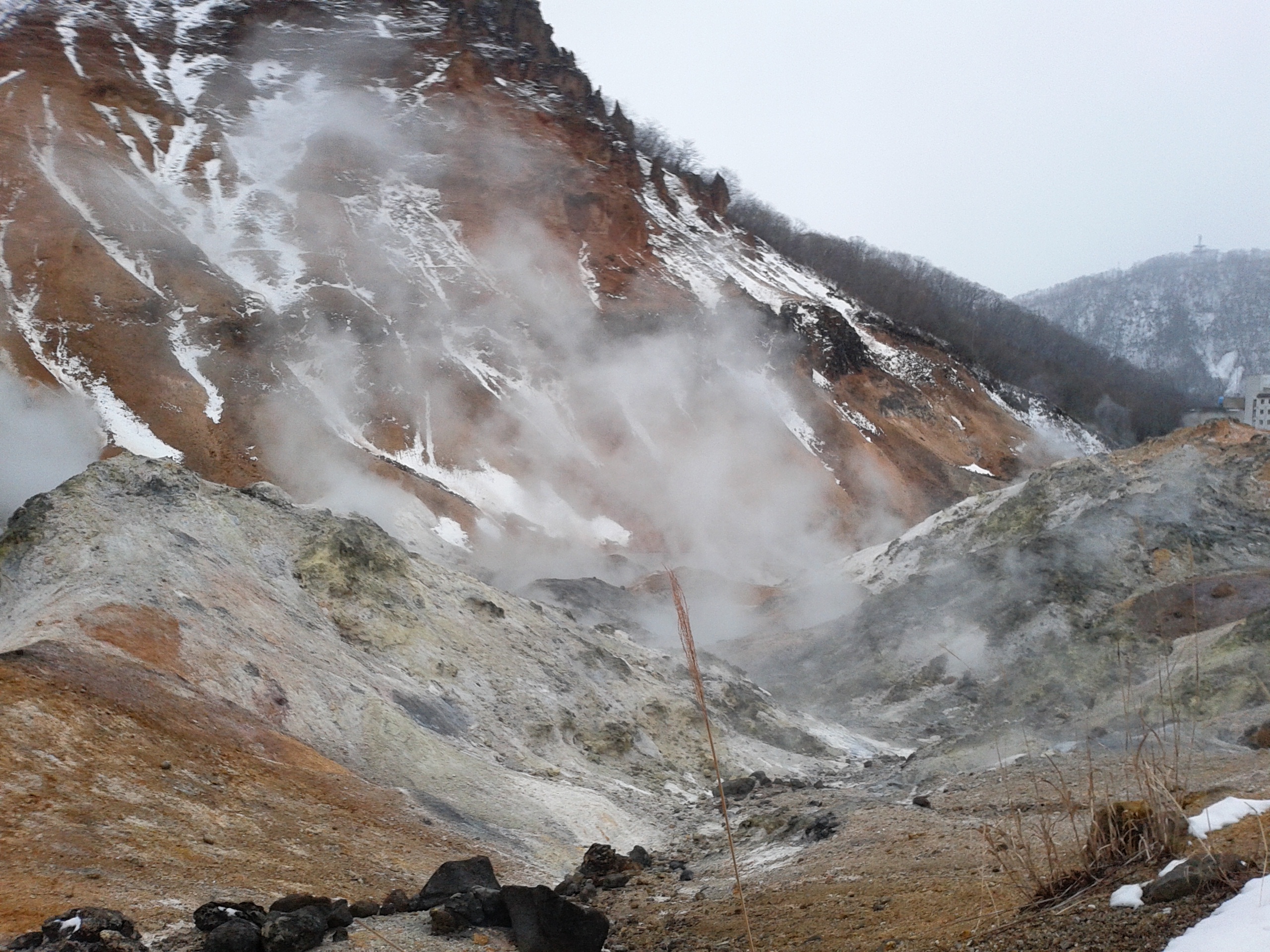
Walk fifteen minutes from Noboribetsu Onsen’s main street and the world opens into something hard to find anywhere else on Earth: a 450-meter-wide explosion crater where white steam rises from countless vents, the air smells of sulfur, and the ground itself is still alive—a hot-spring reservoir that pours 10,000 tons of mineral water per day into the town below.
This is Jigokudani, “Hell Valley”—formed by phreatic eruptions starting roughly 8,000 years ago, with the most recent activity estimated about 200 years ago. The Ainu and later Japanese pilgrims considered it a powerful place; today it remains the spiritual and physical heart of Japan’s most celebrated hot-spring town.
This guide gathers the practical information you need to actually plan a successful visit: 2026 bus fares, parking lots, the new Noboribetsu Onsen Parking facility (opened December 2025), 2026 Oni Hanabi (Demon Fireworks) dates, accessibility for wheelchairs, and what foreign visitors need to know. All sourced from the Noboribetsu International Tourism & Convention Association, the city of Noboribetsu, the Japan Meteorological Agency, and Donan Bus.
What Makes This Spot Special
A 450-Meter-Wide Living Volcano
Noboribetsu Jigokudani is an explosion crater in the Kuttara volcanic system, formed by repeated phreatic (steam-driven) eruptions that began roughly 8,000 years ago, according to the Japan Meteorological Agency. The most recent activity is estimated at about 200 years ago.
The scale, from the tourist association: diameter approximately 450m, area approximately 11 hectares, daily hot-spring output 10,000 tons. That output supplies the hotels and inns of Noboribetsu Onsen below. The valley is not a museum—it is the source that powers an entire resort town.
Japan’s “Department Store of Hot Springs”
Noboribetsu Onsen is often called Japan’s premier hot-spring resort because, within a small area, it contains nine to ten different types of mineral water. The tourist association lists sulfur, sodium chloride, iron, acidic iron, alum-iron, glauber, and sodium bicarbonate springs among them. Few resorts anywhere in the world offer this many distinct waters within a 15-minute walk.
The Realm of the Yukijin (Hot-Spring Demons)
The tourist association’s mythology page describes Jigokudani as the home of Yukijin—hot-spring demons who guard the healing waters. Unlike the malevolent demons of European folklore, the *oni* of Noboribetsu are protective spirits who ward off misfortune. The temple-street (“Gokuraku-dori,” meaning “Paradise Street”) is lined with statues of demon-gods, and the annual Noboribetsu Jigoku Matsuri features a parade of Enma, the King of Hell.
Best Times to Visit
By Season
| Season | Highlight | Notes |
|——–|———–|——-|
| Spring (Apr–May) | Snowmelt, clear mountain air | Early mornings still below freezing |
| Summer (Jun–Sep) | Oni Hanabi fireworks, lush green setting | Steam less visible mid-day; bring water |
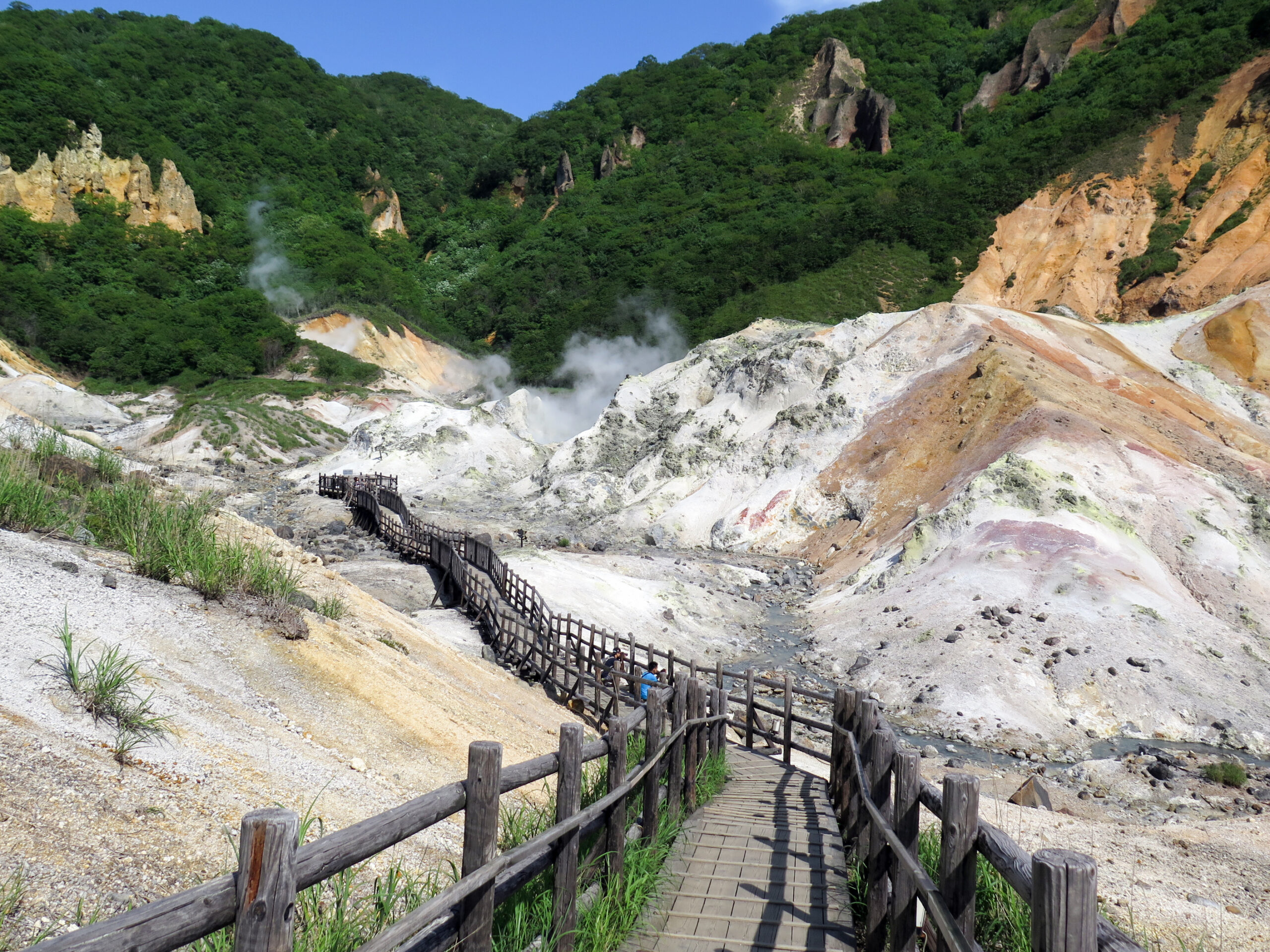
| Autumn (mid–late October) | Red maple + rising steam—the iconic view | Combine with “Onibi-no-Michi” night lighting |
| Winter (Dec–Mar) | White snow + dramatic steam columns | Some trails closed; ice-cleats recommended |
Time of Day
- Morning (8–9 AM): Fewer visitors, strong steam in cold air, best contrast with low sun
- Midday (10 AM–3 PM): Best window for the 120-minute extended loop including Oyunuma and Okunoyu
- Evening (sunset–9:30 PM): “Onibi-no-Michi” night lighting operates year-round, sunset to 21:30 (this is not a seasonal-only event)
How to Walk Jigokudani: Two Official Courses
The Noboribetsu Tourist Association publishes two model courses.
30-Minute Course (Recommended for First-Time Visitors)
Town → Jigokudani trail entrance → Jigokudani Observation Deck → Tessen Pond → return. The observation deck is accessible by a wheelchair ramp with maximum 8% grade from the Park Service Center.
120-Minute Extended Course
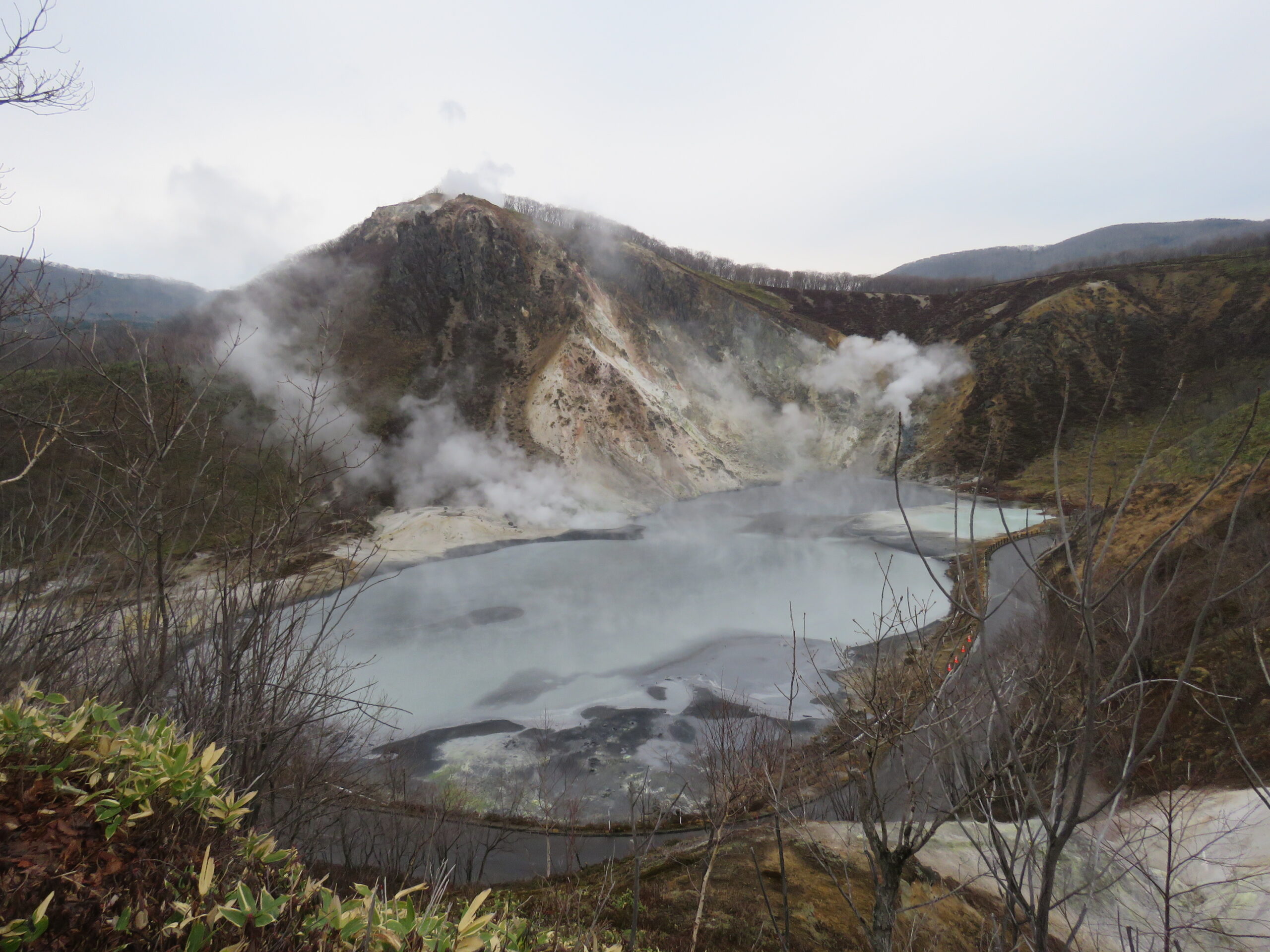
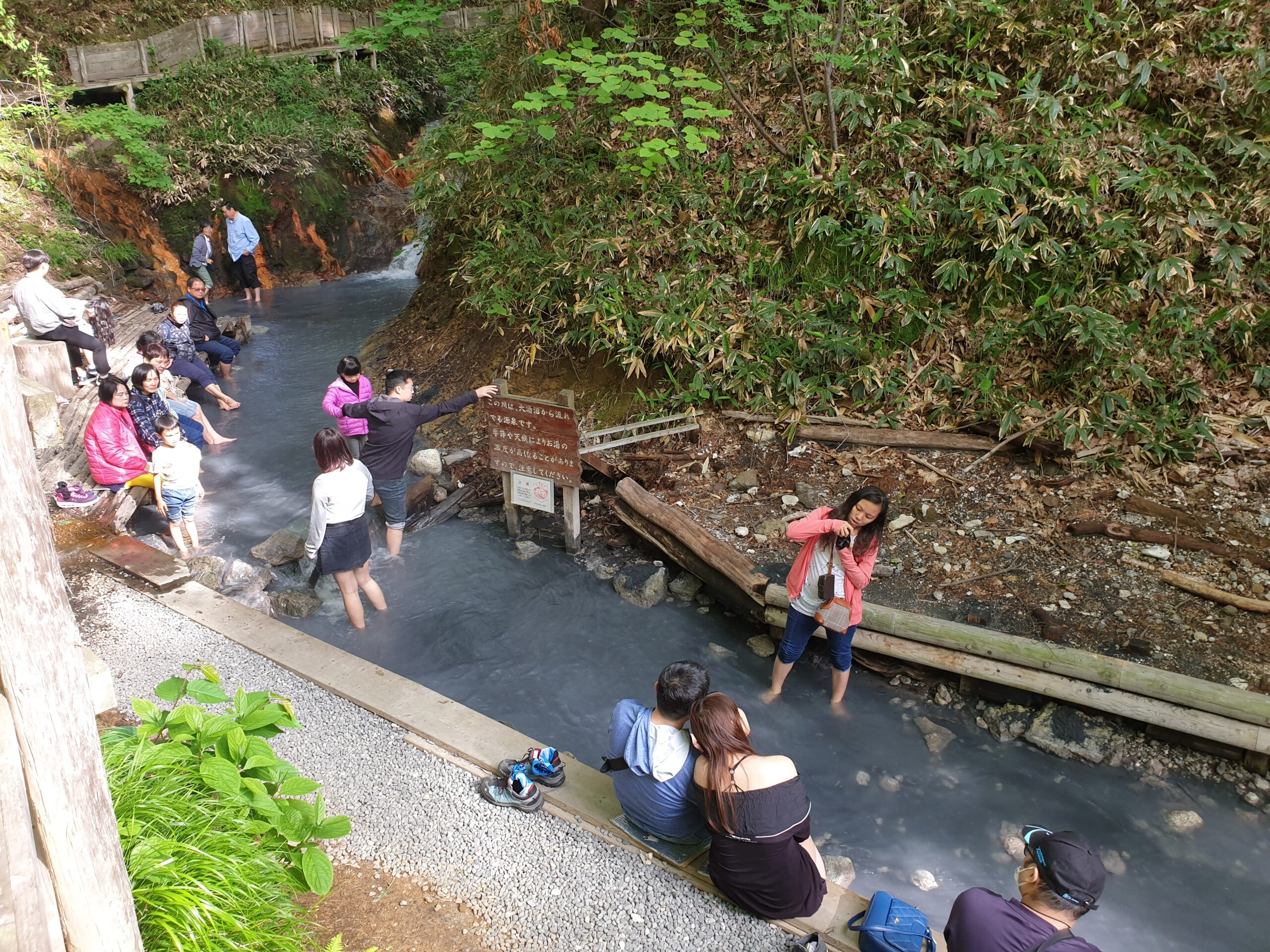
Jigokudani Observation Deck → Tessen Pond → Oyunuma Observation Deck → Okunoyu → Oyunumagawa Natural Footbath → return to town. Bring a towel for the free natural footbath (hot mineral water overflowing from Oyunuma, no fee).
About Tessen Pond
Despite its English name “Tessen Geyser,” official sources state the pond no longer erupts as it once did and publish no scheduled show times. Treat it as a quiet, atmospheric stop—any geyser activity is a fortunate surprise, not a guaranteed performance.
Essential Information
| Item | Details |
|——|———|
| Location | Noboribetsu Onsen-cho, Noboribetsu, Hokkaido |
| Admission | Free (Jigokudani, Tessen Pond, Oyunumagawa Footbath, Okunoyu — all free) |
| Hours | Area is not gated. Official guidance: visit before sunset. Observation-deck lighting operates until ~23:00 |
| Phone | +81 143-84-3311 (Noboribetsu Tourist Association) |
| Official site | noboribetsu-spa.jp/en |
Parking (Updated for 2026)
| Lot | Fee | Walk to Jigokudani | Notes |
|—–|—–|———————|——-|
| Jigokudani Parking | ¥500/day | ~1 min | Shared ticket with Oyunuma lot. Closed in winter |
| Oyunuma Parking | ¥500/day | — | Closed in winter |
| Noboribetsu Onsen Parking (NEW) | ¥500/24h regular, ¥800 peak days | ~15 min | Opened December 2025. 141 spaces, open 24/7/365 |
Access
From JR Noboribetsu Station (most common)
- Donan Bus routes NA/NB/NC/ND bound for Noboribetsu Onsen
- 27 minutes, ¥450 one-way for adults
- IC cards not accepted on any route; NA/NB accept Visa contactless
From New Chitose Airport
- Donan Bus “Express Noboribetsu Onsen Airport” (reservation required)
- ~1 hour 15 minutes, ¥1,900–¥2,400 (dynamic pricing)
From Sapporo
- Donan Bus “Express Onsen-go” (one round-trip per day, Ashi-yu Iriguchi ↔ Sapporo Station)
- ~1 hour 20 minutes, ¥2,500–¥3,400 (dynamic pricing)
- Alternative: JR Hokuto or Suzuran limited express to Noboribetsu Station (~1h 10m)
By Car
- Noboribetsu-Higashi IC (Doo Expressway) to Noboribetsu Onsen: about 6 km
- From the interchange to Jigokudani: about 10 minutes
What to Do Around Jigokudani
Day-Use Hot Springs (After Your Walk)
| Inn | Adult Fee | Hours |
|—–|———–|——-|
| Dai-ichi Takimotokan | ¥2,250 | 9:00–21:00 (reception 9:00–18:00) |
| Noboribetsu Manseikaku | ¥1,300 | 7:00–9:30, 13:30–20:00 |
Other Attractions
- Noboribetsu Bear Park: ¥3,200 adult, ¥1,600 child (includes ropeway). 9:00–17:00 (Apr 21–Oct 20); 9:30–16:30 (winter)
- Noboribetsu Marine Park Nixe: ¥3,200 adult, ¥1,600 child, free for under 3. Open 9:00–17:00, year-round
- Enma-do (Mechanical Enma Shrine): Free. Performances at 10:00, 11:00, 13:00, 15:00, 17:00, 20:00, 21:00. *Note: closed for renovations starting mid-March 2026; confirm before visiting.*
- Oyunumagawa Natural Footbath: Free. Bring a towel.
Suggested One-Day Itinerary
| Time | Activity |
|——|———-|
| 8:00 | Arrive JR Noboribetsu, bus to Onsen-machi |
| 9:00 | Jigokudani 120-minute walk (Jigokudani + Oyunuma + Okunoyu + Footbath) |
| 11:30 | Day-use bath at Dai-ichi Takimotokan |
| 13:00 | Lunch on Gokuraku-dori, watch the 13:00 Enma-do performance |
| 14:00 | Noboribetsu Bear Park (ropeway included) |
| 16:30 | Souvenir shopping in the onsen district |
| 19:00 | View “Onibi-no-Michi” night illumination at the observation deck (sunset–21:30, year-round) |
2026 Events
Jigokudani no Onihanabi (Demon Fireworks of Hell Valley) 2026 Schedule
Location: Jigokudani Observation Deck. Official 2026 dates:
> June: 1, 4, 8, 11, 15, 18, 22, 25, 29
> July: 2, 9, 16, 23, 30
> September: 3, 10, 17, 24
- Fee: ¥500 adult, free for elementary-school students and under
- Start time: around 20:00, runs about 15 minutes
- Source: noboribetsu-spa.jp/spot/spot1005/
Onibi-no-Michi (Demon Fire Path)
Year-round nighttime lighting, sunset to 21:30. The observation-deck area is illuminated for atmospheric night visits.
Noboribetsu Jigoku Matsuri (Hell Festival)
Held annually on the last Saturday and Sunday of August at Gokuraku-dori, Sengen Park, and Jigokudani. The 2026 dates have not yet been officially published as of May 2026—confirm via the tourist association before planning.
Visitor Voices
Real experiences from people who have visited recently:
> “I visited at 8 AM and it was quiet—the contrast between morning sunlight and steam was striking.”
> — From a 4travel.jp review
Multiple early visitors describe the same pattern: clearer light, fewer people, more visible steam in cold morning air.
> “In winter, the path to the footbath gets icy. Bring a towel for the footbath—it’s perfect after walking the cold valley.”
> — From a Tripadvisor review of Oyunumagawa Footbath
Winter footing and the value of bringing a towel come up across many independent reviews.
> “Lots of international visitors. The whole onsen town clearly caters to foreign tourists.”
> — From a 4travel.jp review
The tourist association maintains English pages for the spot, access, mythology, and one-day itineraries, and signage is consistently bilingual.
Practical Information for Different Visitors
Wheelchair & Stroller Access
The observation deck is reachable via a wheelchair ramp with maximum 8% grade from the Park Service Center. Trails to Oyunuma, Okunoyu, and the footbath are not wheelchair-accessible. Plan to focus on the observation-deck area if access is a concern.
Pets
Official sources do not state whether pets are permitted on the Jigokudani trail. We cannot confirm pets are allowed—contact the tourist association in advance if you intend to bring a dog. Pet-friendly inns exist in the town.
Photography
Best vantages: Jigokudani Observation Deck (whole crater), Oyunuma Observation Deck (scale of the lake), Okunoyu (blue-tinted high-temperature waters). Tripod restrictions are not officially stated; please be considerate of other visitors when busy. Morning, sunset, and the nighttime Onibi-no-Michi illumination each yield very different images.
Rainy Days
The tourist association distributes free rental umbrellas (“Machi-kasa”) throughout the onsen district. Boardwalks, slopes, and winter ice can be slippery; waterproof shoes (and ice-cleats in winter) are recommended.
Foreign Visitors
The Noboribetsu Tourist Association publishes a full English website including spot pages, access guides, and day-trip itineraries. On-site signage is largely Japanese-English-Chinese-Korean. The town is one of Hokkaido’s most foreign-visitor-friendly hot-spring areas.
Safety Notes
- Volcanic terrain: Active fumaroles and vents emit hydrogen sulfide. Never cross fences or “no entry” signs—this is not a museum, it is an active geothermal field.
- Sulfur fumes: Visitors with asthma or respiratory sensitivities should stay near the observation deck rather than entering deeper sections of the valley.
- Winter trail closures: Snow and ice close portions of the trail in winter. Check the tourist association website for current conditions before visiting.
- Bear (higuma) awareness: The City of Noboribetsu has issued bear-awareness notices for 2026. Around Oyunuma, avoid hiking alone and carry a bear bell or noise-maker.
- Enma-do renovations: Performance schedule is in flux from mid-March 2026 due to renovation work. Confirm before relying on a particular time.
Conclusion
Noboribetsu Jigokudani is not a quiet shrine or a static viewpoint—it is a living volcanic field that has been producing hot water for 8,000 years, the engine that built Japan’s most famous hot-spring town. Walk its trails in the morning steam, soak in one of its nine waters in the afternoon, and stand at the observation deck after sunset as the demon-fire lights flicker on. Few places in Japan offer the source and the experience in the same half-day.
If your route through Hokkaido has space for one onsen town, make it Noboribetsu—and start with Hell Valley itself.
—
We hope this guide helps make your visit to Noboribetsu Jigokudani memorable.
*Information current as of May 2026. Bus fares, hours, event dates, and the Enma-do schedule change frequently. Confirm details on the official site of the Noboribetsu International Tourism & Convention Association (noboribetsu-spa.jp) before your visit.*
あなたに最適なパワースポットを知りたい方へ