Fifty minutes from Tokyo by bullet train, then a fifteen-minute walk through a city fed by Mt. Fuji’s underground springs — and you arrive at one of the most important shrines in eastern Japan.
Mishima Taisha is the Ichinomiya of old Izu Province, meaning it held the highest spiritual rank in the region. But what makes this shrine unforgettable for visitors is something more personal: this is where Minamoto no Yoritomo — the 12th-century warrior who founded Japan’s first samurai government — came to pray during his years of exile, and where his prayers were answered. The shrine became a symbol of perseverance, comeback, and victory against the odds.
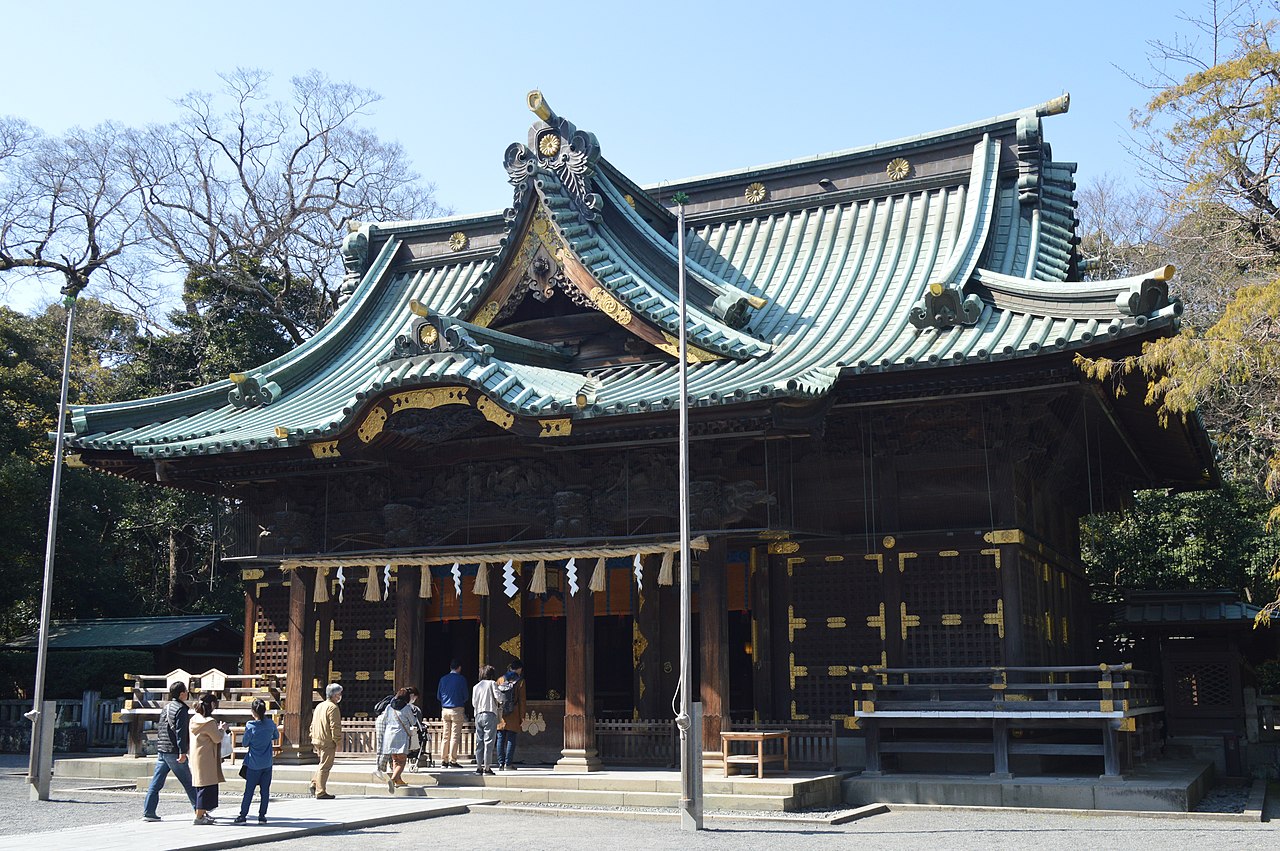
Today, the grounds shelter a 1,200-year-old osmanthus tree (a nationally protected natural monument), a serene spring-water pond with a vermilion sub-shrine reflected on its surface, and a worship hall covered in carvings so detailed that visitors stop mid-step to look up. Entry is free. The atmosphere is calm. And unlike Japan’s mega-famous shrines, you can often have entire sections of the grounds to yourself.
—
Why This Shrine Matters
The Ichinomiya of Izu — Eastern Japan’s Spiritual Anchor
In Japan’s old provincial system, the Ichinomiya was the top-ranked shrine in each region. Mishima Taisha held that title for Izu Province and served as a major sacred site along the Tokaido road, the highway connecting Edo (now Tokyo) and Kyoto.
The shrine enshrines two deities known collectively as “Mishima Daimyojin”: Oyamatsumi-no-Mikoto, the god of mountains, forests, and harvests, and Tsumihayaekotoshironushi-no-Kami, better known as “Ebisu-sama,” the god of prosperity and good fortune. Together, they represent both the power of nature and the blessings of commerce — a combination that drew everyone from court nobles to traveling merchants.
The shrine’s origins are unclear, but records place it in documents from the Nara and Heian periods (8th–12th centuries). By the mid-Heian era, it had been elevated to Myojin Taisha — the highest classification in the national shrine registry. In the Meiji era, it was designated a Kanpei Taisha (Imperial Grand Shrine).
Minamoto no Yoritomo — The Samurai Who Prayed Here
For visitors familiar with Japanese history, Mishima Taisha’s connection to Yoritomo is its most compelling story. Exiled to Izu as a teenager after his clan’s defeat, Yoritomo spent years in political obscurity — and spent those years praying at this shrine for the revival of the Minamoto clan.
His prayers were answered. He raised an army, won a series of decisive battles, and in 1185 established the Kamakura Shogunate — Japan’s first military government, which would define the country’s political structure for the next seven centuries.
After his rise, Yoritomo rewarded Mishima Taisha with land and treasures. His wife, Hojo Masako, donated a masterwork lacquer box — the “Ume Makie Tebako” — now designated a National Treasure and considered one of the finest examples of Kamakura-era lacquer art. Inside the grounds, you can still see the “Koshikake-ishi” (sitting stone), where Yoritomo and Masako are said to have rested together.
For this reason, Mishima Taisha is especially popular with people facing major challenges: job seekers, entrepreneurs, students before exams, and athletes before competitions. The shrine’s spiritual identity is deeply tied to perseverance and victory.
—
What to See Inside the Grounds
The 1,200-Year-Old Osmanthus Tree
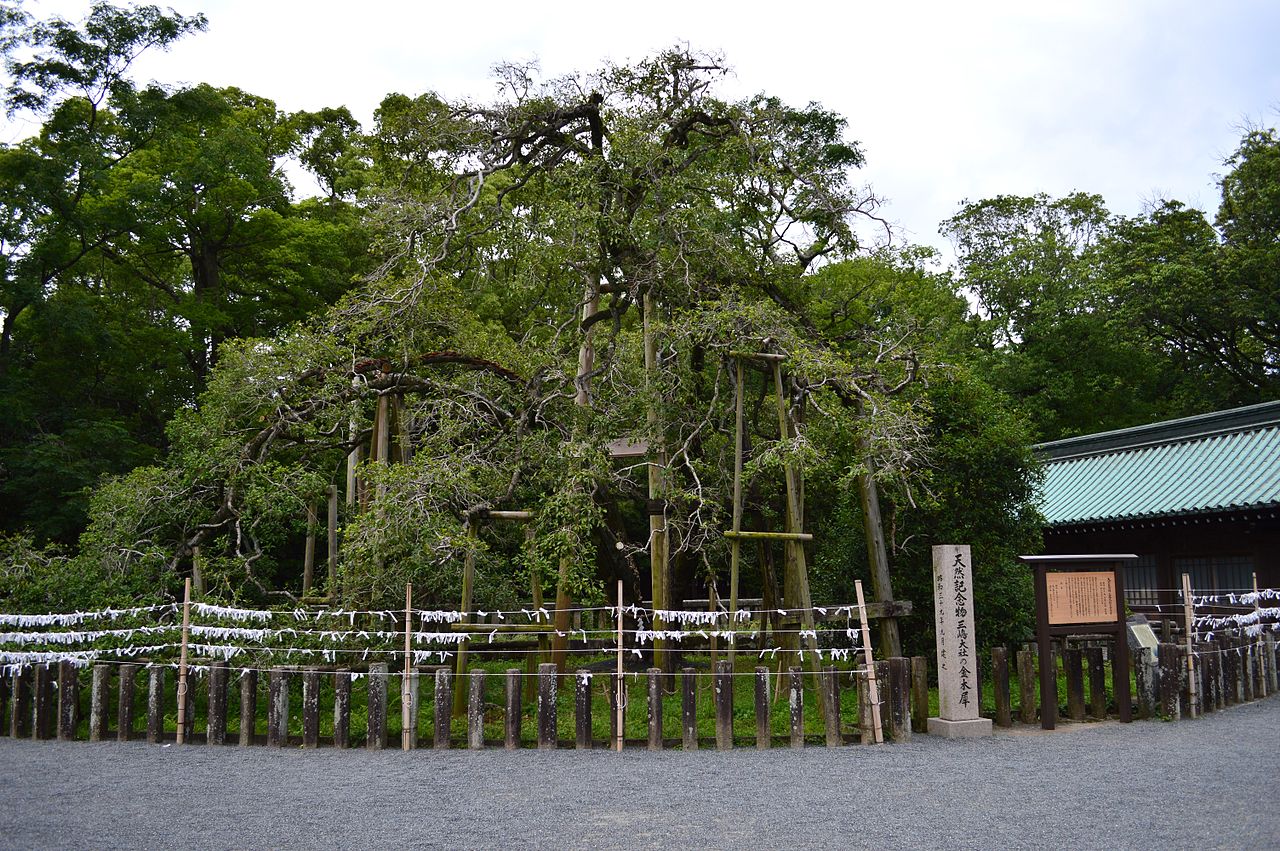
This single tree is reason enough to visit. Estimated at over 1,200 years old, the kinmokusei (fragrant osmanthus) is designated a National Natural Monument and is the oldest of its kind in Japan.
What makes it extraordinary: the tree blooms twice each September — once in early September and again in late September — filling the entire shrine grounds with its sweet fragrance. Locals say, “When Mishima Taisha’s osmanthus blooms, autumn has arrived.”
Even outside of blooming season, the sheer scale of the tree — propped up by support poles, its branches spreading wide — conveys a quiet power that photographs don’t fully capture.
Kamiike Pond and Itsukushima Shrine
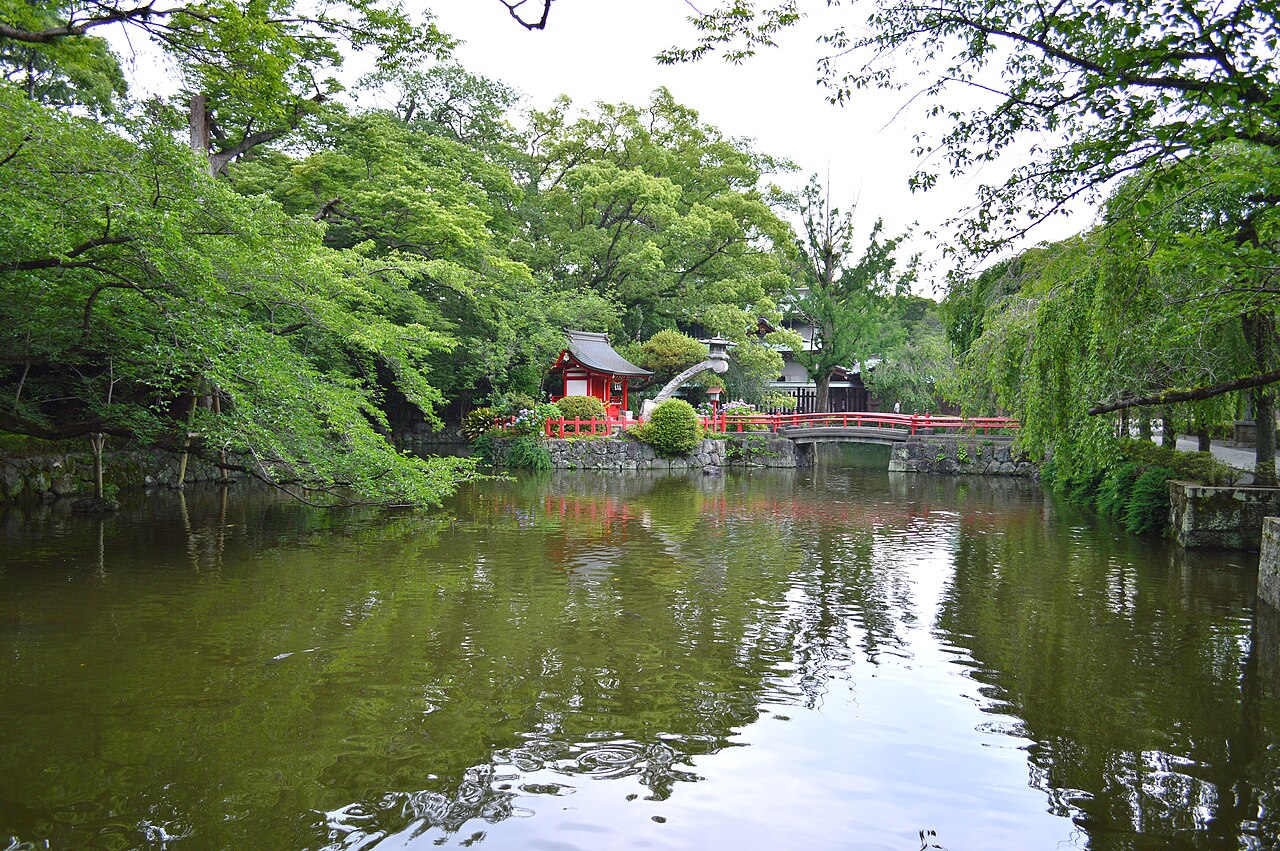
On the western side of the grounds, Kamiike Pond collects spring water from the surrounding area. In 1185, Yoritomo held a hojoe (ceremony releasing captive animals) here — a Buddhist practice meant to accumulate merit.
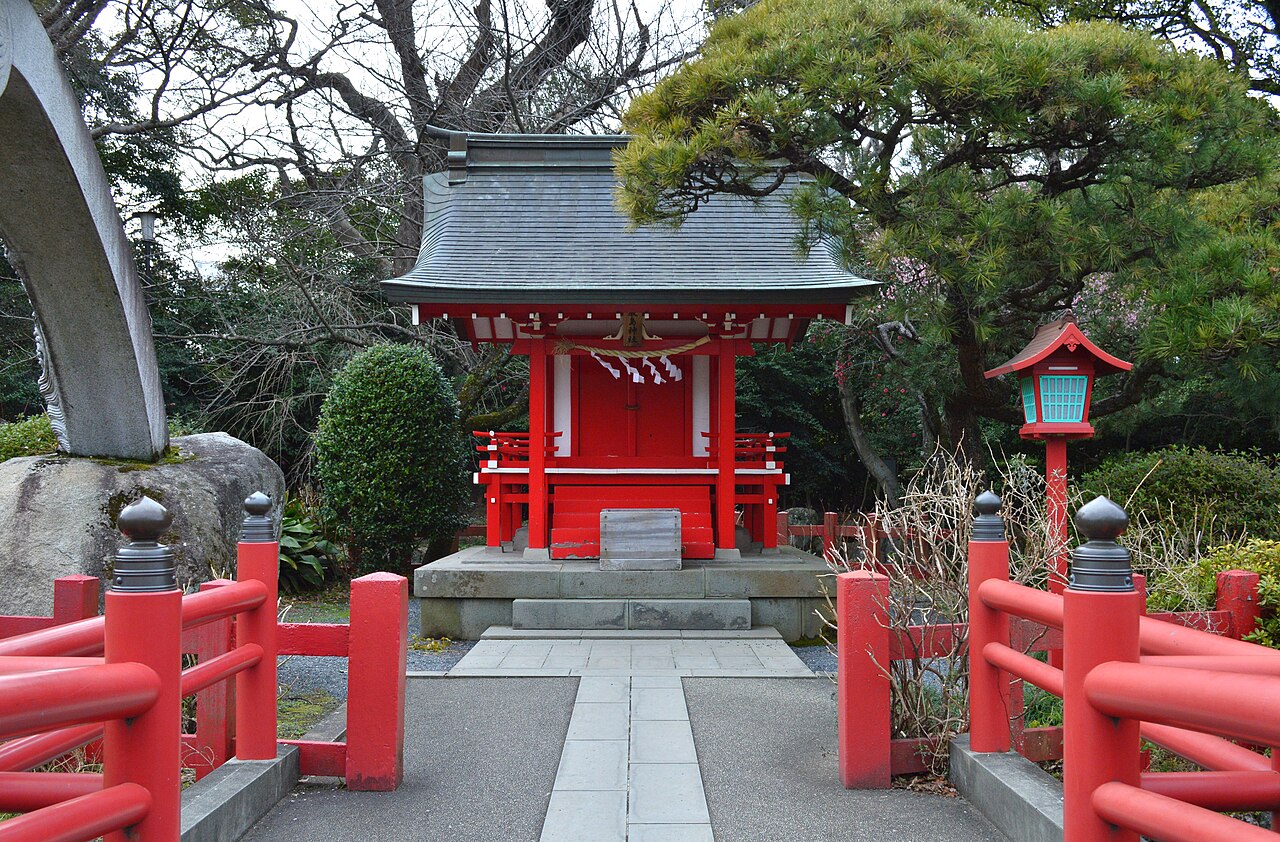
A small Itsukushima Shrine stands on the pond’s edge, its vermilion structure reflected perfectly on the water’s surface. This sub-shrine, said to have been established by Hojo Masako, is associated with business success and artistic skill. The combination of red wood, green trees, and still water makes this the most photogenic spot on the grounds.
The Worship Hall and Main Hall
The current haiden (worship hall) was completed in 1866 — one of the last major shrine constructions before the Meiji Restoration. Built entirely of zelkova wood in an unfinished, unpainted style, the hall is covered in carvings of mythological scenes by Izu’s finest craftsmen. Both the worship hall and the main hall behind it are designated Important Cultural Properties.
Tatari-ishi (The Guiding Stone)
Near the entrance, a curious stone sits behind a fence. Tatari-ishi originally stood at the junction of the Tokaido and Shimoda roads, directing foot traffic. The name “tatari” here means “to arrange” or “to regulate” — it was a traffic stone, not a curse stone. It’s said to be a volcanic rock carried by a Mt. Fuji eruption roughly 2,900 years ago.
—
Spiritual Benefits
Business prosperity — With “Ebisu-sama” as one of its two main deities, Mishima Taisha has been a pilgrimage site for merchants and business owners for centuries. New Year sees massive crowds praying for commercial success.
Victory and perseverance — Yoritomo’s story makes this shrine the go-to destination before any major challenge. Job interviews, entrance exams, athletic competitions, business launches — people come here when the stakes are high.
Protection and safety — Formal prayer services cover family safety, traffic safety, disaster protection, safe childbirth, illness recovery, academic success, and matchmaking. Gokito (formal blessings) are available from about 8:30 AM to 4:00 PM daily.
Goshuin and charms — Goshuin (shrine seal calligraphy) is available at the Kyakuden hall (weekdays 8:30–16:00, weekends 8:30–16:30). The charm selection includes a distinctive “Mishima Koma” — a horse figurine symbolizing good luck, unique to this shrine.
—
Best Times to Visit
Osmanthus Season (September) — Rating: 5/5
The twice-blooming osmanthus tree makes September the most atmospheric month. Early September and late September each bring a wave of fragrance that transforms the entire grounds.
Cherry Blossom Season (Late March to Early April) — Rating: 4/5
About 200 cherry trees of 15 varieties line the approach and surround the pond. During peak bloom, the shrine holds nighttime illuminations, making the blossoms glow against the darkened buildings. The reflection of cherry blossoms on Kamiike Pond is extraordinary.
Mishima Taisha Reisai / Summer Festival (August 15–17) — Rating: 5/5
The shrine’s annual grand festival draws over 500,000 visitors across three days. Highlights include the Yabusame (mounted archery) ritual, hand-held fireworks ceremonies, and a parade honoring Yoritomo’s military departure. Note: the shrine parking lot is closed during the festival, so use public transport.
Recommended Time of Day
Weekday mornings, 8:30–10:00 AM are the quietest. Midday (10:00 AM – 2:00 PM) tends to be busier, and November weekends during Shichi-Go-San (children’s blessing festival) are especially crowded.
—
Visitor Guide
Walking Route Inside the Grounds (45–60 minutes)
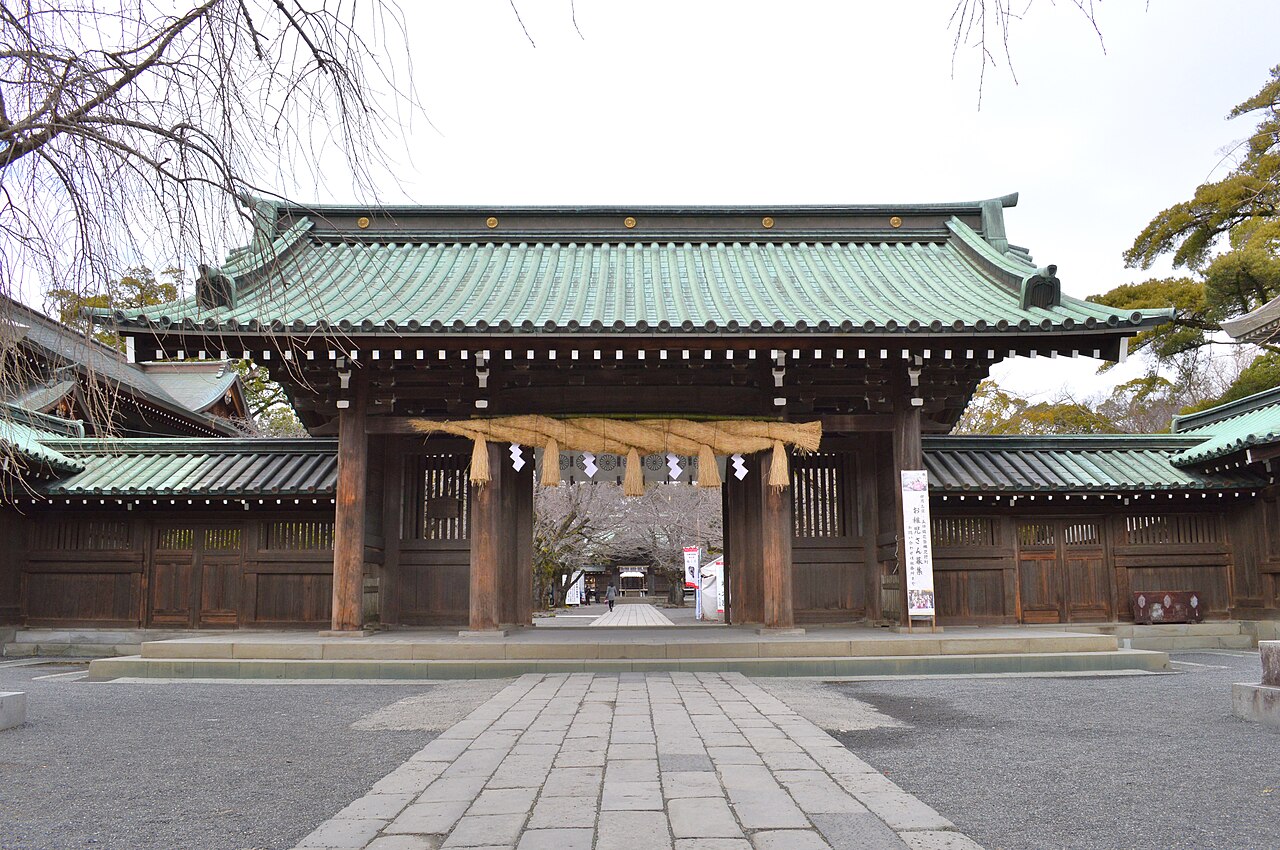
1. Somon Gate (5 min) — Pass under the 400 kg shimenawa rope
2. Kamiike Pond & Itsukushima Shrine (10 min) — Best photo spot; morning light recommended
3. Shinmon Gate (5 min) — Note the carvings on the 1867 structure
4. Maiden (Dance Stage) (3 min) — Where ritual performances take place
5. Haiden Worship Hall (10 min) — Pray and admire the zelkova carvings
6. Osmanthus Tree (5 min) — The 1,200-year-old natural monument
7. Koshikake-ishi & Tatari-ishi (5 min) — Yoritomo’s power spots
8. Treasure Museum (optional, 30 min) — Replica of the National Treasure lacquer box. Adults 500 yen
Half-Day Itinerary Including Mishima City (3–4 hours)
Morning: Mishima Taisha (60–90 min) → Walk to Genbe River stepping stones (10 min walk) → Lunch: Mishima eel at a restaurant near the shrine → Afternoon: Rakujuen Park (30 min) or Kakita River Spring Water Park (15 min by car)
Full-Day Itinerary with Mishima Skywalk
Morning: Mishima Taisha → Genbe River → Lunch: Mishima eel → Afternoon: Bus to Mishima Skywalk (25 min, Mt. Fuji views from Japan’s longest pedestrian suspension bridge) → Return to Mishima Station
—
Practical Information
| Item | Details |
|——|———|
| Official Name | Mishima Taisha (三嶋大社) |
| Deities | Oyamatsumi-no-Mikoto, Tsumihayaekotoshironushi-no-Kami |
| Address | 2-1-5 Omiya-cho, Mishima, Shizuoka 411-0035 |
| Phone | 055-975-0172 |
| Grounds | Open daily (free entry) |
| Gokito (Formal Blessings) | Approximately 8:30 AM – 4:00 PM |
| Treasure Museum | 9:00 AM – 4:00 PM (Adults 500 yen) |
| Parking | ~55 spaces, 300 yen/hour (closed New Year’s Dec 31–Jan 3 and festival Aug 15–17) |
| Website | https://www.mishimataisha.or.jp/ |
Access
By Shinkansen (Recommended)
Tokyo Station → Mishima Station on the Tokaido Shinkansen: about 50 minutes (Kodama or Hikari). From Mishima Station’s south exit, walk south for about 15 minutes (1.1 km).
By Local Train
Mishima-Tamachi Station on the Izu Hakone Railway is about 7 minutes on foot from the shrine — useful if you’re coming from the Izu Peninsula area.
By Bus
From Mishima Station’s south exit, take the Tokai Bus to “Mishima Taisha-mae” stop (about 5–10 minutes).
By Car
From the Tomei Expressway, take the Numazu IC exit — about 20 minutes to the shrine. The Shin-Tomei Nagaizumi-Numazu IC is also convenient.
Tips for International Visitors
- English pamphlets are available at the shrine
- The Mishima Sightseeing Center near Mishima Station South Exit has English-speaking staff
- Mishima is an excellent day trip from Tokyo or a stopover en route to Hakone, Izu Peninsula, or Mt. Fuji
- The city is known as “Water City” (mizu no miyako) because of Mt. Fuji’s spring water — the entire area is photogenic
—
Mishima: The Spring Water City
Mishima Eel (Mishima Unagi)
Mishima has been famous for eel cuisine for generations. Local restaurants keep live eels in Mt. Fuji spring water to remove any muddy flavor, resulting in clean-tasting, fluffy grilled eel. Multiple restaurants are within walking distance of both Mishima Taisha and Mishima Station. Expect to pay 3,000–5,000 yen for a full unagi set.
Mishima Croquette (Mishima Korokke)
A local street food made with Mishima potatoes (Meikween variety). At 150–200 yen each, they’re an easy snack while walking between the shrine and the station.
Genbe River
A crystal-clear stream of Mt. Fuji spring water running through the center of town. In summer, visitors can walk on stepping stones placed in the shallow water. In May, fireflies appear along the banks. A 10-minute walk from Mishima Taisha.
Kakita River Spring Water Park (15 min by car)
Home to the Kakita River Springs — a National Natural Monument and one of Japan’s “100 Best Spring Waters.” The water clarity here is extraordinary and worth the short side trip.
Mishima Skywalk (25 min by bus)
Japan’s longest pedestrian suspension bridge at 400 meters. On clear days, you get a panoramic view of Mt. Fuji, Suruga Bay, and the Izu mountains. Bus service runs from Mishima Station.
—
Frequently Asked Questions
Q: How long does a visit take?
A: Prayer only: 20–30 minutes. With full grounds exploration: 45–60 minutes. Add 30 minutes for the Treasure Museum.
Q: Is the shrine accessible for wheelchairs?
A: The main paths are flat and paved. The grounds are generally accessible, though some sub-shrine paths and the Treasure Museum may have steps.
Q: Can I visit with pets?
A: The shrine’s policy on pets is not explicitly stated on their website. Call ahead (055-975-0172) to confirm before visiting with animals.
Q: When does the osmanthus tree bloom?
A: Typically in early September and again in late September. Check the shrine’s website or social media for real-time bloom updates.
Q: Is Mishima Taisha worth visiting if I’ve already been to Ise Jingu or Izumo Taisha?
A: Absolutely. Mishima Taisha offers a different experience — it’s more intimate, deeply tied to samurai history rather than imperial mythology, and the spring-water city setting gives it a unique atmosphere. It also requires far less time commitment.
—
Summary
Mishima Taisha is one of eastern Japan’s most historically significant shrines — the spiritual home base of the man who created the samurai government, set in a city of crystal-clear spring water at the foot of Mt. Fuji. The 1,200-year-old osmanthus tree, the carvings on the worship hall, and the vermilion shrine reflected in the spring-fed pond create a quietly powerful atmosphere that lingers after you leave.
At just 50 minutes from Tokyo by shinkansen, it’s one of the most rewarding half-day trips in the Kanto-Tokai region — especially if you pair it with Mishima eel for lunch and a walk along the spring-water rivers. Whether you’re seeking business success, facing a personal challenge, or simply want to visit a beautiful shrine without the crowds, Mishima Taisha delivers.
—
Information in this article is current as of April 2026. Please check the official website for the latest details before visiting.
—
Discover your spiritual compatibility
Every person has a unique connection with different power spots. Is Mishima Taisha’s energy of perseverance and prosperity the right match for you? Take our free compatibility diagnosis to find out. (Takes about 3 minutes)
あなたに最適なパワースポットを知りたい方へ