Japan’s Only Shrine That Floats on the Sea — And How Tides Change Everything
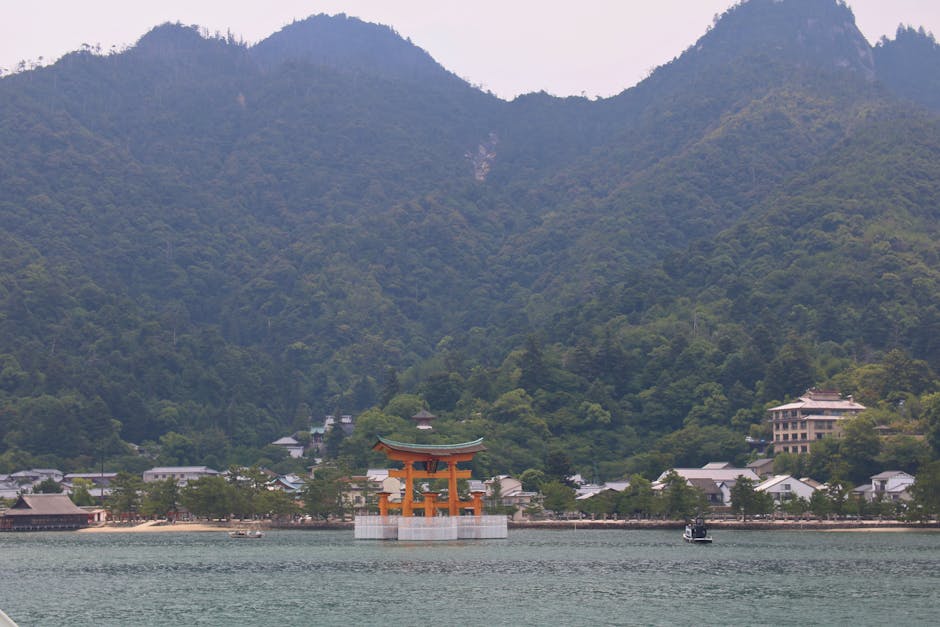
“Can I walk to the torii gate?”
Yes — but only at low tide. The difference between high and low tide at Miyajima is about 3-4 meters, completely transforming the experience. At high tide, the shrine buildings appear to float on the sea. At low tide, you can walk right up to the Great Torii and touch its base. Checking the tide table before your visit is the single most important thing you can do.
Itsukushima Shrine, traditionally said to have been founded in 593 CE during Empress Suiko’s reign, has over 1,400 years of history and is a UNESCO World Heritage Site on Miyajima Island. The entire island is considered sacred, and historically a custom existed of conducting births and burials on the mainland to preserve its purity. Miyajima itself welcomed a record 4.85 million visitors in 2024 — the most in its history — and 2025 is expected to exceed that again.
Quick Facts
| Detail | Info |
|——–|——|
| Admission | Adults 300 yen, Students 200/100 yen (combo with Treasure Hall: 500/300/150 yen) |
| Hours | Varies by season (see table below; 6:30 AM – 5:00 to 6:30 PM range) |
| Time needed | 1 hour (shrine only), 4+ hours (with Mount Misen) |
| Best time | High tide for floating shrine, low tide to walk to torii |
| Access | Ferry from Miyajimaguchi (10 min, 200 yen one-way + 100 yen Miyajima Visitor Tax) |
| Phone | 0829-44-2020 |
—
Tide Times: The Key to Your Visit
This is the most important planning detail for Miyajima. The shrine looks completely different depending on the tide:
| Tide | Experience | Best For |
|——|———–|———-|
| High tide | Shrine buildings float on the sea. Torii gate reflected in water | Photography, the “classic” Miyajima view |
| Low tide | Walk across the seabed to the Great Torii (16.6m tall). Tide pools and marine life visible | Touching the torii base, exploring beneath the shrine |
| Mid-tide rising | Water flowing under the corridors | Watching the transformation in real-time |
How to check: Search “Miyajima tide table” or “宮島 潮汐” for the day of your visit. The Miyajima Tourist Association website provides monthly tide charts. Aim to arrive 2 hours before low tide for the best walking window to the torii.
Pro tip: Plan a full-day visit to see both tides. Arrive at high tide for morning worship, explore Mount Misen midday, then walk to the torii at afternoon low tide.
—
What Makes Itsukushima a Power Spot — 3 Reasons
1. Over 1,400 Years as a “Divine Island”
Founded in 593 CE, Itsukushima enshrines the three Munakata goddesses — guardians of maritime traffic who have protected travelers on the Seto Inland Sea since ancient times. The island itself is the deity’s body: no trees are felled, no one is born or buried here, and to this day there is no cemetery on the island. Residents still hold funerals on the opposite shore.
2. Taira no Kiyomori’s Grand Vision
Japan’s most powerful warlord of the late Heian period poured his wealth into expanding this shrine. In 1168, Kiyomori constructed the prototype of the current buildings — a shinden-zukuri palace complex built over the sea. This was not just architecture; it was a statement that even the sea bows to divine power. The shrine survived Kiyomori’s fall and was later restored by Mori Motonari after his famous 1555 victory in the Battle of Itsukushima.
3. Architecture That Breathes with the Ocean
The shrine complex is a National Treasure: roughly 275 meters of vermilion corridors connect the Main Hall, Worship Hall, Takabatai Stage, and Japan’s only Noh stage built over the sea. The current Great Torii (16.6m tall, ~60 tons; reconstructed in 1875 — the Miyajima Tourist Association lists it as the 9th torii at this site) is not buried in the seabed — it stands purely by its own weight, made from natural camphor wood.
The Shrine’s Power Spots
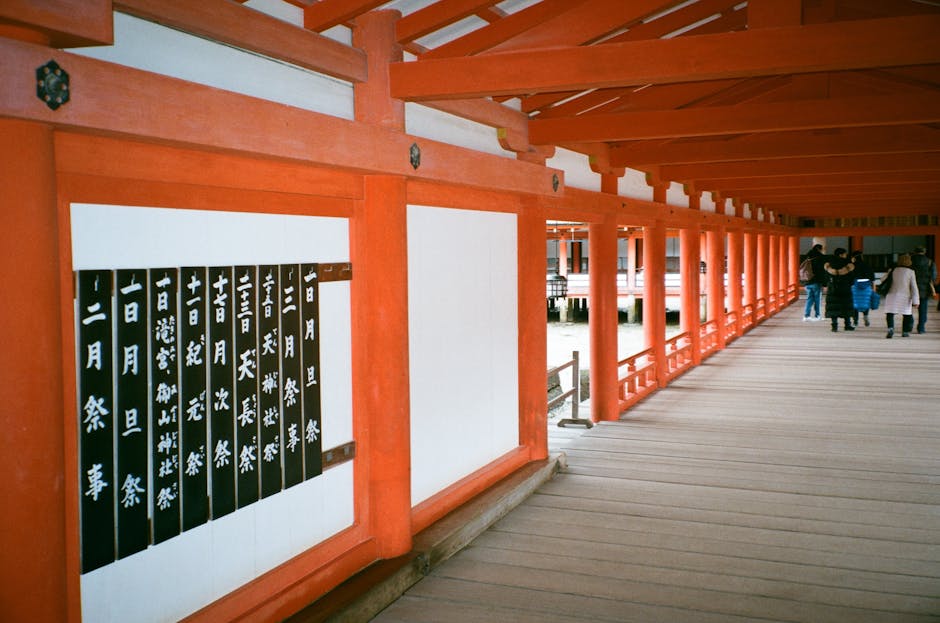
Before the Great Torii (Low Tide)
Walking across the exposed seabed to stand at the base of the Great Torii is Miyajima’s most powerful spiritual experience. Look up at the massive camphor wood pillars and the plaque reading “嚴島神社” — you’re standing at the threshold between the human world and the divine. The 10-15 minutes of quiet reflection here, with seawater still draining around the base, is unforgettable.
Kagami-no-Ike (Mirror Pond)
Visible only at low tide, this pond appears in the seabed near the shrine buildings. Its still surface perfectly mirrors the sky and surrounding structures — traditionally seen as a portal reflecting the world of the gods.
Reikado Hall (Mount Misen Summit)
At the top of Mount Misen (535m), this hall contains the “Eternal Flame” — a fire lit by the monk Kukai over 1,200 years ago that has never been extinguished. The water boiled over this flame is said to cure any illness. On August 1, 1964, this flame was officially used as one of the source fires for the “Flame of Peace” at Hiroshima Peace Memorial Park (source: Japan Tourism Agency multilingual database).
The Main Hall
Stand before the Main Hall at high tide when seawater flows beneath the floorboards. The combination of ancient Heian architecture hovering over living ocean creates a sensation of being suspended between worlds — exactly what Taira no Kiyomori envisioned nearly 900 years ago.
Spiritual Benefits
Maritime and Traffic Safety — The three Munakata goddesses are guardians of the sea, now extended to all travel safety.
Business Prosperity — As the shrine of Taira no Kiyomori, Japan’s most powerful medieval merchant-warrior, it carries strong business fortune energy.
Victory and Competition — After Mori Motonari’s legendary victory here, athletes and competitors come to pray before major events.
Romance and Beauty — Ichikishimahime is revered as a goddess of beauty, drawing visitors seeking good relationships.
Purification and Renewal — The tidal rhythm of seawater flowing beneath the shrine symbolizes washing away the old and welcoming the new. Many visitors describe feeling “reset” after their visit.
Best Times to Visit
Autumn (September-November) ★★★★★
Peak season. About 700 maple trees in Momijidani Park turn brilliant red in mid to late November. The combination of autumn colors, vermilion shrine buildings, and the sea is spectacular. Weekends are extremely crowded — visit on weekdays or arrive before 9 AM.
Spring (March-May) ★★★★☆
Cherry blossoms (early to mid-April) beautifully frame the shrine. Temperatures of 15-22°C are comfortable for walking. Avoid Golden Week if possible.
Summer (June-August) ★★★★☆
The Kangen-sai festival (held on the 17th day of the 6th lunar month — July 30, 2026 (Thursday)) is the year’s greatest spectacle — ceremonial boats cross the sea accompanied by gagaku court music at night. Very crowded during summer vacation. Temperatures 25-32°C; bring water and sun protection.
Winter (December-February) ★★★☆☆
Fewest tourists — worship in genuine solitude. Snow-covered torii gate is rare but breathtaking. About 150,000 visitors come for New Year worship (January 1-3). Dress warmly (3-10°C).
Best Times of Day
- Early morning (6:30-8:00 AM): Sacred atmosphere, few visitors, morning light on the shrine
- High tide: The “floating shrine” experience — check tide tables
- Low tide: Walk to the Great Torii — arrive 2 hours before lowest point
- Sunset (5:00-6:30 PM): Torii silhouetted against the sky — photographers’ favorite
Worship and Visiting Guide
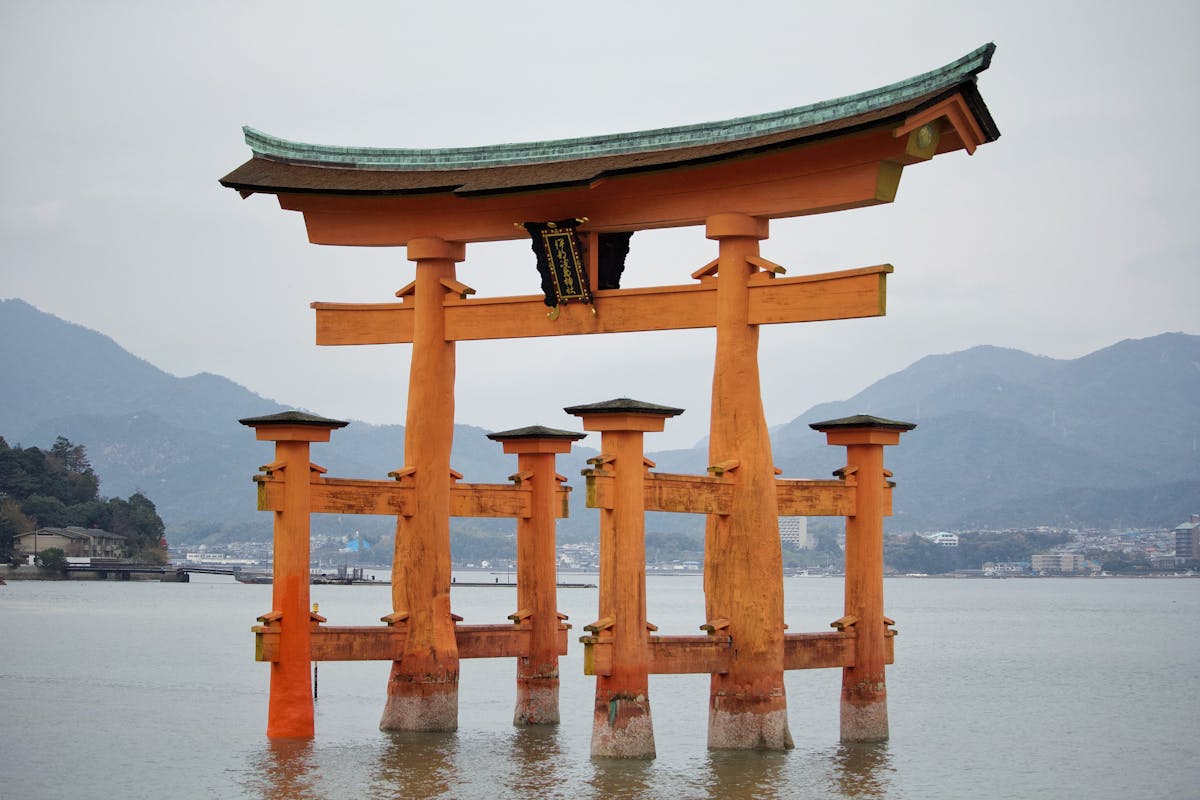
How to Worship
1. Approach from the ferry: Walk along the main approach (10 min), passing friendly deer along the way. Bow toward the Great Torii over the sea before entering
2. Purify at the Temizuya: Right hand holds ladle, rinse left → switch, rinse right → cup water in left palm, rinse mouth → hold ladle vertically to cleanse handle
3. Worship at the Main Hall: Two bows, two claps, one bow. Take a moment to calm your heart before praying
Recommended Route
From the entrance, follow the corridor: Purification Hall → Takabatai Stage → Main Hall → Okuninushi Shrine → Tenjin Shrine. Near the exit is the Noh Stage — the only one in Japan built over the sea.
Goshuin (Shrine Seal)
Available at the shrine office during regular hours. Fees are not publicly listed on the official site — confirm at the office on the day. Weekends and autumn foliage season can mean 30-60 minute waits. Weekday or early morning visits recommended.
What to Wear
- Comfortable walking shoes (corridors are wooden, sandy beach at low tide)
- Waterproof sandals or shoes if walking to the torii at low tide
- Modest clothing appropriate for a sacred site
- No eating, drinking, or smoking on corridors
- Tripod photography prohibited inside the shrine
Essential Information
Access
By Ferry (the only way to reach Miyajima):
- JR Sanyo Line to “Miyajimaguchi Station” (30 min from Hiroshima Station), then 5-min walk to the pier
- JR West Miyajima Ferry or Miyajima Matsudai Kisen: 10-minute crossing
- One-way fare: 200 yen adult / 100 yen child + 100 yen Miyajima Visitor Tax (2026 rates)
- JR Pass holders ride the JR ferry free (visitor tax still applies)
From Hiroshima City:
- JR Sanyo Line: about 30 minutes to Miyajimaguchi (~420 yen)
- Hiroden streetcar: about 70 minutes (270 yen, scenic route)
By Car:
- From Sanyo Expressway “Hatsukaichi IC” or “Ono IC” to Miyajimaguchi: about 15 minutes
- Paid parking near Miyajimaguchi (1,000-1,500 yen/day)
- Vehicles cannot enter the island — park on the mainland
Basic Information
- Address: 1-1 Miyajima-cho, Hatsukaichi City, Hiroshima 739-0588
- Phone: 0829-44-2020
- Hours (seasonal — official):
– Jan 1: 0:00–18:30
– Jan 2–3: 6:30–18:30
– Jan 4 – end of Feb: 6:30–17:30
– Mar 1 – Oct 14: 6:30–18:00
– Oct 15 – Nov 30: 6:30–17:30
– Dec 1 – Dec 31: 6:30–17:00
- Closed: Never
- Admission: Adults 300 yen, High school students 200 yen, Elementary/Junior high 100 yen
- Time required: 1 hour (shrine only), 3-4 hours (with Mount Misen), full day (island exploration)
- Official website: https://www.itsukushimajinja.jp/
Nearby Attractions
Must-Do on Miyajima
Mount Misen (ropeway + 30-min walk to summit)
Sacred mountain at 535m. Kukai’s training ground with the Eternal Flame (1,200+ years). Panoramic views of the Seto Inland Sea’s island-dotted beauty from the summit. Ropeway: 2,000 yen adult round-trip / 1,100 yen one-way (2026 rates). Operating hours 9:00 AM – 4:00 PM, last descent 4:30 PM.
Momijidani Park (10-min walk from shrine)
700 maple trees creating stunning autumn colors (mid to late November). Free entry. Also the starting point for the Mount Misen ropeway.
Daisho-in Temple (15-min walk)
Miyajima’s oldest temple, said to have been founded by Kukai. Hundreds of Buddhist statues line the approach — a completely different spiritual atmosphere from the shrine.
Toyokuni Shrine / Senjokaku (5-min walk)
Massive sutra hall ordered by Toyotomi Hideyoshi. Called “Hall of a Thousand Tatami” (actually 857 tatami). Admission 100 yen. Important note for 2026: The adjacent Five-Story Pagoda is under preservation works through December 2026 and is currently closed to viewing — check the Miyajima Tourist Association site for updates before visiting.
Recommended Restaurants
Anagomeshi Ueno — The island’s most famous restaurant, established 1901. Anago (conger eel) over rice: bento 2,160 yen, dine-in 2,530 yen. Located at Miyajimaguchi (mainland side). 10:00 AM – 7:00 PM, closed Wednesdays.
Kakiya — Miyajima oyster specialty shop on the main approach. Grilled oysters from 400 yen (2 pieces), Kakiya set meal 2,310 yen. 10:00 AM – 6:00 PM. Hiroshima oysters are Japan’s finest — don’t miss them.
Iwamura Momijiya — Meiji-era momiji manju (maple leaf cakes) shop. Try the fried momiji (200 yen) — crispy outside, sweet inside. Hand-baked traditional version 120 yen. 9:00 AM – 6:00 PM.
sarasvati — Quiet machiya (traditional townhouse) cafe away from the crowds. House-roasted coffee 550 yen, sweets set 1,100 yen. 10:00 AM – 5:00 PM, closed Tuesdays and Wednesdays.
Souvenirs
- Momiji Manju: Miyajima’s iconic maple leaf-shaped cakes — over a dozen flavors from classic to matcha to chocolate
- Hiroshima Oyster Products: Oil-preserved, smoked, and more
- Shamoji (Rice Paddles): Originated in Miyajima, now popular as good luck charms
- Miyajima Beer: Local craft beer, perfect after a Mount Misen hike
Suggested Itineraries
Half-Day (4 hours)
10:00 AM — Ferry from Miyajimaguchi
10:15 AM — Walk along main approach to shrine
10:45 AM — Worship at Itsukushima Shrine (60 min)
12:00 PM — Lunch (anago-meshi or oysters)
1:00 PM — Toyokuni Shrine and Five-Story Pagoda
1:30 PM — Souvenir shopping
2:00 PM — Ferry back
Full Day (7 hours) — Recommended
9:00 AM — Ferry to Miyajima (arrive at high tide if possible)
9:30 AM — Worship at the “floating” shrine (60 min)
10:45 AM — Walk to Momijidani Park, take ropeway
11:15 AM — Explore Mount Misen summit and Reikado (90 min)
1:00 PM — Ropeway descent
1:30 PM — Lunch on main approach
2:30 PM — Daisho-in Temple
3:30 PM — Toyokuni Shrine, main approach stroll (note: Five-Story Pagoda closed for restoration through Dec 2026)
4:30 PM — Walk to Great Torii at low tide
5:00 PM — Ferry back (or stay for sunset)
Visitor Experiences
> “We planned our visit around the tide table — worshipped at morning high tide when the shrine seemed to float, then walked to the torii at afternoon low tide. Same place, completely different experience. Touching the massive torii base was genuinely moving.”
> — Google Maps review
> “The view from Mount Misen summit was the highlight of our entire Hiroshima trip. The Seto Inland Sea dotted with islands in every direction. And having tea warmed by the 1,200-year-old eternal flame — you can’t get that anywhere else.”
> — Google Maps review
> “Visited on a rainy November weekday. Almost no tourists, the wet corridors glowed a deeper red, and the mist over the sea was hauntingly beautiful. Sometimes rain is a gift.”
> — Jalan.net review
Frequently Asked Questions
Q: Is the Five-Story Pagoda open in 2026?
A: No — the pagoda is undergoing preservation works through December 2026 and cannot be viewed. The adjacent Toyokuni Shrine / Senjokaku Hall is still open. Confirm the latest schedule on the Miyajima Tourist Association site before your visit.
Q: Can I walk to the Great Torii?
A: Only at low tide. Check the tide table before visiting. The best walking window is about 2 hours around the lowest tide point. The seabed can be muddy — wear waterproof shoes.
Q: How much time should I allow?
A: 1 hour for the shrine only, 3-4 hours with Mount Misen, a full day to explore the entire island at a relaxed pace.
Q: Is it worth climbing Mount Misen?
A: Absolutely. The ropeway takes you most of the way (adult round-trip 2,000 yen, 2026 rate), with a 30-minute walk to the summit. The panoramic views and 1,200-year-old Eternal Flame are unmissable.
Q: Can I bring my pet?
A: Pets are not allowed inside the shrine buildings. However, Miyajima is relatively pet-friendly otherwise — pets on leash are welcome on island streets and beaches. Small pets in carriers are allowed on ferries; larger dogs can ride on deck on leash. Warning: Keep pets away from the island’s deer. Several main-approach cafes have pet-friendly terraces.
Q: Is it accessible by wheelchair or stroller?
A: Partially. The route from the ferry terminal to the shrine is flat and paved (10 min). Main corridors have ramps and are wheelchair accessible. Some areas have steps. Free wheelchair rental is available at the ferry terminal (first-come basis). Accessible restrooms at the ferry terminal and near the shrine. Mount Misen is not wheelchair accessible.
Q: Is it enjoyable in the rain?
A: Yes! The corridors are roofed, so worship is comfortable. Rain actually enhances the atmosphere — wet vermilion corridors glow deeper, and mist over the sea creates a mystical scene. Mount Misen trails get slippery though, so use caution.
Q: What are the benefits of staying overnight on Miyajima?
A: Quiet morning worship before day-trippers arrive, evening illumination (irregular schedule), and strolling the empty streets at night. The island has about 30 inns and hotels.
Q: Do JR Pass holders ride the ferry free?
A: Yes — the JR West Miyajima Ferry accepts JR Pass. The Matsudai Kisen ferry does not.
Guides for Various Visitors
Visiting with Children
Miyajima is great for families:
- Deer interaction: Children love the friendly deer on the approach (don’t feed them though — they approach on their own)
- Beach play: At low tide, kids can explore tide pools and walk to the torii
- Momiji manju making: Several shops offer hands-on experiences (ages 5+, about 800 yen)
- Miyajima Public Aquarium: 10 minutes from ferry terminal, perfect for rainy days
- Ropeway: Fun for all ages, 15-minute ride with scenic views
Tips: Bring a change of clothes for beach play. Watch for deer near food. The aquarium is your rainy-day backup plan.
Photography Tips
- Floating shrine: High tide + morning or late afternoon light
- Walking to torii: Low tide, any time. The reflection in remaining puddles creates stunning shots
- Sunset silhouette: 5:00-6:30 PM from the shrine corridors or the beach
- Autumn foliage: Mid to late November in Momijidani Park
- Tripods: Prohibited inside the shrine, but OK on the beach and in the park
Summary: 5 Key Takeaways
1. Check the tide table: This is the #1 planning tip. High tide = floating shrine. Low tide = walk to the torii. Plan a full day to experience both
2. Climb Mount Misen: The ropeway + 30-min walk is worth it for panoramic Seto Inland Sea views and the 1,200-year-old Eternal Flame
3. Arrive early or on weekdays: The island gets crowded by 10 AM, especially in autumn. Early morning worship at 6:30 AM is a completely different experience
4. Try the oysters and anago: Hiroshima oysters at Kakiya and anago-meshi at Ueno are not tourist traps — they’re genuinely excellent
5. The island itself is sacred: No births, no burials, no cemeteries for over 1,400 years. This isn’t just a beautiful shrine — it’s an entire island consecrated to the divine
—
*Last updated: May 2026. Please verify the latest information on the official website before your visit.*
—
Want to discover your ideal power spot?
Japan has countless sacred sites beyond Miyajima. Each person resonates differently with different places. To find the power spots most compatible with your personal energy, try our free compatibility assessment — it takes just 3 minutes.
あなたに最適なパワースポットを知りたい方へ