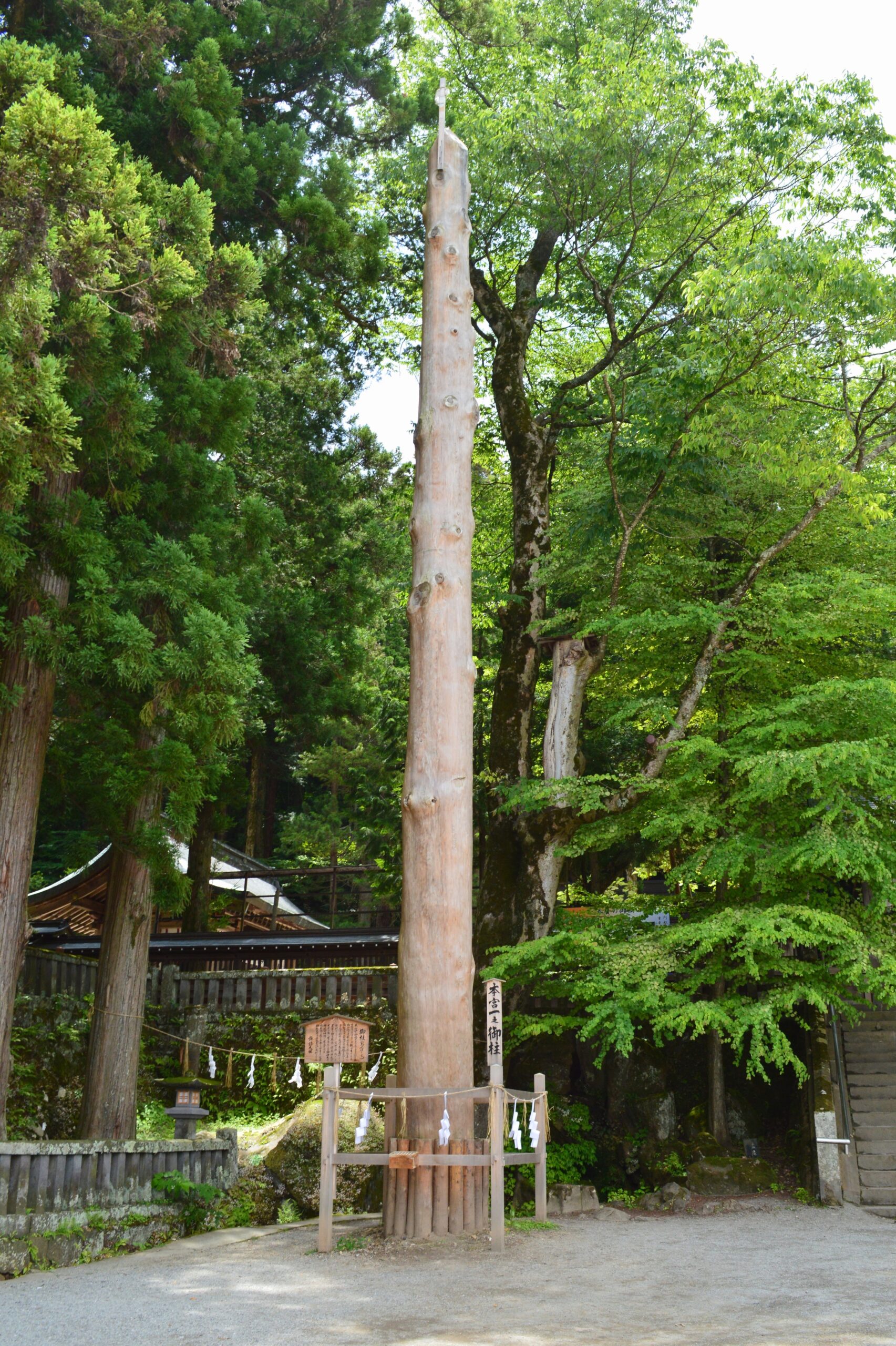
A five-minute drive from Suwa Interchange on the Chuo Expressway, deep within a grove of towering cedars, stands the Ichi-no-Onbashira (First Sacred Pillar)—pointing straight toward the heavens. This is the symbol of Suwa faith: a total of 16 sacred pillars, four placed at the four corners of each of the four shrines. Suwa Taisha is one of Japan’s oldest shrines, and the primordial form of worship—venerating nature itself as the divine body without any main hall (honden)—survives here intact to this day.
“Isn’t Suwa Taisha just one shrine?” “When is the Onbashira Festival held?” “Can you still see the Omiwatari today?” Across Lake Suwa, two upper shrines (Honmiya, Maemiya) and two lower shrines (Harumiya, Akimiya) form a unique configuration. The Shikinen Zōei Onbashira Taisai, held every six years (counted as the seventh year by traditional reckoning) in the years of the Tiger and Monkey, is one of Japan’s most spectacular festivals. The Omiwatari, meanwhile, has not appeared for eight consecutive seasons (2019–2026). This guide is built on official and primary sources to give you everything you need for the best possible visit.
The Allure of This Sacred Site
History—One of Japan’s Oldest Shrines
The exact founding date of Suwa Taisha is unknown. Official records describe it as “one of the oldest shrines in Japan, with origins reaching back to the Kuni-Yuzuri (transfer of the land) myth in the Kojiki.” In the *Engishiki Jinmyōchō* (an early 10th-century shrine register), it is listed as “Minakatatomi-no-Kami-no-Yashiro” and was already revered as the foremost shrine among the 48 in Shinano Province—i.e., the ichi-no-miya (first-ranked shrine) of Shinano.
During the Meiji era, it rose through the modern shrine hierarchy: Kokuhei Chūsha (1871) → Kanpei Chūsha (1896) → Kanpei Taisha (1916). After WWII, the name was changed from “Suwa Jinja” to “Suwa Taisha” to distinguish it from its many branch shrines across Japan.
The deities enshrined at each of the four shrines are officially documented as follows:
| Shrine | Official Enshrined Deities |
|—|—|
| Kamisha Maemiya | Yasakatome-no-Kami |
| Kamisha Honmiya | Takeminakata-no-Kami |
| Shimosha Harumiya | Takeminakata-no-Kami, Yasakatome-no-Kami, Yaekotoshironushi-no-Kami |
| Shimosha Akimiya | Takeminakata-no-Kami, Yasakatome-no-Kami, Yaekotoshironushi-no-Kami |
Takeminakata-no-Kami is the son of Ōkuninushi-no-Mikoto. According to the *Kojiki*, he journeyed from Izumo to Suwa, where he developed the land. As a deity of victory, military prowess, agriculture, wind and water, he has received deep devotion from warriors, farmers, and—since the early modern period—merchants as well.
Shrines Without Honden—The Original Form of Shintai Worship
Suwa Taisha’s defining feature is that none of the four shrines has a honden (main sanctuary). This preserves the most primordial form of nature worship in Japan, dating from before formal shrine architecture developed.
- Kamisha Honmiya: Worships the sacred mountain (shintai-yama) behind it
- Kamisha Maemiya: Worships the slopes of the sacred mountain and the Kanbara grounds (has a honden within the precincts)
- Shimosha Harumiya: Worships a sacred cedar tree
- Shimosha Akimiya: Worships a sacred yew tree
“Recognizing nature itself as the dwelling place of the kami”—the origin of Japanese Shinto—lives on here in unmistakable form. Standing before the worship hall at Kamisha Honmiya, one feels in direct dialogue with the mountain range itself.
National Treasures and Important Cultural Properties
Each of the four shrines houses culturally designated structures:
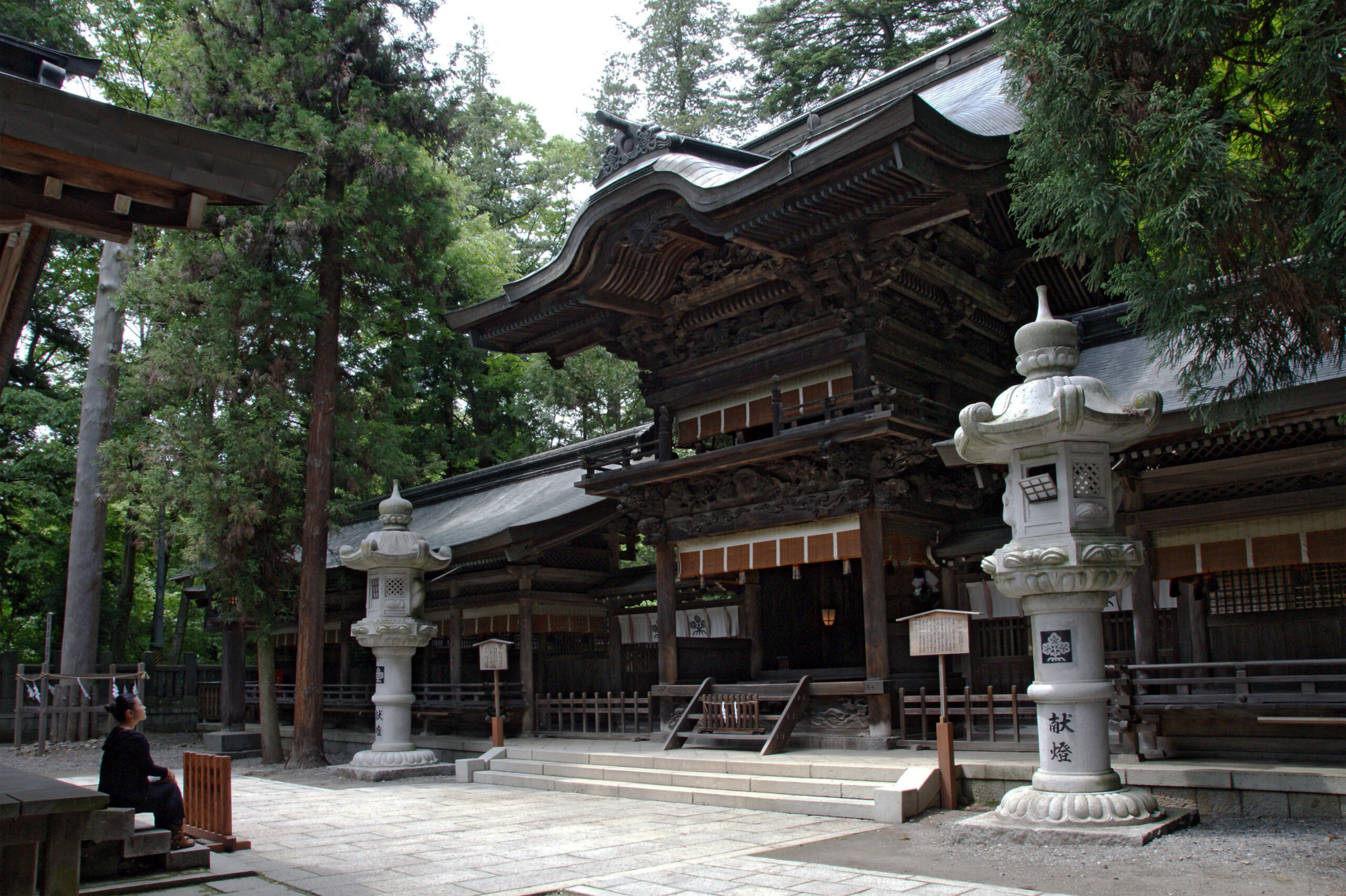
- Kamisha Honmiya Haiden, Heiden, and Side Halls (Important Cultural Property)
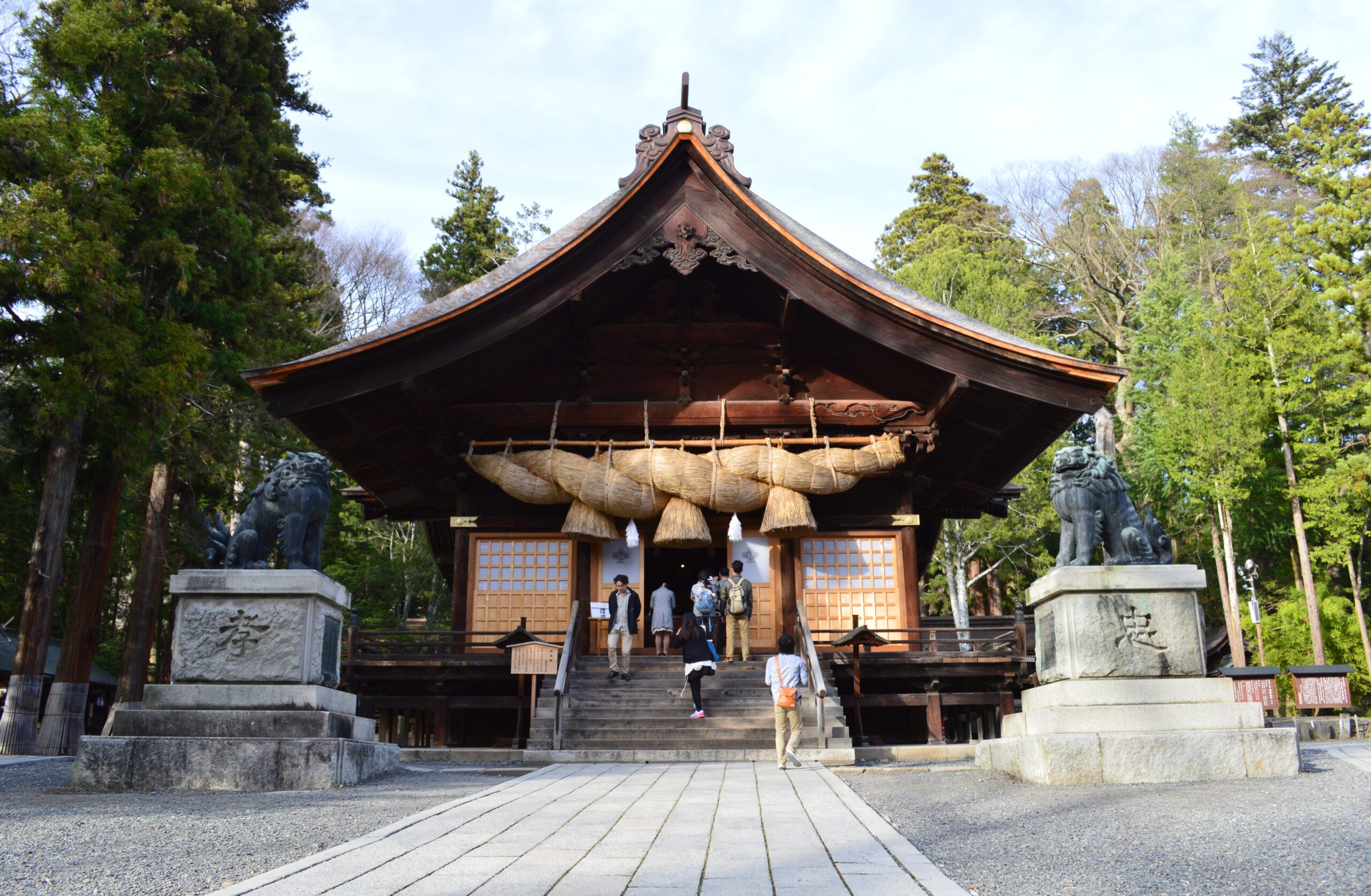
- Shimosha Akimiya Kaguraden (Important Cultural Property)—home to one of Japan’s largest sacred ropes (shimenawa), approximately 13 m long and 500 kg in weight
- Shimosha Akimiya Heihaiden and Side Halls (Important Cultural Property)
- Shimosha Harumiya Heihaiden and Side Halls (Important Cultural Property)
The massive shimenawa at Akimiya’s Kaguraden is famously compared with that of Izumo Taisha’s Kaguraden—a sight that overwhelms every visitor.
Spiritual Benefits and Effects
Officially Recognized Blessings
Takeminakata-no-Kami is renowned as a deity of victory and martial valor—and today continues to be invoked by visitors seeking good fortune in competition, new business ventures, and life challenges. As a deity of agriculture, industry, wind, and water, prayers for abundant harvests, business prosperity, and protection from storms and floods are also offered.
Yasakatome-no-Kami, enshrined alongside her consort at the lower shrines, brings blessings of harmonious relationships, family safety, and marital happiness.
The Four Shrine Pilgrimage: Resolve and Action
Pilgrims have long made the rounds of all four shrines—the Yonsha Mairi (Four Shrine Pilgrimage). Visiting Kamisha Honmiya and Maemiya together with Shimosha Harumiya and Akimiya is considered the complete expression of Suwa faith.
- Kamisha (Honmiya, Maemiya): The main line of Takeminakata-no-Kami. Energy of resolve and forward motion
- Shimosha (Harumiya, Akimiya): The harmonious energy that includes the consort deity. Power of stability and action
Visitors facing major life transitions—starting a business, changing careers, getting married—often report that “the four shrine pilgrimage clarified my mind.”
Visitor Testimonials
Real visitor feedback:
> “There were many points of interest. Suwa Taisha Kamisha Honmiya was fascinating.”
> — Tripadvisor review (visited December 2022)
> “Just after the Onbashira Festival, held once every seven years.”
> — Tripadvisor review (visited May 2022)
Each of the four shrines has its own distinct atmosphere, and many visitors return more than once. In Onbashira years (next: 2028), pilgrims arrive from across Japan.
The Onbashira Festival—Every Six Years (Seventh by Traditional Count)
What is the Shikinen Zōei Onbashira Taisai?
The official name is Shikinen Zōei Onbashira Taisai. Officially described as occurring “in every seventh year, in the years of the Tiger and Monkey,” in actual years this means every six years, or the seventh year by traditional counting.
- Most recent: 2022 (Reiwa 4, Year of the Tiger)
- Next: 2028 (Reiwa 10, Year of the Monkey)
The festival has two main purposes:
1. To rebuild the shrine buildings
2. To erect massive pillars at the four corners of each shrine
16 Pillars Hauled from the Mountains
Each of the four shrines receives 4 pillars, for a total of 16—not 8, as sometimes incorrectly stated. The four pillars at each shrine are called Ichi-no-Onbashira, Ni-no-Onbashira, San-no-Onbashira, and Yon-no-Onbashira.
- The 8 pillars for the upper shrines come from Mt. Okoya in the western foothills of the Yatsugatake range
- The 8 pillars for the lower shrines come from the Higashimata national forest near Kirigamine plateau
- The largest pillars are approximately 17 m long and 13 tons in weight
- According to official sources, between 1,000 and 2,000 parishioners pull each pillar together
Traditional Schedule
- Yamadashi (Mountain Out): Early April of the Onbashira year
- Satobiki (Village Pulling): Early May
- Hōden Senzasai (Treasure Hall Transfer Ceremony): June 15 for upper shrines, eve of Satobiki for lower
The signature event is Kiotoshi—the log drop. With a maximum slope of approximately 35 degrees, parishioners ride the pillars as they slide down—a ritual known as life-risking. The upper shrines also feature Kawagoshi (river crossing), and Satobiki includes equestrian processions, naga-mochi pole carriers, kasa-odori dancing, kanmurioshi, and the climactic Tateonbashira (pillar raising).
Note: in 2022, due to COVID-19 measures, the Yamadashi was conducted with trailer transport (not human-powered hauling), and Satobiki ran with restrictions. The 2028 format will need to be confirmed via official guidance closer to the date.
The Omiwatari—Years of “Ake-no-Umi”
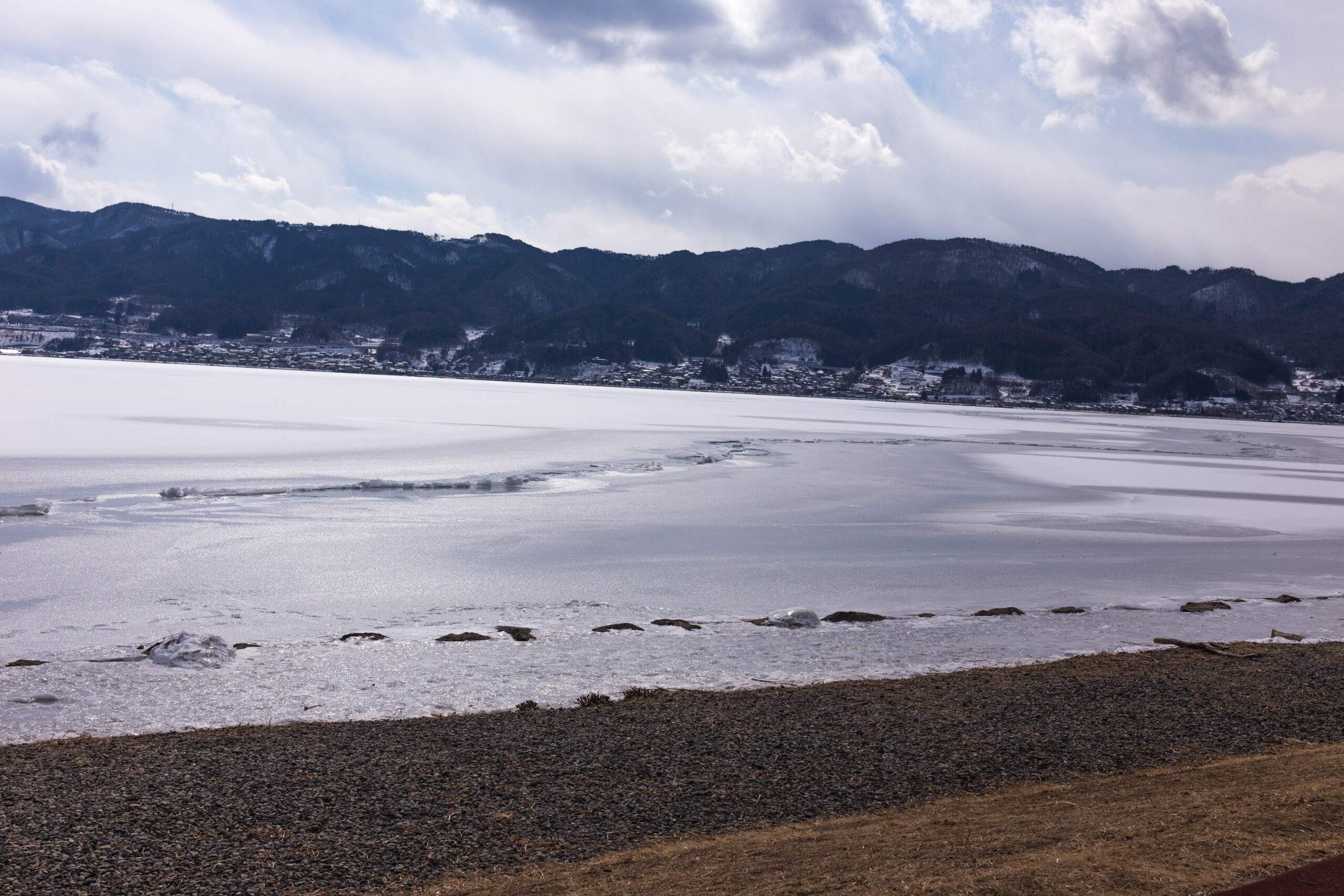
After Lake Suwa freezes over completely, temperature swings cause the ice to ridge up in linear cracks—a phenomenon known as the Omiwatari. Traditionally interpreted as “the trail left by Takeminakata-no-Kami as he crossed the lake to visit Yasakatome-no-Kami,” its observation and official judgment have been the responsibility of Yatsurugi Shrine in Suwa City for centuries.
Last Appearance: 2018
Climate change has caused the Omiwatari to fail to appear for years on end:
- Last appearance: 2018 (after a five-year gap)
- 2019–2026: 8 consecutive seasons of “Ake-no-Umi” (the term for a year when the Omiwatari fails to form)
- February 2026: The Suwa Tourism Association declared the 8th consecutive Ake-no-Umi season
You can no longer assume you will see it “by visiting in winter.” Appearance varies year to year. Observation runs roughly from early January through early February. Walking on the ice without authorization is extremely dangerous—always check local announcements for ice thickness and access restrictions.
Best Times to Visit
Spring (March–May)
Cherry blossoms typically peak around mid-April. Official figures for the number of trees on the grounds are not published, so check seasonal bloom forecasts. Shimosha Harumiya (“Spring Shrine”) is at its most beautiful in this season. Avoid Golden Week (early May) crowds; weekdays recommended.
Recommendation: ★★★★☆
Summer (June–August)
The Lake Suwa Fireworks Festival on August 15 is one of Japan’s largest (organization, launch counts, and viewing arrangements vary by year—confirm official information before traveling). On August 1, the lower shrines hold Ofunamatsuri (Boat Festival)—a *shibafune* boat is hauled between Harumiya and Akimiya. Highland climate makes summer worship pleasant; temperatures 20–28°C (68–82°F).
Recommendation: ★★★★☆
Autumn (September–November)
Autumn colors peak from late October to early November. Particularly beautiful around the shrine groves and Shimosha Harumiya, with striking contrast between the Onbashira pillars and the autumn leaves. Temperatures 8–18°C (46–64°F)—ideal for worship.
Recommendation: ★★★★★
Winter (December–February)
With the Omiwatari failing to appear in recent years, the realistic focus shifts to “winter Lake Suwa and the shrines.” Coldest days can drop below -10°C (14°F). Snow-covered shrines are mystical, but warm clothing, ice-traction footwear, and snow preparation are essential.
Recommendation: ★★★☆☆
Best Times of Day
- Early morning (6:00–8:00 AM): Few visitors, crisp air. The area around Kamisha Honmiya’s Onbashira is especially recommended at dawn
- Morning (9:00 AM–noon): Amulet offices open; ideal for goshuin and omamori
- Afternoon (2:00–4:00 PM): For the Four Shrine Pilgrimage, starting from the lower shrines is efficient. Akimiya’s Kaguraden at dusk is exceptional
Major Festival Calendar (Official Events)
| Date | Festival | Location |
|——|———-|———-|
| January 1 | Saitansai, Ontō Onura Shinji, Frog Hunting Ritual | Kamisha Honmiya |
| January 15 | Tsutsugayu Shinji (divination) | Shimosha Harumiya |
| February 1 | Sentensai (Akimiya → Harumiya) | Lower Shrines |
| Early February | Omiwatari Hakanshiki (if it appears) | Yatsurugi Shrine, Lake Suwa |
| April 15 | Ontōsai | Kamisha Maemiya |
| April (Onbashira year) | Yamadashi | All Four Shrines |
| May (Onbashira year) | Satobiki | All Four Shrines |
| August 1 | Ofunamatsuri / Sentensai (Harumiya → Akimiya) | Lower Shrines |
| August | Misayama-sha Festival | Lower Shrines |
| November 23 | Niinamesai | Honmiya & Akimiya |
Four Shrine Pilgrimage Guide
Pilgrimage Order
Traditionally: Kamisha Honmiya → Kamisha Maemiya → Shimosha Harumiya → Shimosha Akimiya. There is no strict rule, however. Realistic options based on transportation:
- By car: Two upper shrines (Honmiya, Maemiya) → cross Lake Suwa → two lower shrines (Harumiya, Akimiya). Approximately 3–4 hours
- Train + walking: Start with the two lower shrines (within walking distance of Shimosuwa Station), then bus to the upper shrines (Chino/Kamisuwa Station + bus). Approximately 5–6 hours
Worship Etiquette
1. Passing through the torii: Bow once, then walk on the side. The center is reserved for the deities
2. Temizuya (purification): Right hand → left hand → mouth → ladle handle, in that order
3. Prayer: Two bows, two claps, one bow
Highlights of Each Shrine
- Kamisha Honmiya: Ichi-no-Onbashira, Haiden/Heiden (ICP), worship of the sacred mountain
- Kamisha Maemiya: Jukken-rō, the Suiga stream
- Shimosha Harumiya: Heihaiden (ICP), the Manji-no-Sekibutsu outside the precincts (a few minutes’ walk)
- Shimosha Akimiya: Kaguraden’s giant shimenawa, the “Ne-iri no Sugi” (Sleeping Cedar)
Goshuin (Sacred Seals)
- Each of the four shrines offers its own distinct goshuin
- A dedicated Four Shrine Pilgrimage goshuincho (stamp book) is available, with some shrines offering a special completion stamp
- Reception hours generally 9:00 AM–4:30 PM (varies by shrine and season; confirm officially)
Basic Information & Access
Addresses
- Kamisha Honmiya: 1 Nakasu-Miyayama, Suwa City, Nagano
- Kamisha Maemiya: 2030 Miyagawa, Chino City, Nagano
- Shimosha Harumiya: 193 Shimosuwa-machi, Suwa-gun, Nagano
- Shimosha Akimiya: 5828 Shimosuwa-machi, Suwa-gun, Nagano
By Train + Bus
- Kamisha Honmiya: From JR Kamisuwa Station, take the Karin-chan Bus for “Kamisha” or “Kamisha Kita-Sandō.” Approximately 20–35 minutes (varies by service; as of April 2026)
- Kamisha Maemiya: From JR Chino Station, head east about 4 km; bus stop “Maemiya-mae.” Walking is about 50–60 minutes
- Shimosha Akimiya: From JR Shimosuwa Station, about 10 minutes on foot
- Shimosha Harumiya: From JR Shimosuwa Station, about 20 minutes on foot; 1 km west of Akimiya
By Car
- For the upper shrines: From Suwa IC on the Chuo Expressway, about 5 minutes to Kamisha Honmiya
- For the lower shrines: From Okaya IC on the Nagano Expressway, about 15 minutes to Shimosha Akimiya
- From Tokyo (Shinjuku): approximately 2 hours 30 minutes
- From Nagoya: approximately 2 hours 40 minutes
Parking
- Shimosha Akimiya: 60 free spaces (bus-accessible)
- Kamisha Honmiya: Free parking available (capacity not officially specified)
- Year-end/New Year, Onbashira years, and long holidays bring traffic regulations and full lots
Other Information
- Worship hours: Precincts open at all times
- Amulet offices: Generally 9:00 AM–4:30 PM (varies by shrine and season; confirm officially)
- Admission: Free
- Phone: 0266-52-1919 (upper shrines), 0266-27-8035 (lower shrines)
- Official website: http://suwataisha.or.jp/
Area Information
Sightseeing Spots
Lake Suwa (10 minutes by car)
A 16-km circumference lake, the largest in Shinshu. Lakeside walking, cycling, and pleasure boats are easily combined. The August fireworks festival is one of Japan’s largest.
Manji-no-Sekibutsu (a few minutes’ walk from Shimosha Harumiya)
A 2.7-m tall stone Buddha. After artist Tarō Okamoto praised it during the 1974 Onbashira Festival, it gained nationwide fame through media coverage. A must-visit when at Shimosha Harumiya.
Takashima Castle (10 minutes’ walk from Kamisuwa Station)
A reconstructed castle (not original) of the Suwa clan. Known as the “Floating Castle of Suwa,” this water castle is now maintained as a park.
The Five Sake Breweries of Suwa (walking distance from Kamisuwa Station)
A concentration of sake breweries in the Kamisuwa area:
- Masumi (Miyasaka Brewery)
- Reijin
- Maihime
- Honkin
- Yokobue
Brewery tours, tastings, hours, and reservation requirements vary. Check each brewery’s official site.
Hot Springs
- Kamisuwa Onsen: Around Kamisuwa Station, lakeside resort area
- Shimosuwa Onsen: Old post-town atmosphere of the Nakasendo, with surviving public bathhouse culture
- Katakurakan: Important Cultural Property in Kamisuwa, famous for the “Sennin-buro” (Thousand-Person Bath)
Pets and Accessibility
- Pets: Suwa Taisha’s official position is not explicitly stated. We strongly recommend calling the shrine you plan to visit in advance to confirm policy. Etiquette and consideration for other worshippers are essential
- Wheelchairs / Strollers: Kamisha Honmiya’s approach has many stairs and is difficult for wheelchair access. Shimosha Akimiya is relatively barrier-free, with slope access close to the main hall. Strollers may need to be exchanged for a baby carrier. Confirm with each shrine in advance
Recommended Dining
Soba-dokoro Yamaneko-tei (Shimosuwa): 3 minutes’ walk from Shimosha Akimiya. Renowned Shinshu soba
Shinzuru Honten (Shimosuwa): 1 minute’s walk from Shimosha Akimiya. Established 180+ years ago, famous for shio-yokan (salted sweet bean jelly)
Lake Suwa SA restaurant: Service area on the Chuo Expressway (southbound), regional cuisine for travelers by car
Confirm current hours and closures with each establishment.
Model Itineraries
Half-Day Course (4 hours, focused on lower shrines)
- 10:00 Arrive at Shimosuwa Station
- 10:15 Worship at Shimosha Akimiya (Kaguraden shimenawa) — 40 min
- 11:00 Walk to Shimosha Harumiya — 15 min
- 11:20 Worship at Shimosha Harumiya + Manji-no-Sekibutsu — 50 min
- 12:30 Lunch in Shimosuwa (Yamaneko-tei etc.)
- 13:30 Shio-yokan / souvenir shopping, return
Full-Day Course (7 hours, all four shrines)
- 9:00 Arrive at Kamisuwa Station, taxi/bus to Kamisha Honmiya
- 9:30 Worship at Kamisha Honmiya (Onbashira, Haiden) — 60 min
- 10:40 Drive to Kamisha Maemiya — 10 min
- 11:00 Worship at Kamisha Maemiya (Jukken-rō, Suiga stream) — 40 min
- 12:00 Lunch by Lake Suwa
- 13:30 Drive to Shimosha Harumiya — 30 min
- 14:10 Worship at Shimosha Harumiya + Manji-no-Sekibutsu — 50 min
- 15:10 Walk to Shimosha Akimiya — 15 min
- 15:30 Worship at Shimosha Akimiya (Kaguraden) — 40 min
- 16:30 Bath at Shimosuwa Onsen or Katakurakan
- 17:30 Return from Shimosuwa Station
Frequently Asked Questions
Q: How long does it take to visit all four shrines?
A: By car, about 3–4 hours. By public transport, about 5–6 hours. If you want to spend significant time at each shrine, plan for a full day.
Q: When is the Onbashira Festival held?
A: Every six years (or the seventh year by traditional counting) in years of the Tiger and Monkey. The most recent was 2022; the next is 2028 (Year of the Monkey). Yamadashi is in early April, Satobiki in early May.
Q: How many Onbashira pillars are there?
A: 16 in total—four at each of the four shrines (8 at the upper shrines + 8 at the lower shrines). Each shrine’s pillars are named Ichi-no-Onbashira through Yon-no-Onbashira.
Q: Can I still see the Omiwatari?
A: Due to climate change, the Omiwatari has failed to appear for 8 consecutive seasons (2019–2026, all “Ake-no-Umi”). The last appearance was in 2018. Plan winter visits around frozen Lake Suwa scenery and snow-covered shrines rather than expecting to see the phenomenon itself.
Q: Are goshuin different at each shrine?
A: Yes—each of the four shrines offers a distinct goshuin. A dedicated Four Shrine Pilgrimage goshuincho is available, popular with collectors.
Q: What should I know for winter visits?
A: The Suwa region can drop below -10°C (14°F) during the coldest period. Warm clothing is essential. Precincts can be icy and slippery—wear sturdy walking shoes.
Q: Is parking crowded?
A: Yes, on New Year’s holidays, Golden Week, autumn foliage season, and Onbashira years. Shimosha Akimiya has only 60 free spaces, so arrive early. In Onbashira years (next: 2028), traffic regulations and paid viewing seats are arranged.
Q: Can I bring my pet for worship?
A: Suwa Taisha’s official position on pets is not clearly stated. We strongly recommend calling the shrine you plan to visit in advance to confirm. Etiquette and consideration for other worshippers are essential.
Q: Is the site accessible by wheelchair or stroller?
A: Kamisha Honmiya has many stairs along its approach, making wheelchair access difficult. Shimosha Akimiya is relatively barrier-free with slope access close to the main hall. Strollers may need to be exchanged for a baby carrier.
Q: Can I visit on a rainy day?
A: Yes, but gravel paths can become slippery. The Four Shrine Pilgrimage involves long-distance movement, so on rainy days, focus on 1–2 shrines.
Q: Is it enjoyable for children?
A: Yes. The “Ne-iri no Sugi” at Shimosha Akimiya, the Suiga stream at Kamisha Maemiya, and the chance to touch the Onbashira pillars all delight children. Because of the distances involved in the Four Shrine Pilgrimage, families are advised to start with the two lower shrines (within walking distance).
Nearby Power Spots
Conclusion
Suwa Taisha stands among Japan’s most ancient shrines, with a configuration—two upper and two lower shrines, worship of the sacred mountain and trees, and the great Shikinen Zōei Onbashira Taisai—that has no parallel. The lack of a honden and the worship of nature itself as the divine body preserves the original face of Japanese Shinto.
Every six years (the seventh by traditional counting), 16 massive pillars are hauled from the mountains and raised at the four corners of each shrine. The Omiwatari, meanwhile, has not appeared for eight consecutive seasons—its absence itself a record of our changing climate.
The Four Shrine Pilgrimage, traditionally said to grant “resolve at the upper shrines and the power of action at the lower,” is especially recommended for those facing major life transitions or new challenges. Takeminakata-no-Kami—the deity of military valor, agriculture, wind, and water—has supported new beginnings since antiquity.
About 2 hours from Tokyo by limited express. Combined with Lake Suwa’s scenery, the famous hot springs, and Shinshu’s renowned sake, this is a journey that lets you feel the power of an ancient sacred site with all five senses.
—
Looking for a power spot suited to you?
Japan is home to countless power spots. Try our free Compatibility Profile Diagnosis (about 3 minutes) to find the one best matched to you.
→ Take the free Compatibility Profile Diagnosis
—
*Information in this article is current as of May 2026. Please confirm the latest details with the official website before visiting.*
あなたに最適なパワースポットを知りたい方へ